Cajeiri–Damiri relationship
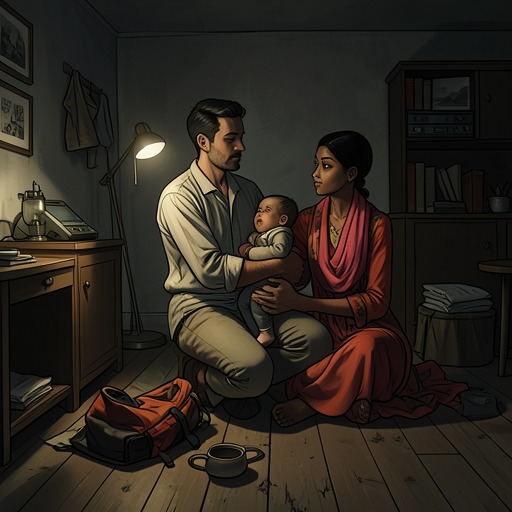
PeacemakerCajeiri and Damiri’s relationship develops within a royal household where family affection and political standing cannot be separated. At Cajeiri’s investiture, he gives his mother public recognition that the formal account of succession cannot give her; later, when she is about to give birth, he chooses to go to her rather than remain with his guests. The birth of Seimiro then turns that concern into a quiet family encounter: Cajeiri approaches his mother, meets his new sister, and introduces himself as her brother.
Family and Political Background
Damiri’s place in Cajeiri’s family carries a history of divided clan loyalties. As a young woman, disaffected from her Ajuri father, she left a family outing during the Winter Festivity in Shejidan and asked her influential Atageini uncle, Lord Tatiseigi, to take her into the Atageini clan. Tatiseigi received her while maintaining relations with Ajuri, and considered whether she might attach her man’chi to him rather than to her father, Lord Komaji. Her later role as Cajeiri’s mother thus connects two powerful clan affiliations, rather than making her position within the household a matter of kinship alone.
That political dimension remains visible after Komaji’s death, when Damiri regards Ajuri as a clan left without a lord and anticipates further trouble in the north. She is herself a possible candidate for its lordship, but Tabini does not want her to take the frequently vacated office. The restriction is linked to a larger danger: Damiri’s great-uncle had supported a Kadagidi claimant and participated in a conspiracy that subverted the Guild, endangered Tabini’s household, and sought to seize Cajeiri. Tabini has rejected proposals to dissolve his marriage, maintaining that Damiri was not complicit in her great-uncle’s actions. For Cajeiri, therefore, his mother’s safety and place in the family exist amid real political suspicions, but not as proof of her involvement in them.
Recognition at the Investiture
During Cajeiri’s investiture, his acknowledgment of Damiri becomes significant precisely because of what the public naming of succession leaves unsaid. Tabini mentions his own Taibeni kinship in his address, but does not name Damiri. The lines of inheritance being recited do not provide a place for the aiji-consort to be named in that way; her son, rather than her husband, is the one who can acknowledge her. Cajeiri does so, and the observer reflecting on the moment is grateful that he has.
The occasion joins a personal act to a wider display of political belonging. The Ajuri banner is present beside the hall despite Komaji’s banishment, while the Kadagidi banner is absent. Lord Keimi of Taiben is also in attendance after signing a peace with Lord Tatiseigi, ending two centuries of war. In this setting, Cajeiri’s acknowledgment does not alter the formal rules of inheritance, but it makes Damiri visible within a ceremony organized around succession and clan ties. The observer considers it likely that Tabini urged the gesture, and understands it alongside Tabini’s continuing effort to keep Damiri beside him despite difficulties in their relationship; the text presents the prompting as a supposition, not a confirmed instruction.
Choosing to Go to His Mother
At the celebration, Cajeiri notices that Damiri’s guards are upset. He follows Antaro toward his father and is reminded that he and the others are not receiving communications. Tabini tells him that Damiri has gone upstairs, that the baby may be coming, and that she has called for her physician. She has chosen not to go to the Bujavid clinic and is giving directions; Bren is with her, and Ilisidi will make the announcement in the hall. Tabini says that she is most probably all right, but the news leaves Cajeiri with an immediate choice about where to go.
Tabini asks whether he wants to go with Jase or with his parents. Cajeiri has never been given that choice before and initially does not know which answer is right. He decides that he should go where his mother is, trusting Jase to look after his guests. Tabini accepts the decision and tells him to come quickly. Cajeiri also takes responsibility for the gathering he is leaving: he asks Jegari to apologize to the guests and explain what has happened. His response is both direct attachment and practical consideration, not a withdrawal from the responsibilities of the occasion.
Meeting Seimiro
By the time Cajeiri reaches Damiri, she is propped with pillows, her hair arranged with a ribbon, and holding a white blanket. Tabini is seated at her bedside. The scene initially seems to Cajeiri like a performance, as though he were looking at another family on a stage; as he comes closer, Damiri smiles and moves the blanket to show him the newborn. She introduces the baby as Seimiro, his sister.
Cajeiri asks permission to touch her. With Damiri’s agreement, he touches Seimiro’s tiny fist with one finger and greets her, identifying himself as her brother. When Tabini asks whether he wants to hold her, Cajeiri declines. He believes he could do it, but fears making a mistake with so delicate a baby and upsetting his mother. The restraint is not distance: he has chosen to leave the hall to reach Damiri, and now approaches the new child carefully, with her comfort in mind.
The Relationship’s Significance
Across these scenes, Cajeiri’s bond with Damiri is expressed through recognition, choice, and care. At the investiture he acknowledges her where the succession formula cannot; at the birth he makes his own decision to be with her; beside Seimiro he is attentive to his mother’s feelings as well as to his sister’s vulnerability. The family relationship remains framed by questions of clans, inheritance, and political danger, but the scenes give Cajeiri a personal role within that structure: he is not only the heir being publicly invested, but also Damiri’s son and Seimiro’s newly introduced brother.