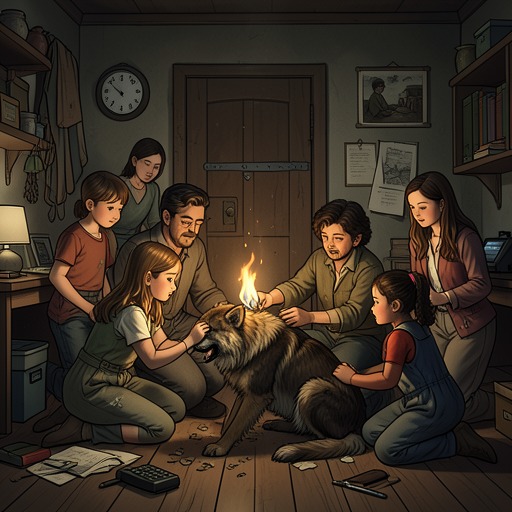
Cajeiri’s care for and devotion to Boji
PeacemakerCajeiri’s care for and devotion to Boji turns an unruly pet into a continuing responsibility: after Boji’s escape at Tirnamardi, Cajeiri understands that protecting him means anticipating what he might do, not merely wanting him close. The relationship is marked by both attachment and hard-earned caution. Cajeiri takes Boji with him through a hurried journey and into the crowded guest quarters of Lord Tatiseigi’s apartment, where feeding, housing, and keeping the parid’ja secure become part of his attention to the people around him as well as to the animal himself.
A Pet Worth the Trouble
Boji is a black-furred Parid’ja, a species described as fairly rare on the continent outside Taiben and the foothills of the continental divide. He is noisy, prone to escape, and difficult to catch. His care therefore brings practical complications from the outset; he is not an easy companion to transport or keep in unfamiliar rooms. Yet after the previous evening’s troubles, the party makes a special effort to bring him along. Boji had been of service, and they are resolved not to leave him behind if they can avoid it.
That decision gives Cajeiri’s attachment a concrete form. Boji travels in an ornate antique cage about the size of a small dining set, with staff baggage in the rail car ahead of Cajeiri’s party. The arrangement takes space and coordination during a journey when the group is trying not to delay its departure. The cage makes visible what caring for Boji requires: he is included in the party, but his inclusion depends on planning around his particular needs and habits.
The Lesson of Tirnamardi
At Tirnamardi, Boji escaped after chewing through his thin leather leash while a window was open. Cajeiri identifies the escape as their mistake, rather than treating it simply as Boji’s disobedience. He recognizes that a light chain would have been a better safeguard and that Madam Saidin’s practical suggestion could prevent a recurrence. His response joins affection to responsibility: wanting Boji with him does not mean assuming that affection alone will keep him safe.
The escape also carries a troubling consequence in retrospect. Cajeiri realizes that, had Boji not gotten away, people might have been killed. He calls the way events turned out fortunate, but remembers the warning that good fortune cannot be expected twice. The moment changes the meaning of Boji’s escape. It was frightening and inconvenient, yet its outcome may have prevented worse harm; Cajeiri’s care must now account for both the danger Boji can create by getting loose and the unexpected consequences that followed when he did.
Making Room in the Apartment
On arriving at Lord Tatiseigi’s Bujavid apartment, Cajeiri worries that Boji may not be welcome among the fine antiques. He is also concerned that his mother is already unhappy about his having the pet and might refuse to let him keep Boji. When the group reaches the lift, it briefly appears that Boji may be sent back to his parents’ apartment. Instead, Lord Tatiseigi orders that the cage be taken to the guest quarters. Cajeiri promises to be especially careful so that Boji will cause no problem.
The accommodation reflects the fact that Boji’s presence has to fit within a larger household under high security. Madam Saidin, responsible for the apartment staff, quickly asks how the human guests should be housed and gives discreet orders after Cajeiri explains the arrangements used at Tirnamardi. Boji’s cage is placed in the guest suite, near the bedroom where Cajeiri and his guests are staying together. Cajeiri wakes to find Boji upset beside the curtained bed and remembers that he must see to the pet’s food and clean accommodation before restlessness becomes another difficulty.
The apartment’s arrangement also keeps Cajeiri’s companions together: the guests use the small bedrooms intended for a visitor’s attendants, while Cajeiri’s attendants volunteer to sleep in the sitting room. Boji is part of this shared domestic space, not an animal set apart in a distant room. That closeness carries responsibility with it. Cajeiri has to consider the staff’s schedule, the guests’ comfort, and the risk of Boji becoming hungry, bored, or unsettled, while making sure that his care does not create an avoidable burden for the household.
Reassurance and Vigilance
Cajeiri speaks to Boji gently, asking him to wait, be quiet, and behave for a little while; he imitates the clicking sound Boji makes. The exchange is brief, but it shows Cajeiri trying to calm him through familiar attention rather than relying only on the cage. His tenderness does not erase the practical demands of care: Boji still needs food, a clean enclosure, and protection from another escape.
Across the journey and the first morning in the apartment, Cajeiri’s conduct develops from insistence on bringing Boji along into watchfulness shaped by experience. He wants the pet near him, recognizes Boji’s particular habits, and accepts that keeping him safe requires help and better precautions. The relationship’s warmth is therefore inseparable from its ordinary work. Boji’s noisy, escape-prone nature makes affection inconvenient, but it also gives Cajeiri repeated reasons to demonstrate what that affection entails.