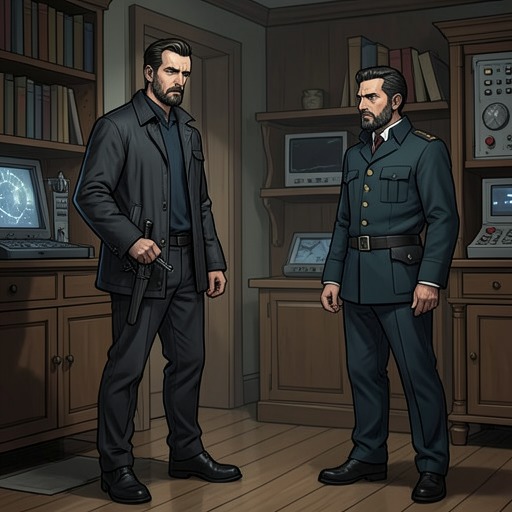
Bren and Banichi: tending to the wounded guard at Guild headquarters
PeacemakerBren and Banichi: tending to the wounded guard at Guild Headquarters centers on a partnership that holds under pressure. Banichi carries the authority and experience needed to lead an operation inside the Assassins’ Guild, while Bren accepts his judgment and stays beside him. When Banichi is injured, that practical reliance becomes care: Bren helps him during the fighting, supports him after the Guild Council recesses, and later uses Tabini’s ring to make him stop working and rest.
Operational Trust
Before the team sets out, Bren asks whether Banichi is going. Jago explains that Banichi has medication for infection and pain, as well as a stimulant he may be taking too much of, but must attend because he promised the Guild in exile that he would. His presence also adds firepower. The plan assigns Algini as his backup; Banichi and Algini can recognize the senior units, an important advantage that Jago and Tano do not share. Jago also identifies a part for Bren: obtaining a document from Tabini, marked with conspicuous seals and ribbons, that could reasonably be brought before the Guild.
Bren understands the reasons for sending Banichi, although he dislikes the risk. His own comparison makes the stakes relational as well as tactical: a team member taken out of action is like an arch missing its keystone. Banichi is not simply additional force; he is a central support whose experience and standing give the plan coherence. Bren’s concern does not become an attempt to overrule the decision. He accepts the necessity while registering what Banichi’s participation could cost.
Following Banichi into the Guild
As the group travels toward the train station, its systems are already programmed and linked, but the wrist locators and voice communications go dead. The team is running dark. At this stage Bren recognizes that he is no longer directing events: Banichi is in charge, and Bren trusts that Banichi understands his own limits, the demands ahead, and the reason for pressing on. Tabini has established that only two surviving units have the rank to lead and do what is required. Banichi’s authority is therefore not an informal preference but part of the mission’s structure.
Bren’s role becomes to keep pace with his bodyguard, follow his cues, and accompany him into the heart of an organization whose purpose is to eliminate threats. He judges the plan both nearly impossible and necessary. He has also arranged for other mechanisms to take effect if he and his team do not survive. That contingency gives the sequence an important balance: Bren trusts Banichi’s leadership without assuming that trust can guarantee safety. Their cooperation is deliberate, but the danger remains real.
Care During the Operation
When Bren sees Banichi after a burst of fire and a return volley, Banichi is sitting upright but is badly affected by blood loss. Bren moves to him despite the movement of people through the hall and calls for Tano. Banichi gives instructions of his own: Bren is to stay down, and Tano is to activate the locator bracelet. The bracelet begins identifying the team and its location, restoring a signal of who they are amid the confusion.
Bren then uses the handkerchief he carries to apply pressure beneath Banichi’s arm and tells him not to move it. The action is simple and immediate, a practical response rather than a speech about loyalty. Banichi, even while weakened, notices that Bren is also contributing blood to the operation. Their exchange preserves the familiarity between them without obscuring the seriousness of the moment: Banichi continues to direct and assess, while Bren attends to the injuries and follows the instructions that can still be followed.
After the Guildmaster ends the Council session, Bren wants to get himself and his aishid to safety. Instead, Tano is supporting Banichi’s full weight. Bren adds his help, as does Algini, but the two guards are needed to hold Banichi upright. Bren turns to the Guildmaster and the people in the chamber and demands assistance. The shift from following Banichi’s lead to openly seeking help for him is not a rejection of their operational roles; it is the consequence of Banichi’s condition and Bren’s refusal to treat him as expendable once the immediate task is complete.
Recovery and Authority
Later, Bren checks with Tano to learn whether Banichi has awakened. Banichi opens his eyes and answers for himself. Bren sits nearby and asks how he is doing. Banichi’s first concern is the distraction and inconvenience he caused in the Council chamber and to the operation. Bren counters with the result: they took down the target. The exchange places the injury within a successful mission, but it does not allow success to become a reason to ignore recovery.
When Banichi begins to move, Bren orders him not to lift his head, sit up, shift his arm, or take more of the pills he has been using. Banichi replies that his arm is taped and that he is well enough. Bren raises Tabini’s gold ring and makes clear that it gives force to the instruction that Banichi obey his caregiver’s orders. The ring transforms Bren’s concern into an enforceable command, while the limits he specifies—no movement and no more pills—answer the particular risks already established before the mission.
Bren also refuses to let Banichi reclaim responsibility for the Guild’s next steps from his bed. The senior leadership left behind must now lead, he reasons, and he believes they can do so. His instruction to rest is thus both personal and political: Banichi’s work matters, but the institution cannot depend on a wounded man continuing to direct it. Jago reinforces the order and offers him water. Bren’s praise for Banichi’s work sits beside, rather than in place of, the insistence that he remain in bed.
Significance of the Partnership
Across the operation, the relationship moves through distinct forms of dependence. Bren first accepts Banichi’s authority because Banichi knows the Guild’s people and can lead the mission. In the dangerous interior of the headquarters, he follows Banichi’s cues while remaining ready to act when Banichi is hurt. Afterwards, he takes responsibility for protecting Banichi from his own determination to resume work. Trust here is not passive obedience: it includes knowing when to follow, when to provide immediate care, and when to use legitimate authority to stop a partner from taking further risks.
The repeated movement between command and care gives their partnership its particular shape. Banichi leads the team into danger and continues directing others while wounded; Bren supports that mission, then insists that its leader recover. The Guild operation succeeds, but its completion does not erase the human cost or release Banichi from the need for care. Their bond is shown through those concrete duties—keeping pace, responding to instructions, applying pressure, asking after an awakening, and enforcing rest—rather than through an abstract declaration of loyalty.