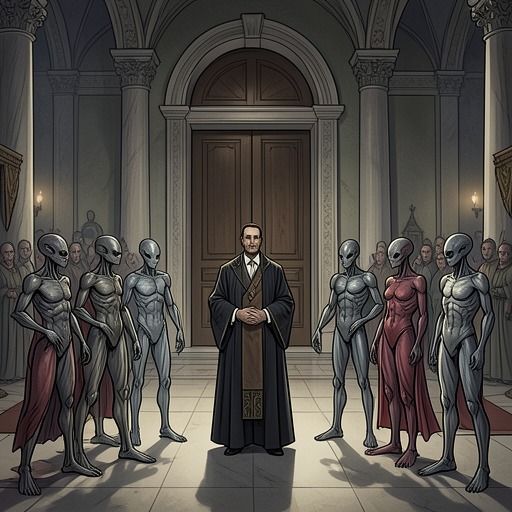
Cajeiri’s Ninth-Birthday Investiture
PeacemakerCajeiri’s Ninth-Birthday Investiture transforms a birthday celebration into a public succession ceremony. At the Festivity, Tabini presents his nine-year-old son as heir to the aijinate, making Cajeiri’s place in the ruling family visible before an audience whose support he explicitly seeks. The occasion joins numerical auspiciousness to political performance, while a private conversation during the celebrations exposes the danger and family tensions surrounding Damiri.
From birthday to national Festivity
The event’s enlarged scope becomes clear after a period of running dark, when Bren receives a notice from the Bujavid Events Office. The planned reception has been moved from the Green Hall to the larger Audience Hall, and the program now includes a private dinner in Tabini’s apartment followed by an invitation-only tour of Lord Tatiseigi’s porcelain display in the Bujavid Museum. The museum is to close for the day; souvenir cards will be distributed on the third landing rather than inside the Bujavid hall because of the expected crowds.
The change is more than a question of managing visitors. What had been treated as Cajeiri’s birthday has become a Festivity expected to close the city and produce a business holiday across the continent. The legislature’s suspension of a vote until after the celebration, which had seemed disproportionate, now has a political explanation: the event’s scale makes it a public occasion in its own right. Recent events deepen its significance. The news available before the communications blackout had included Lord Ajuri’s assassination, and the omen was serious enough to contribute to the legislature’s recess amid pressure to advance the tribal bill.
The museum opening gives the public celebration a second focus. Lord Tatiseigi has lent part of his prized porcelain collection, including small tea services, vases, and ancient cloisonné armor. Tabini and Damiri enter through the museum’s open central doors with Ilisidi, Cajeiri, and Lord Tatiseigi, while other lords seek their assigned places in the order of entry. The exhibit’s opening will consequently be remembered alongside Cajeiri’s investiture. Lord Tatiseigi, usually unaccustomed to smiling, is visibly pleased: his collection and his nephew’s future are brought together in one national occasion.
The announcement and its political meaning
The investiture is kept secret until the event. Bren learns in advance that Tabini intends to make Cajeiri his heir and asks Narani to preserve the confidence. The timing is striking: nine is described as an exceptionally fortunate year, but the customary age for investing a child as heir is fifteen, which is both another auspicious number and an age associated with greater maturity. Tabini’s choice therefore carries the force of a deliberate surprise rather than an ordinary family announcement.
The ceremony also answers a difficulty in Tabini’s own political history. Algini explains that investiture applies to the aijinate and to the highest office in the College of Numerology. Tabini himself was never invested, a deficiency that could have been raised as a legal issue had Ilisidi strongly opposed his accession and that his detractors have continued to cite. Murini, by contrast, also lacked investiture, and his seizure of power is associated with political upheaval. Restoring the ceremony gives Tabini a way to distinguish Cajeiri’s claim from those contested precedents and to make the choice publicly legible.
The rite does not bind the legislature or make the aijinate a technically inherited office. Its force is instead political and, in ordinary inheritance, relational: investiture makes future business relationships public and clarifies the position of an heir among competing claims. Once invested, an heir can ordinarily be passed over only for disgrace or crime. For an heir of the aishidi’tat, the College of Numerology’s sanction also associates the choice, on that particular date, with favorable numbers. A later challenge to those numbers must account for when and how the supposed change arose. In this way, the ceremony makes it harder to argue that Cajeiri’s claim is inauspicious in origin without pretending to remove the legislature’s authority.
The public declaration
In the Audience Hall, the oldest numerologist announces that the numbers have been counted and that the gathering and its time are felicitous. Tabini then identifies Cajeiri as his son before the assembled witnesses and declares him his heir. He names Cajeiri as grandson and great-grandson of his forebears, and calls on the tashrid and the hasdrawad to proclaim him, at the appropriate time, aiji of the aishidi’tat and heir to Tabini’s titles and rights. He also calls on his kin and associates to support the claim and give Cajeiri their man’chi.
The announcement makes succession a collective matter without presenting the future proclamation as already accomplished. The hall responds with a murmur and then a shout. Cajeiri does not flinch; Tabini’s hand remains on him as the response rises. The repeated strikes of the staff restore silence, placing the spoken declaration within an ordered ritual rather than leaving it as a private paternal promise.
Afterward, secretaries and officials bow to father and son, and their bodyguards take their positions. An older secretary lays out cards for Cajeiri to sign; the cards are then to pass to Tabini for his signature before the seal and ribbons are applied. Tabini tells his son to take his time and speak to the people. Cajeiri tests the pen and ink on blotting paper before beginning. These practical steps give the heir an active place in the public procedure: the claim is declared by his father, but Cajeiri is also required to sign and address those gathered.
Family danger beneath the celebration
The Festivity’s public welcome coexists with a more private account of the political crisis that has touched Damiri’s family. At her son’s investiture, Bren speaks with her in a quiet nook and explains why Tabini has forbidden her to take the Ajuri lordship, despite her being a possible candidate after her father’s death. Bren says that Damiri’s great-uncle supported a Kadagidi claimant with southern ties and was involved in the subversion of the Guild. That subversion, he explains, helped set regions against one another, endangered Tabini and Ilisidi, and included an effort to seize Cajeiri. He connects the danger on the west coast to information withheld from both Tabini’s bodyguard and Bren’s own protective staff, and says that investigations have traced the threads back to the Guild in Shejidan.
Bren stresses that the great-uncle is dead but that not all his agents are believed to be. The explanation reframes Tabini’s earlier distrust of Damiri’s clan and his effort to keep her father and bodyguard away from the Bujavid: Bren presents these as security measures, not proof that Damiri herself participated in the conspiracy. He also tells her that Tabini has rejected suggestions that their marriage be dissolved for political convenience, insisting that she was not complicit in her great-uncle’s actions.
The conversation places Damiri’s position as wife and mother alongside the political future being announced in the hall. Bren warns that ambitious clans may one day press upon both Cajeiri and his sister, and advises Damiri not to reject Ilisidi or her allies but to learn from them. Damiri receives the disclosures in shock and says nothing. Thus the investiture does not settle every question surrounding succession: while it publicly strengthens Cajeiri’s claim, it also reveals the concealed threats and family choices that have shaped the security of that claim.