Treaty of the Landing
PeacemakerThe Treaty of the Landing ended the War of the Landing and established the uneasy settlement governing relations between humans and the Aishidi’tat. It offered the defeated humans sanctuary on Mospheira, but required total disarmament and the surrender of their technology; in return, a Paidhi would live in Shejidan to translate and supervise its gradual transfer. The agreement secured peace without erasing mistrust, and the empty Foreign Star remained overhead as a reminder that the human presence had not necessarily reached its end.
Defeat and the Offer of Sanctuary
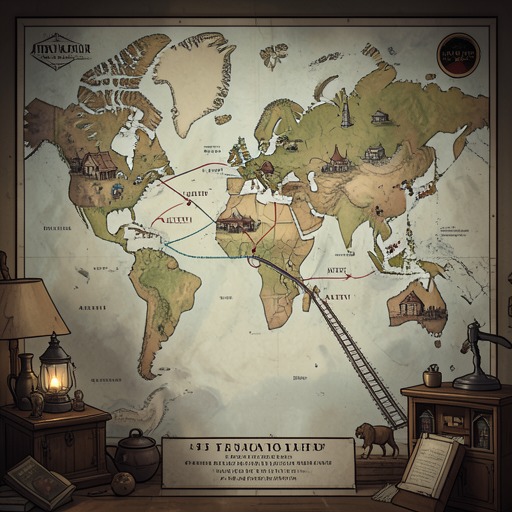
The treaty followed a military strategy that first narrowed the humans’ choices. The Aiji directed that they be pushed off the continent and onto Mospheira, where most humans already lived. The Edi and Gan peoples, who had first encountered the humans and taken part in the bloodiest fighting, lived there too, but were outside the Aishidi’tat and followed different customs. Their continued attacks on humans, undertaken independently, ended disastrously.
The Aiji also offered the tribal peoples refuge in two small areas on the west coast, where they could continue their traditional ways and fishing livelihoods. With attacks no longer reaching them on Mospheira, human non-combatants gathered there as well. That separation left the most aggressive humans on the mainland, where they could be driven into isolated pockets and cut off. Forces from the Marid held the strait, closing the route between the continent and the island.
By the time the Aiji in Shejidan made the offer, the mainland groups had no supplies, no way back to the space station, and no prospect of rescue from Mospheira or retreat to it. Their choice was extermination or a way out. The treaty’s offer of sanctuary therefore came from a position of overwhelming leverage: the humans could have the large, rich island, but only on terms that dismantled their capacity to wage war and limited their technological independence.
Terms and Unequal Understanding
The first condition was total disarmament. The humans had to take their weapons out to sea and sink them. The second was surrender of their technology. In exchange for an untroubled sanctuary, they were to send a Paidhi to Shejidan to live, translate, and oversee the gradual turnover of all their technology to the Aishidi’tat, specifically to the Aiji. They were also forbidden to build or use technology that the Paidhi had not approved.
The two sides did not enter the arrangement with the same understanding of its implications. The desperate humans knew little about what a Paidhi was beyond the roles of mediator and translator and an official at the Aiji’s court. They chose their most fluent Ragi speaker, hoping that his appointment might delay demands for their weapons technology. The Aiji accepted the arrangement and indicated that areas of agreement and useful exchange would surely emerge.
That diplomatic assurance did not mean the Aiji disclosed everything. Atevi scientists were already learning the secrets of captured foreign machines and could put such knowledge to other uses, a fact left unmentioned to the humans. The humans, for their part, failed to disclose that they still hoped the starship would someday return. The settlement thus rested not on shared knowledge but on managed disclosure: each side entered peace while withholding a consequential part of its understanding.
Peace, Limits, and the Unresolved Future
The Treaty of the Landing brought sufficient peace to become the basis of all subsequent dealings between humans and the Aishidi’tat. Its bargain was both a refuge and a restraint: humans could make Mospheira their home, while disarmament, technological oversight, and the Paidhi’s presence tied their security to continuing supervision by the Aiji’s government. The agreement ended the immediate war without making the two populations politically or culturally interchangeable.
The Foreign Star continued to orbit the world, empty. Humans set about transforming Mospheira to suit themselves, while the Aiji argued that the association the Atevi had formed for their own defense should remain intact in case more humans arrived from the heavens. The treaty therefore settled the immediate conflict but preserved its central uncertainty: whether the human presence was limited to those who had survived the war, or whether the sky might bring others.