Murini Coup
PeacemakerThe Murini Coup was an overthrow of the government engineered from within the Assassins’ Guild, the institution meant to enforce the law. It put Murini in Tabini’s place through a combination of violence, forged or unreliable orders, and manufactured urgency. The coup’s consequences extended beyond the change of ruler: it revealed that the Guild itself had divided, threatening the legal procedures and public trust on which the political order depended.
Seizure of power
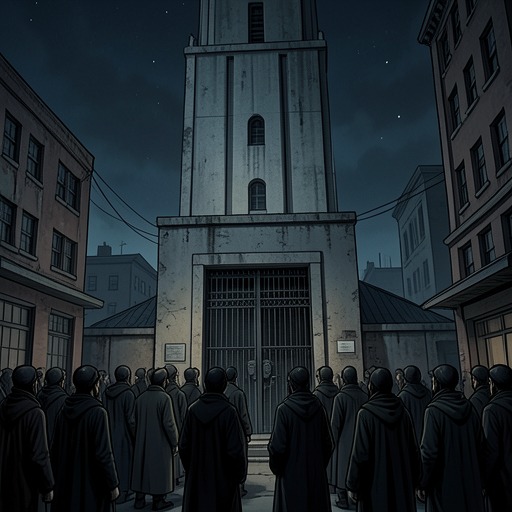
The coup’s decisive opening was an attack on Tabini’s residence at Bujavid. A quarter of an hour later, a gathering brought together the lord of Senjin Marid, the lord of the small Bura clan on the west coast, the head of the southern Tosuri clan, and four elderly Conservatives. They publicly declared man’chi to Murini and placed him in Tabini’s position. The speed of the gathering and the sequence of reports around it became the first clues in a later effort to reconstruct how the government had fallen.
The assembled lords had been told that Tabini was dead and that a conspiracy of Liberal lords threatened to plunge the continent into chaos. They were also warned that human activity in space could bring further danger. The Conservative lords maintained that they had been urged to endorse Murini quickly and publicly to prevent the government from collapsing. Their support therefore rested on a false report of Tabini’s death and a claimed emergency, not on a demonstrated transfer of power.
The report proved premature. Tabini was alive, and another attack followed in the forests of Taiben. That attempt also failed to kill him, though it cost him his original bodyguard. The elderly lords who had backed Murini were not told that Tabini had survived. The coup thus relied not only on force but on controlling what different participants knew: its supporters could be rushed into declaring allegiance while the truth remained concealed from them.
The Guild inside the coup
The coup did not originate as a broad revolt among the lords or the populace. Its source was within the Assassins’ Guild, where a faction seized the government and installed a ruler who, in the later assessment, should never have held office. At the critical beginning, the legitimate Guild itself mistakenly followed orders from the conspirators. When reports changed—first that Tabini was alive, then that he had been killed at Taiben—Guild members again obeyed superiors and Murini, without yet understanding that some of the people issuing trusted orders were hunting Tabini and Damiri.
The distortion had a specific institutional advantage. When anyone later sought to establish who had ordered an assassination, the natural recourse was the Guild. A faction within that same organization could exploit the public expectation that its records and decisions were reliable. The Shadow Guild, as the splinter faction came to be called, violated the Guild’s longstanding rules of procedure and law, while the legitimate Guild continued to follow its rulebook in an effort to protect the lords who formed the structure of the Aishidi’tat.
The contrast was not abstract. A legal assassination required a Filing of Intent: a Document of Intent entered in the official state registry and preserved in the archive, with any answer likewise filed. The process required public notice, depositions from both sides, Guild Council consideration of whether adequate cause existed, and deliberation over settlement or another remedy before a vote could approve action and set a date. A Filing was required before action against a person or institution, except in defense against an illicit attack. The coup’s unlawful orders and its resort to assassination without due process stood against this framework. Senior Guild objections were dismissed as out of order, and several objecting members were arrested and marked in the records.
A ruler imposed without a clear program
The coup’s leadership did not appear to have a coherent plan for governing. Its motive was described as a diffuse discontent with the world as it had become, joined to the wish that humans had never existed. The elders and political operators who endorsed Murini said that his appointment would secure the consent of the influential, ancient Kadagidi clan and lend legitimacy to the new government. Yet they had not actually selected him. A message from somewhere inside the Guild presented Murini as the choice, and its origin could no longer be traced.
Murini proved a poor instrument for those who had put him forward. Ambition, animosity, jealousy, and suspicion shaped his conduct; once in office, he treated power as personal entitlement and set about pursuing private feuds. The Shadow Guild under his authority did not challenge his orders. A higher layer of the faction restrained him from attacking the Taibeni and Lord Tatiseigi, not because such attacks were unlawful, but because they would have raised doubts about his claim to be defending order and the Conservatives. The limits imposed on Murini were therefore tactical, not a restoration of lawful government.
Fracture, evidence, and restoration
Within hours of the coup, senior Guild members had begun gathering in the shadows. They distrusted the new Aiji’s first orders and the way the Guild was being run. The units sent to search the Taibeni woods, the withdrawal of experienced units from the spaceport in favor of junior personnel unfamiliar with its technology, and the orders for assassinations without proof all deepened their alarm. The crisis widened from an attack on the government into a struggle over who could legitimately command the institution that enforced the law.
Some senior members went underground when Murini took power. Certain Guild members listed as dead were alive; some of them had helped build the network that restored Tabini. The most senior members claimed retirement, while others remained dead on the official record. After the coup ended, they refused repeated calls from the current Guild leadership to return, and the conflict between the exiled members and the Council continued. They had watched the Guild purge itself twice and did not trust its current leaders.
Their eventual return was presented as an effort to restore the law, not as uncomplicated political allegiance. These exiled members did not favor humans, and had not favored Tabini because of his association with them. Nevertheless, they had worked with humans on Mospheira during Murini’s rule and gave their word to return, take back the Guild, examine its records, and restore lawful practice. They accepted the cost of leaving their assumed identities, families, and marriages behind. The proposed course carried a serious risk: a direct assault on Guild Headquarters could kill uninvolved members, destroy essential records, and leave the wrong faction in control. Without evidence, the case against the Council could not be proved to the membership, and Tabini would be left to act by decree—an outcome that would further damage the Guild’s legitimacy.
The records became a literal measure of whether lawful restoration was possible. Shishogi died in a fire at the Office of Assignments; the office’s records were damaged but not destroyed, and a man was intercepted carrying several notebooks from it. Because the Guild’s authority depended on evidence, preserving those records mattered as much as defeating its disloyal faction. Later, confidence in the Guild’s sealed information and review procedures was described as badly shaken by the discovery that the problem reached the organization’s integrity, not merely a few leaks. That confidence, the narrative suggests, had to be repaired if the Guild was again to function as a trusted institution.
The coup’s institutional stakes
The Guild’s importance had been built into the political order over generations. As eleven regional associations agreed to construct a railroad from Shejidan westward, elected leaders coordinated the project and the Guild began as a body protecting those leaders from assassins employed by individual lords. It later backed the Aiji against three powerful clan lords who sought to break the railroad agreement into separate administrative districts. Its authority had helped hold together cooperation that crossed clan and regional boundaries.
After the War, the Aiji proposed that the Guilds—including the Assassins’ Guild and Transport—recruit and assign members according to qualification rather than clan origin, kinship, or regional association. In return for the Assassins’ Guild’s prohibition on holding political office or lordship, it received statutory protections against political pressure: its records could not be summoned by a lord, its members testified before its own Council, and investigations into a member’s disappearance or death belonged to the Guild itself. Those arrangements made the Guild both independent and powerful. The coup exposed the danger in that design when a faction inside an autonomous law-enforcement body could seize political authority and compromise the procedures intended to restrain violence.
The response to the coup consequently had to preserve more than Tabini’s rule. It had to establish who had issued the orders, retain proof, and return authority to a Guild leadership capable of demonstrating that it followed its own law. The event is remembered as a crisis of government, but its sharper institutional warning is that legality depends on trustworthy procedures and records—and that using political power alone to overcome their failure would not restore the confidence those procedures were meant to secure.