Construction of the First Railroad and Formation of the Aishidi’tat
PeacemakerThe Construction of the First Railroad and Formation of the Aishidi’tat was a political transformation carried by infrastructure: a railway built through cooperation among regional associations helped create institutions able to bind those associations into a larger order. The project did not erase clan or regional interests, but it made their coordination consequential, and its success established a model in which shared purpose, guild authority, and the Aiji’s power could hold agreements together without recurring to war.
Background and the Railroad Project
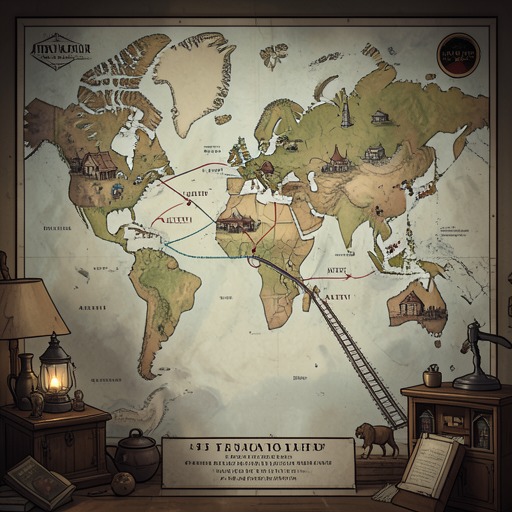
Before the Foreign Star appeared, Atevi society had already begun moving beyond the clan structure associated with ruinous wars. Eleven regional associations agreed to build a railroad from Shejidan westward without fighting over the project. These associations had grown out of temporary alliances formed for trade and regional interests; such arrangements could fracture bitterly. The railroad therefore tested whether cooperation could be made durable rather than remaining a convenience that dissolved when interests diverged.
The project also changed the political work assigned to the Aiji. Aijiin had previously been elected as war leaders for a particular purpose. For the railroad, they were elected to manage the undertaking: coordinating guilds, clans, and sub-clans, getting the line through particular districts, and upholding commitments sealed by individual clan lords. Their authority now served a shared construction project, not command over armies.
The arrival of the Foreign Star, about three hundred years earlier, coincided with the railroad’s construction and intensified concern about change. It appeared in the heavens and was interpreted variously, including as an omen; some attached its meaning to the railway. The Star occupied the attention of lords and clans for a year, but the railroad continued beneath that speculation. The project succeeded, and the Star itself harmed nothing. In retrospect, the portent could be understood as good fortune, but the political change came through the work of building and maintaining agreement.
Guilds, Enforcement, and Political Formation
A new institution emerged alongside the Aiji’s project authority. A small group that was itself beginning to transcend clan and regional divisions became the Assassins’ Guild. Its initial task was to protect the Aijiin from attacks by other assassins serving individual lords. The Guild thus helped secure the people responsible for carrying out a project that depended on promises being honored across competing interests.
The first railway’s success led to further projects. Associations grew larger and overlapped, as clans and kinships did. When a dispute threatened to dissolve the new associations, three powerful clan lords wanted to alter the agreement and divide the railroad into administrative districts. The Assassins’ Guild backed the Aiji against them, enforcing the existing agreement. The three clans collected no tolls, but their people benefited from the trade the railway enabled. The episode showed how a common undertaking could produce benefits beyond the parties with the most direct control over it—and how an institution could uphold a settlement against powerful signatories who wished to change it.
The resulting political structure was more than a network of convenient trade arrangements. Lords, trades, and guilds had to meet in Shejidan and reach agreement with the Aiji who served and ruled them. This was the true beginning of the legislature and the Aishidi’tat, although neither yet bore that name. Shejidan grew as a town with no lord but the Aiji; smaller clans, especially those engaged in crafts and trade, settled there and prospered through railway commerce. They supported the Aiji’s authority when it was threatened, while guilds also established themselves in the city. Lords seeking the services of the Scholars, Merchants, Treasurers, Physicians, or Assassins had to accept members whose primary man’chi was to their guilds and the Aiji in Shejidan.
From Shared Work to Guild Authority
The railroad’s political legacy developed into formal principles governing guild membership and assignments. After the War, the Aiji proposed that guilds working across regional lines should continue to do so, with candidacy and assignment determined without regard to clan origin. Guild members would be appointed according to qualification, not kinship, regional association, or clan. The proposal placed authority over membership in the hands of guild masters. Guild leaders favored it, while some regional associations remained apart from the guild system; in practice, the principle became an internal guild rule rather than a statute.
The Assassins’ Guild accepted an additional restriction: its members could neither seek nor hold political office or a lordship. In exchange, it received statutory immunities from political pressure. Lords could not summon its records, Guild members testified only before their own council, and investigations into a member’s disappearance or death belonged to the Guild under its own rules. These arrangements extended the early pattern of the railroad era: institutions that served the shared order acquired authority and protections beyond the control of individual clan lords. They also made the Guild’s independence a lasting feature of the political system.
The Railway in Later Political Life
The railroad remained a working system rather than a monument to an earlier settlement. In a later crisis, Tano used the train’s internal communication to contact the engineer while Jago reported the switches’ settings and timing. The Red Train could be routed from the Bujavid track to an eastern line and then onto an old line serving freight yards and the city’s historic center. Tatiseigi’s and the dowager’s men arranged a diversion to the freight yard under the plausible explanation that the train was collecting crates of artwork for an exhibit at the Bujavid Museum. The crates actually carried spare belongings from Tirnamardi, showing how the railway’s ordinary freight function could also make a covert movement possible.
The same infrastructure could be used to stop movement across the city. When the operation required it, the plan was to bring the city rail to a prolonged halt and ensure that the Transportation office did not rush crews to the train, but instead stopped traffic. The railway that had once made cooperation possible could thus become a means of coordination, concealment, or restriction, depending on who controlled its routes and communications.
Significance
The first railroad’s most durable achievement was not simply a connection between Shejidan and the west. It created pressure and opportunity for political relationships that crossed regional boundaries: associations expanded, guilds acquired a transregional role, and the Aiji became the center of a legislative order. The arrangement did not make conflict disappear. Rather, it provided institutions through which disputes could be settled and agreements enforced without breaking the railway into competing jurisdictions or returning to war.
The formation of the Aishidi’tat is therefore presented as a gradual consequence of collective work. The railroad supplied a practical reason to meet, a test of whether distant commitments could be kept, and a material benefit that reached even clans that collected no tolls. The legislature, the guilds, and Shejidan’s growing authority arose from that accumulated cooperation. In later crises, the network’s switches, freight capacity, and operating communications continued to shape what political actors could do, preserving the project’s founding connection between infrastructure and power.