War of the Landing
PeacemakerThe War of the Landing was the conflict in which Atevi organized resistance to armed humans and drove the mainland forces toward a negotiated retreat to Mospheira. Its decisive turn was not simply military: the aiji in Shejidan converted local responses into a wider campaign, used the island as a refuge and a trap, and ended the war by attaching human sanctuary to disarmament and strict technological limits. The struggle brought western clans and eventually the Marid into the Aishidi’tat, while establishing a political relationship between the two peoples structured by the Landing Treaty.
Causes and Historical Setting
The surviving account frames the war as the culmination of pressure rather than an inexplicable first strike. When Atevi attacked, humans did not understand the reason. In fact, Atevi had already been pushed beyond what they would accept; the encounter with station managers and a large supply of weapons prompted them to push back. The gap between what the humans understood and what Atevi had endured shaped the conflict from its beginning: what seemed to one side to be an unprovoked attack was, to the other, a response to accumulated provocation.
The immediate crisis followed a breakdown among the humans associated with the station. Technicians deserted, maintenance deteriorated, and the administrative and systems managers eventually joined the movement. They mothballed the station, set its systems to maintain stable orbit for as long as possible, and descended to the planet with their armed bodyguards. The last group of humans arrived unwillingly and resisted adapting to the planet. Their weapons and presence became part of the conditions under which Atevi finally struck back.
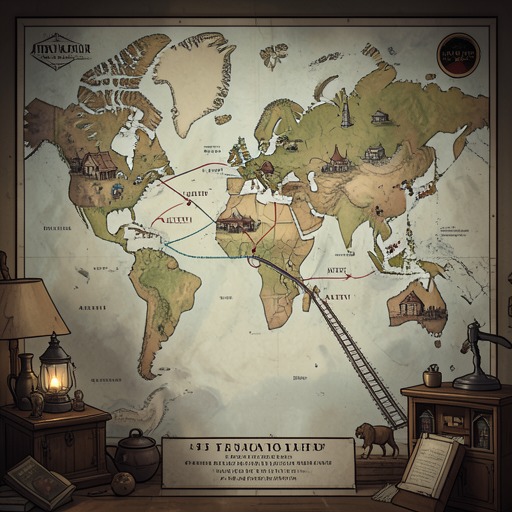
The war also belongs to a longer history of political organization. Clans had formed regional associations for alliance and trade, but these arrangements were temporary and could dissolve into bitter conflict. Before the war, eleven regional associations had agreed to build a railroad west from Shejidan without fighting over it. Guilds had already begun to cross clan boundaries; during the railway’s construction, the Transportation Guild and Builders also crossed regional boundaries, becoming the first political entities to do so. The war’s later consolidation of regional power thus followed earlier, incomplete experiments in cooperation.
From Local Response to Wider Campaign
Atevi responded through clans, guilds, and associations: an offense against one group could trigger the involvement of others. Coastal associations acted first. The aiji in Shejidan then asserted control and assumed leadership of the war. That leadership expanded the political reach of the conflict, bringing in the western clans that had remained outside the Aishidi’tat and, eventually, the Marid. The campaign therefore operated on two linked fronts: it confronted the humans and drew previously separate Atevi territories into a larger political order.
The aiji’s strategy was to contain the conflict and move the humans off the continent, onto Mospheira, where most humans were already living. The island was home to the Edi and Gan peoples, who had first encountered the humans and had taken part in some of the bloodiest fighting. They were not part of the Aishidi’tat, were not Ragi, and followed different customs. They continued to attack humans independently, with disastrous results. The aiji’s plan addressed this wider and unstable setting by separating the island from the mainland campaign rather than treating every human or every local conflict as identical.
The aiji offered tribal peoples refuge in two small areas on the west coast, where they could continue their traditional lives and fishing. With attacks no longer reaching them on the island, humans used it as a safe retreat and centered their noncombatants there. This changed the military situation on the mainland: the people left there were the most aggressive human forces, which the aiji could then maneuver into small, isolated pockets. Atevi forces from the Marid held the strait, closing off a route of retreat as well as helping contain the mainland forces.
Defeat and Terms of Settlement
By the end of the war, the humans on the mainland had been cut off from supplies. They had no route back to the space station, no prospect of rescue from the island, and no way to retreat there while Marid forces held the strait. The aiji offered them a choice between extermination and a way out. The proposed way out was ownership of Mospheira, a large and rich island, but that sanctuary came with conditions designed to prevent a return to armed conflict.
First, the humans had to disarm completely. Their weapons were to be taken out to sea and sunk. Second, they had to surrender their technology. In return for an untroubled sanctuary, they were to send a Paidhi to live in Shejidan, translate, and supervise the gradual transfer of their technology to the Aishidi’tat and its aiji. They were also forbidden to build or use technology that the Paidhi had not approved. The settlement thus made the Paidhi more than an interpreter: the office became part of the system regulating human technology and the terms of human life on the island.
The desperate humans had only a limited understanding of what the Paidhi’s role would mean. They understood that he would mediate and translate, and that he would represent them at the aiji’s court. They chose the human with the strongest command of Ragi, hoping that this choice would delay demands concerning their weapons technology. Their limited grasp of the settlement’s full implications contrasts with the precise controls it imposed: weapons removed, technological transfer supervised, and future use subject to approval.
Political and Narrative Significance
The war’s outcome joined military containment to political consolidation. Coastal associations responded, the aiji took command, western clans entered the Aishidi’tat, and the Marid eventually joined as well. The settlement also gave the humans a protected home on Mospheira while imposing disarmament and technological restrictions. Neither result erased the conflict’s unequal pressures: the humans’ sanctuary depended on surrendering weapons and technological independence, while Atevi action had first been provoked by conditions the humans had failed to recognize.
In Geigi’s historical account, the war sits within a broad narrative of changing institutions, from fragile clan alliances and the first cross-regional guilds to a political union able to coordinate resistance across regions. Its significance lies not only in the humans’ removal from the mainland, but in the arrangements that followed: a larger Aishidi’tat, an island refuge, and a continuing relationship managed through the Paidhi and the rules established by the settlement.