Paris
PerfumeParis, the largest city of eighteenth-century France, is the suffocating, stinking womb from which Jean-Baptiste Grenouille emerges and the vast olfactory prison he must learn to navigate, exploit, and finally transcend. In Süskind's novel, the city is not a neutral backdrop but an active, overwhelming presence—a realm of such profound and varied stench that it defines the very conditions of life, death, and perception for its inhabitants. It is the place of Grenouille's abominable birth, the proving ground for his genius, and the ultimate target of his ambition to rule the hearts of men through scent.
The Stench of Eighteenth-Century Paris
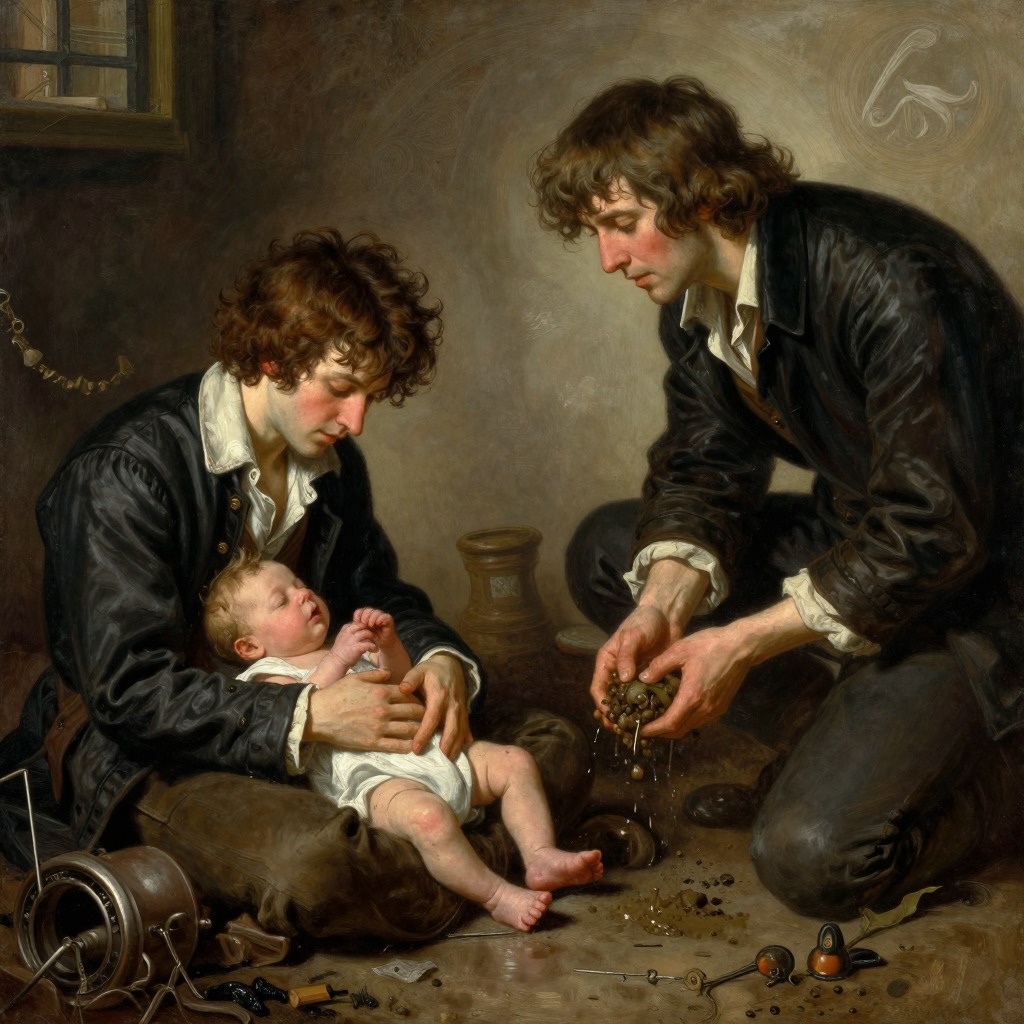
The novel opens with an exhaustive catalogue of the city's filth, establishing Paris as a place where "there reigned a stench barely conceivable to us modern men and women." The streets stank of manure, the courtyards of urine, the stairwells of mouldering wood and rat droppings, the kitchens of spoiled cabbage and mutton fat. The stench of sulphur rose from chimneys, caustic lyes from tanneries, and congealed blood from slaughterhouses. People themselves stank of sweat, unwashed clothes, rotting teeth, and from their bodies, if they were no longer very young, came the stench of rancid cheese, sour milk, and tumorous disease. The rivers stank, the marketplaces stank, the churches stank. This was a world where "there was nothing to hinder bacteria busy at decomposition," and every human activity was accompanied by stench. The foulest spot in the entire kingdom was the Cimetière des Innocents, where for eight hundred years the dead had been carted and tossed into long ditches, stacking bone upon bone, until the stench drove the neighbors to insurrection and the graveyard was finally closed and replaced by a food market. It was here, on the most putrid spot in Paris, that Jean-Baptiste Grenouille was born on 17 July 1738, one of the hottest days of the year, when the heat squeezed the graveyard's putrefying vapour—a blend of rotting melon and fetid burnt animal horn—out into the nearby alleys.
The Olfactory Hunting Ground
For the young Grenouille, Paris becomes the greatest preserve of odours in the world. After his years of hibernation-like survival under the tanner Grimal, he is seized with an urge to hunt. The adjacent neighbourhoods of Saint-Jacques-de-la-Boucherie and Saint-Eustache are a wonderland, where people lived so densely packed that the air at ground level formed damp canals where odours congealed. He would stand in dark corners, eyes closed, nostrils flaring, and dissect the mixture of human and animal smells, of water and stone and ashes and leather, of soap and fresh-baked bread and eggs boiled in vinegar, of noodles and polished brass, of sage and ale and tears, of grease and soggy straw. He hunted for new odours with the passion of an angler, storing them up inside him. He explored the market of Les Halles, where the odours of the day lived on into the evening, and the Place de Grève, where his mother had been beheaded, which stuck out to lick the river like a huge tongue. From the west, via the river, came a broad current of wind bringing the odours of the country, of the meadows around Neuilly, of the forests between Saint-Germain and Versailles, and sometimes of the sea itself—a smell so immense and unique that Grenouille hesitated to dissect it, preferring to preserve it whole in his memory. He expanded his hunting grounds to the faubourg Saint-Honoré, to the Bastille, and across the river to the Sorbonne and the faubourg Saint-Germain, where the rich people lived and where he first smelled perfume in the literal sense: lavender, rose water, and more complex scents of musk, neroli, tuberose, jonquil, jasmine, and cinnamon that floated behind carriages like rich ribbons on the evening breeze.
The City of Commerce and Craft
Paris is also the centre of the perfume trade, and its most renowned shop is that of Giuseppe Baldini on the Pont au Change. Baldini's establishment, with its green-lacquered baldachin, golden coat of arms, and Persian chimes, is a temple of scent, stocked with thousands of essences, pomades, soaps, and perfumes. Yet the city's commercial heart is also a place of fierce rivalry. Baldini, an aging master, is threatened by the upstart Pélissier from the rue Saint-André-des-Arts, whose fashionable new scents like "Amor and Psyche" capture the public's fancy and make a shambles of the market. It is in this competitive Parisian milieu that Grenouille, delivering goatskins to Baldini, demonstrates his genius by flawlessly recreating Pélissier's perfume, launching Baldini's house to European renown. The city thus becomes the stage for Grenouille's first triumph and his apprenticeship in the craft, where he learns the language of perfumery and the techniques of distillation, though he finds the city's own resources insufficient for his grander ambitions.
The Oppressive Human Effluvium
Despite his mastery of Paris's olfactory landscape, Grenouille is oppressed by its human presence. Six or seven hundred thousand people lived in Paris, packed more densely than in any other city in the world. Its streets and squares teemed with them, and the houses were crammed full from cellars to attics. There was hardly a corner that was not paralysed with people, not a stone or patch of earth that did not reek of humans. For eighteen years, their compacted human effluvium oppressed him like air heavy with an imminent thunderstorm. He had thought it was the world in general he wanted to squirm away from, but it was not the world—it was the people in it. This realization drives him to flee Paris, seeking the greatest possible solitude on the Plomb du Cantal. Yet even in his retreat, the memory of Paris's stench remains a key component of his inner theatre, a repulsive aperitif he conjures to fuel his hatred and his fantasies of revenge.
Return and Final Dissolution
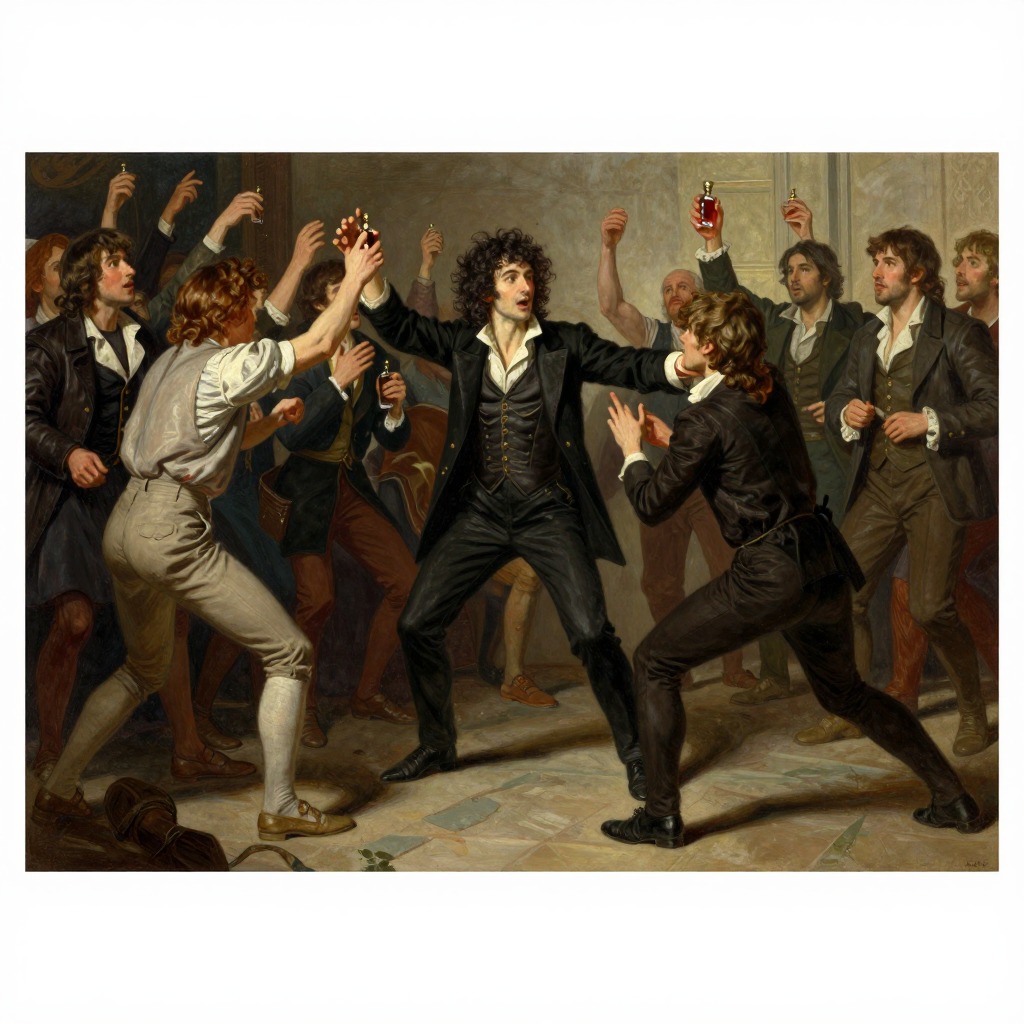
After his journey through France and his apotheosis in Grasse, Grenouille returns to Paris to die. He enters the city on 25 June 1766, the hottest day of the year, when the thousands of odours and stenches oozed out as if from thousands of festering boils. He walks across the Pont-Neuf to the right bank and down to Les Halles and the Cimetière des Innocents, the very spot of his birth. He sits down in the arcades of the charnel house bordering the rue aux Fers, before him the cemetery grounds like a cratered battlefield, a garbage dump of death. There, among the thieves, murderers, and whores, he unstoppers his ultimate perfume and sprinkles himself. The crowd, overcome with frenzied desire, falls upon him, tearing him apart and devouring him. Jean-Baptiste Grenouille disappears utterly from the earth on the same stinking ground where he was born, his body consumed by the very human mass he had always despised and sought to rule. Paris, the city of his origin and his final destination, thus witnesses the complete, cannibalistic dissolution of its most abominable son.