Rue aux Fers
PerfumeRue aux Fers is the narrow Parisian street that serves as the birthplace and final destination of Jean-Baptiste Grenouille, the protagonist of Patrick Süskind's Perfume. Located in the heart of the city's most fetid quarter, adjacent to the Cimetière des Innocents, this street is the most putrid spot in the whole kingdom, a place where the stench of rotting corpses, fish guts, and human filth coalesces into an unbearable miasma. It is here, on 17 July 1738, that Grenouille is born beneath a fish stall, and it is here, twenty-eight years later, that he returns to die, consumed by a mob of thieves and murderers. The street thus forms the symbolic axis of his life, from his squalid birth to his cannibalistic death, encapsulating the novel's central themes of stench, odorlessness, and the fleeting nature of scent.
Location and Atmosphere
Rue aux Fers is situated in the most foul-smelling district of Paris, a city already notorious for its overwhelming stench. The street lies between the rue aux Fers and the rue de la Ferronnerie, directly adjacent to the Cimetière des Innocents, a graveyard that had received corpses for eight hundred years. The heat of the day on which Grenouille is born squeezes a putrefying vapour from the graveyard, a blend of rotting melon and fetid burnt animal horn, into the nearby alleys. The fish stall where his mother works, ostensibly selling whiting taken that very morning from the Seine, already stinks so vilely that the smell masks the odour of corpses. This environment is the epitome of the eighteenth-century urban stench that Süskind describes as permeating every aspect of life: the streets stank of manure, the courtyards of urine, the stairwells of mouldering wood and rat droppings, the kitchens of spoiled cabbage and mutton fat. The stench of sulphur rose from chimneys, caustic lyes from tanneries, and congealed blood from slaughterhouses. People themselves stank of sweat, unwashed clothes, rotting teeth, and rancid cheese. In this world, the Rue aux Fers is the epicentre of olfactory horror.
Grenouille's Birth and His Mother's Fate
Grenouille's mother, a young woman in her mid-twenties, stands at a fish stall on the Rue aux Fers, scaling whiting she has just gutted. When her labour pains begin, she squats down under the gutting table and gives birth, cutting the umbilical cord with her gutting knife. She then grows faint from the heat and stench, topples into the street, and lies there with the knife in her hand. The infant, discovered beneath a swarm of flies and amid offal and fish heads, begins to squall. The mother confesses to having let her previous four children perish in the same manner, is tried for multiple infanticide, and is decapitated a few weeks later at the Place de Grève. The Rue aux Fers is thus the site of both Grenouille's entry into the world and his mother's condemnation to death, a place where birth and death, innocence and guilt, are inextricably linked.
Grenouille's Return and Death
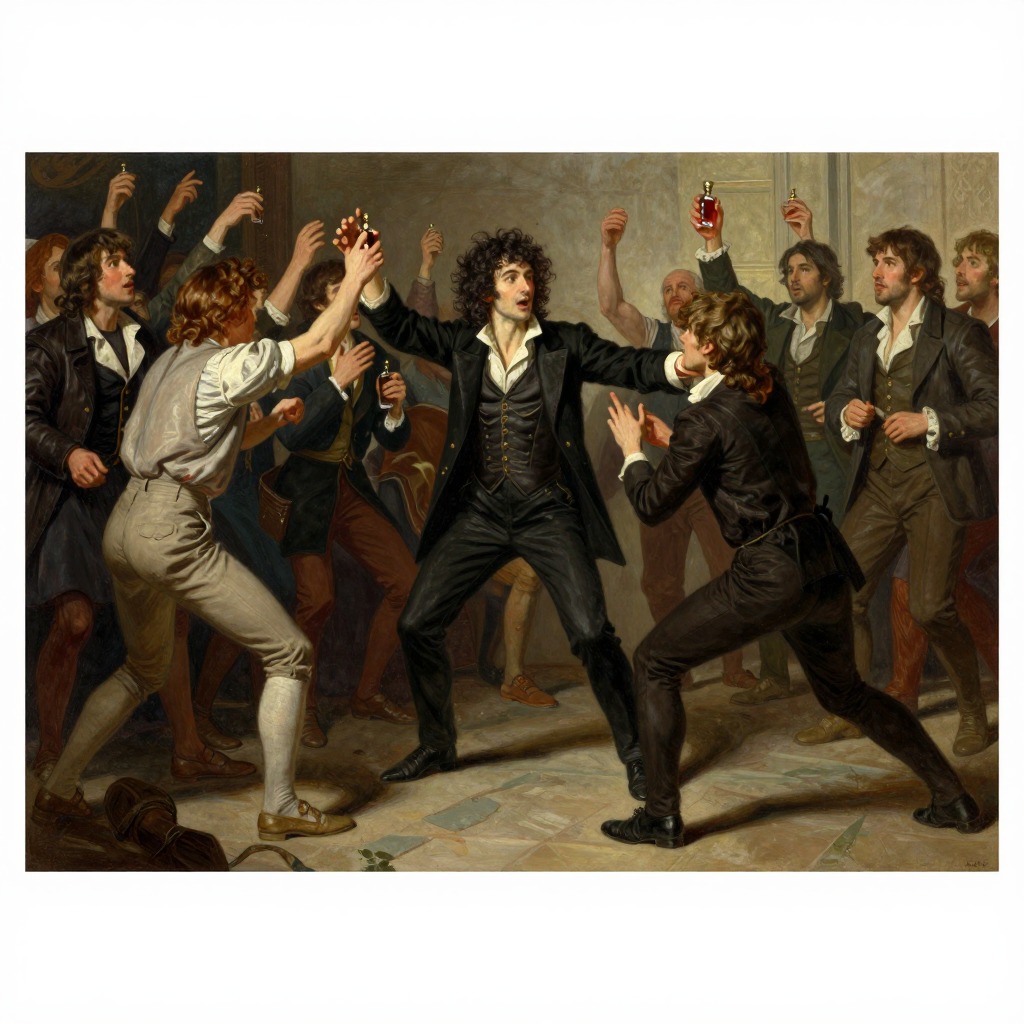
Decades later, on 25 June 1766, the hottest day of the year, Grenouille returns to Paris and walks across the Pont-Neuf to the right bank, then down to Les Halles and the Cimetière des Innocents. He sits down in the arcades of the charnel house bordering the Rue aux Fers. The cemetery grounds lie before him like a cratered battlefield, burrowed and ditched with graves, sown with skulls and bones, a garbage dump of death. The stench of corpses is so heavy that even the grave-diggers have retreated. After midnight, the place comes alive with thieves, murderers, whores, and desperadoes. Grenouille mixes with them, unstoppers his bottle of the ultimate perfume, and sprinkles himself. The mob, overcome by the scent, falls upon him, tears him apart, and devours him. The Rue aux Fers, the site of his birth, becomes the site of his annihilation, completing a circle that began in the most putrid spot in the kingdom and ends in a cannibalistic feast.
Narrative Significance
The Rue aux Fers functions as a powerful symbol of the novel's central themes. It represents the extreme of human filth and decay, the world from which Grenouille emerges and to which he ultimately returns. His odorlessness, which sets him apart from all other humans, is born in this place of overwhelming stench. The street's association with the Cimetière des Innocents, a graveyard that had been in use for eight centuries, underscores the novel's preoccupation with death and decomposition. Grenouille's journey from this street to the heights of the Plomb du Cantal and back again mirrors his trajectory from a despised, odorless creature to a godlike figure who commands love, and finally to a man who chooses to die among the dregs of society. The Rue aux Fers is not merely a location; it is the olfactory and moral ground zero of the novel, the place where the story begins and ends, and where the paradox of Grenouille's existence is most starkly revealed.