Place de Grève
PerfumeThe Place de Grève was the principal public execution ground of Paris, a broad tongue of land that licked the river on the right bank. In the eighteenth century, when the city reigned in a stench barely conceivable to modern sensibilities, the square was one of the most visible stages of royal justice. The streets stank of manure, the courtyards of urine, the stairwells of mouldering wood and rat droppings; the rivers stank, the marketplaces stank, the churches stank, and the King himself stank like a rank lion. The Place de Grève, jutting out to meet the Seine, was no exception to this universal foulness, but it held a specific, grim significance in the life of Jean-Baptiste Grenouille.
Execution of Grenouille's Mother
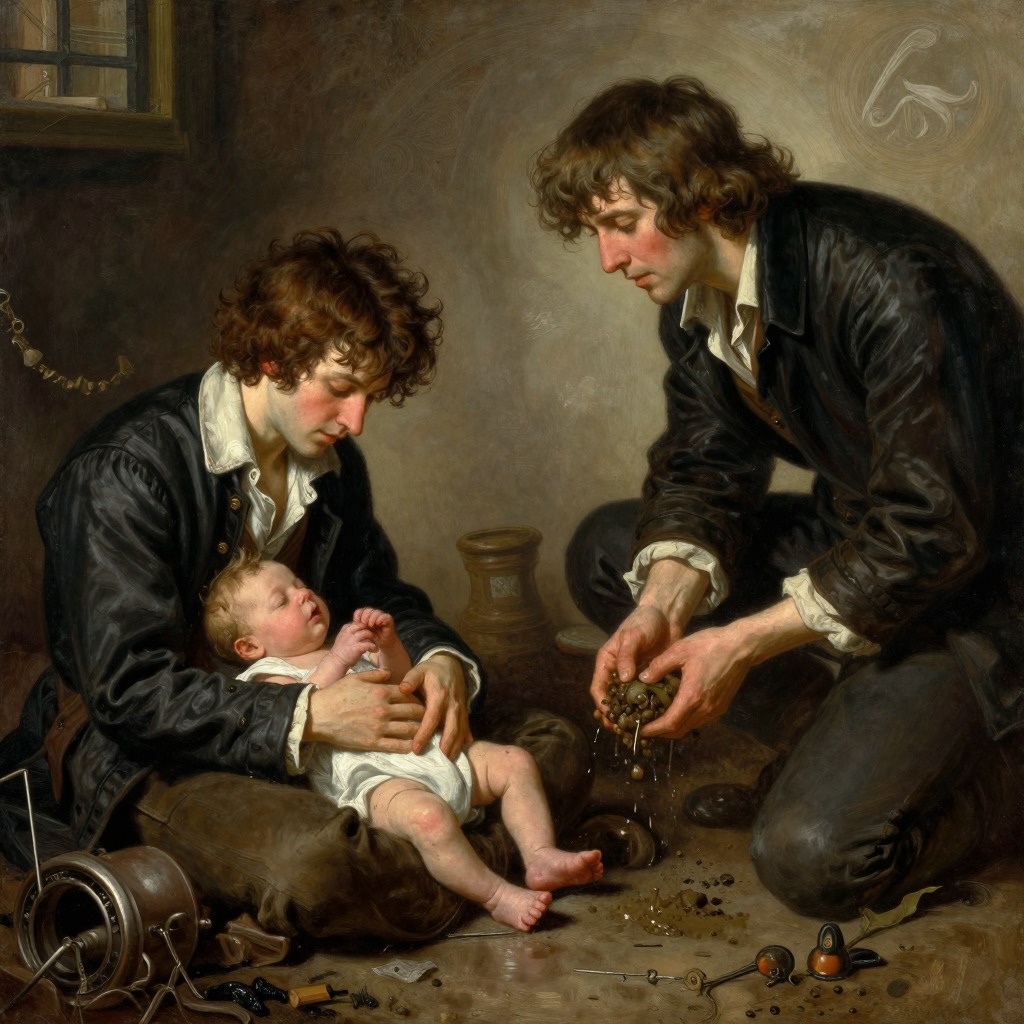
It was on the Place de Grève that Grenouille's mother was decapitated a few weeks after his birth. She had been arrested after abandoning the newborn under a fish stall in the rue aux Fers, and she confessed openly to having let her four previous children perish in the same manner. Tried and found guilty of multiple infanticide, she was led to the square and beheaded. The infant Grenouille, meanwhile, had already changed wet nurses three times and was being passed through the bureaucratic machinery of the city's foundling system. The Place de Grève thus marked the first public consequence of Grenouille's entry into the world: the death of the woman who had borne him.
A Place of Olfactory Discovery
Years later, after Grenouille had survived the tannery of Grimal and begun his nocturnal wanderings through Paris, he returned to the Place de Grève not as a witness to punishment but as a hunter of scents. The square, he found, was a place where ships were pulled up on to the shore or moored to posts, and they smelled of coal and grain and hay and damp ropes. More importantly, from the west, via this one passage cut through the city by the river, came a broad current of wind bringing with it the odours of the country, of the meadows around Neuilly, of the forests between Saint-Germain and Versailles, of far-off cities like Rouen or Caen, and sometimes of the sea itself. The sea smelled like a sail whose billows had caught up water, salt and a cold sun; it had a simple smell, immense and unique, and Grenouille hesitated to dissect it into fishy, salty, watery, seaweedy, fresh-airy components. He preferred to leave the smell of the sea blended together, preserving it as a unit in his memory, relishing it whole. The smell of the sea pleased him so much that he wanted one day to take it in, pure and unadulterated, in such quantities that he could get drunk on it. He imagined himself sitting high up in the crow's nest of a ship, gliding on through the endless smell of the sea, dissolving with pleasure in that breath. But it was never to be: Grenouille, who stood there on the river bank at the Place de Grève steadily breathing in and out the scraps of sea breeze that he could catch in his nose, would never in his life see the real sea, the immense ocean that lay to the west, and would never be able to mingle himself with its smell.
Narrative Significance
The Place de Grève functions in the novel as a hinge between two poles of Grenouille's existence. It is the site of his mother's public annihilation, the first violent erasure of a human being connected to him, and it is also the place where he first catches the scent of a world beyond the suffocating human mass of Paris. The square's dual character—execution ground and riverine threshold—mirrors Grenouille's own trajectory: born from a death sentence, he spends his life trying to escape the human stench that first defined him, and the Place de Grève offers him a fleeting, tantalizing glimpse of an olfactory freedom he will never attain.