Ketterley brings Piranesi to the House
PiranesiKetterley brings Piranesi to the House through a ritual whose details are not fully recounted in the evidence, beginning a life inside an immense world of halls and statues. The entry’s significance unfolds over time: Piranesi comes to know the House as a traversable world, but its routes are hazardous, access between worlds depends on unusual abilities or elaborate equipment, and escape finally requires him to cross a shimmering passage with Raphael.
Entry and Access
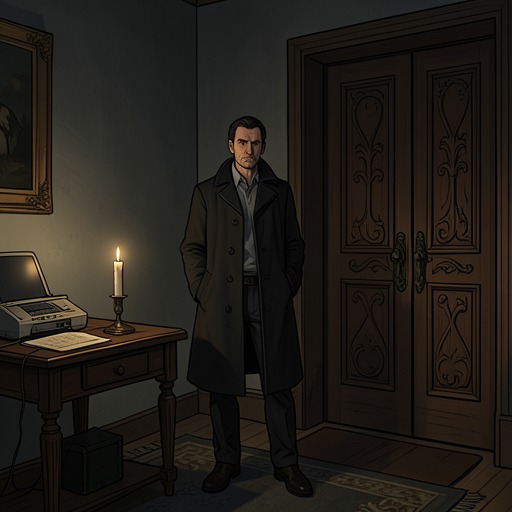
The known account of the crossing comes retrospectively from the Prophet, who recalls that Ketterley needed equipment, candles, uprights representing a door, and a ritual to enter the House. Ketterley had been shown how to make the passage numerous times, yet remained unable to reach it without those aids. Sylvia D’Agostino, by contrast, could slip between worlds at will; the Prophet also mentions cats, birds, and a capuchin monkey as creatures able to find the way. The contrast presents entry not as an ordinary journey, but as an uneven capacity: some can cross instinctively, while others depend on a contrived procedure.
The Prophet later says that Ketterley had brought Piranesi into the House using the equipment and ritual. The available evidence does not describe the original crossing itself or establish what Piranesi understood at the moment he entered. Instead, it shows the long aftermath of that passage through the life he makes inside the House and the eventual return route he takes out.
The House as a World
Piranesi’s life in the House is marked by expansive exploration. He travels as far as the Nine-Hundred-and-Sixtieth Hall to the West, the Eight-Hundred-and-Ninetieth Hall to the North, and the Seven-Hundred-and-Sixty-Eighth Hall to the South. He climbs into the Upper Halls, where clouds move through the spaces and statues emerge from mist; in the Drowned Halls, white water lilies carpet the dark waters. In the Derelict Halls of the East, collapsed ceilings, floors, and sometimes walls leave shafts of grey light cutting through the dimness.
These regions make the House more than the setting of his confinement: they are the substance of his learned life. Looking ahead from doorways, Piranesi sees no sign that the world is ending, only halls and passageways continuing into the distance. Statues occupy nearly every hall, vestibule, staircase, and passage, while occasional empty plinths, niches, apses, and bare patches interrupt their abundance. His account records a world whose apparent immensity invites continued discovery, even as its absences remain unexplained.
Routes, Risk, and Unequal Knowledge
The House’s geography has immediate bodily consequences. On the path to the One-Hundred-and-Ninety-Second Western Hall, Piranesi warns that the Seventy-Eighth Vestibule floods frequently. When the waters recede, tides scatter debris from the Lower Halls; some pieces have jagged edges that can cut bare feet and risk infection. The crossing remains possible, but demands careful movement through broken marble and takes time. Piranesi’s explanation exposes a change in his circumstances: he once had shoes, but no longer does. A route that had previously been manageable has become a hazard because the means of protection have disappeared.
Knowledge of paths also governs contact between inhabitants. Piranesi follows 16’s directions from the Sixth North-Western Hall back to the First Vestibule, tracing each doorway marked in yellow chalk. The marks sit below Piranesi’s eye level, and he estimates that 16 is 12 to 15 centimetres shorter than himself. Under each doorway, 16 has repeated the directions so they will survive a tide or mishap. Piranesi recognizes the care and method in this system, then returns with blue chalk to the Sixth North-Western Hall and begins writing beneath the earlier instructions. Inside the House, route-finding is also a way to leave messages and establish a connection across distance.
Danger and the Way Out
The Prophet’s warning gives the routes a further danger. He says that 16 is looking for Piranesi, not Ketterley, and decides to give 16 detailed directions to reach him partly because he hates Ketterley, who has slandered him for years. But he warns Piranesi that Ketterley fears 16 and will become more dangerous as 16 draws closer; he even suggests that Piranesi might avert the threat by killing Ketterley. Later, Piranesi makes finding 16 and ensuring her safety his most important task. He suspects that the Other has set a trap, possibly by promising 16 a meeting and information about how to find Matthew Rose Sorensen. Although he would rather avoid the Other, he reasons that finding the Other may be the most reliable way to find 16, and hopes to reach her first. Access to the House and knowledge of its routes therefore become bound up with pursuit, deception, and the possibility of violence.
The House is not Piranesi’s final destination. When he prepares to leave with Raphael, he gathers his journals and favourite pens in his messenger bag and walks with her toward two Minotaurs in the South-Eastern Corner. Between them, the shadows shimmer into the suggestion of a corridor: dim walls, with flashes of moving colour at its end. Piranesi takes one last look at the House; Raphael takes his hand, and they enter the passage together. The ending turns the problem of crossing that began with Ketterley’s ritual into a different kind of departure: Piranesi leaves carrying the records of the life he has made there, accompanied rather than brought by force.