The Great Flood and Valentine Ketterley’s death
PiranesiThe Great Flood and Valentine Ketterley’s death are the turning point at which the House’s tidal system becomes both a mortal threat and the setting for a final confrontation. A Conjunction of Four Tides fills the halls in sequence; amid the rising water, Matthew Rose Sorensen turns against the armed Ketterley, Raphael arrives to find Matthew, and the flood carries Ketterley away. Its aftermath brings Matthew and Raphael’s recognition of each other—and of Matthew’s identity.
Causes and Background
The flood grows out of the House’s ordinary structure. Its Lower Halls belong to the tides, and the waters there provide fish, crustaceans, and sea vegetation; tides are not an exception to life in the House but part of its sustaining order. The danger comes when several tidal movements coincide, raising the water across connected halls and vestibules.
The House’s weather has already shown how its regions can change. Two years after the ceilings of the Twentieth and Twenty-First North-Eastern Halls collapsed, clouds began to enter the Middle Halls, where they would not normally go. This altered the climate of the region, making it colder and greyer. The breach does not cause the later flood, but it establishes that damage to the House can alter the conditions its inhabitants must navigate.
Matthew normally maintains a Table of Tides using observations and equations of his own devising, checking every few months for extraordinary events. Having neglected the calculations, he discovers that a Conjunction of Four Tides will occur in less than a week. His previous calculations had ended more than two weeks earlier. The warning is therefore not a prophecy detached from practical knowledge: it is a danger his regular system could have identified, had he kept it current. He recognizes that the lapse has put both himself and Ketterley in mortal danger.
On the day of the flood, the last two tides rise around noon in the Tenth and Twenty-Fourth Vestibules. Water is already advancing through the connected halls before Matthew reaches Ketterley. That timing narrows his choices: the predicted event has arrived, and escape depends on finding Raphael and getting above the inundation.
Confrontation as the Waters Rise
Matthew first follows the path specified in 16’s directions, walking between the First Vestibule and the Sixth North-Western Hall six times without finding her. By the time he returns to the First Vestibule, water is beginning to spread over the surrounding pavements. He decides he must search for Ketterley, but Ketterley appears before he can act on that decision.
Ketterley crosses the First Vestibule in unfamiliar clothing—jeans, an old jumper, sneakers, and what Matthew identifies as a life-jacket harness. Matthew recognizes the thought as belonging to Matthew Rose Sorensen, a brief sign that his buried identity is becoming accessible even as he continues to experience the encounter through his life in the House. Ketterley enters the First Western Hall and unpacks the inflatable boat. Matthew follows and hides, still watching for Raphael.
The confrontation becomes physical when Ketterley rejects Matthew’s warning as something Raphael has put into his mouth and moves for the gun lying on the pavement. Matthew reaches it first and kicks it away, sending it to the northern wall, about fifteen metres off. The rising ripples pursue the gun across the floor, while Matthew asks where 16 is. Her voice answers from one of the southern doors: she has come for Matthew Rose Sorensen. Ketterley is disoriented by the halls’ echoes, but the flood’s approach leaves little time for either man to control the situation.
Raphael enters from the door leading to the First Southern Hall, wearing jeans and a green jumper, her dark hair tied back. Ketterley retains his grip on Matthew and swings at him; Matthew moves with the motion, unbalances him, breaks free, and runs toward Raphael. He warns her that Ketterley means harm and has a gun, then calls out that a flood is coming and they must climb.
Escape and Ketterley’s Death
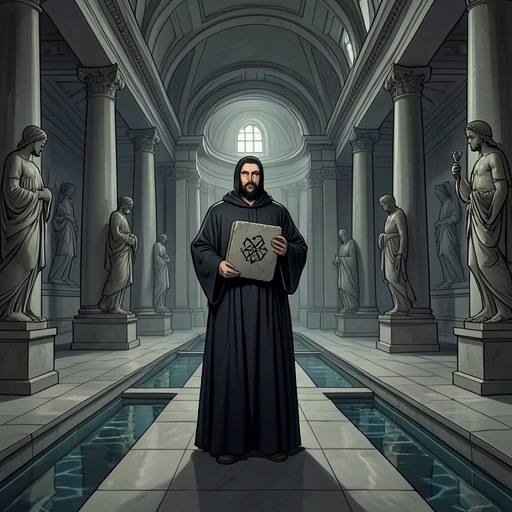
The pair cannot use the Horned Giants beside the Eastern Door as a direct climbing route: their bodies emerge from the wall above the floor, leaving no footholds at the bottom. Matthew instead climbs onto a nearby niche containing a statue of a father seated with his son, plucking a thorn from the boy’s foot. Using the statue and a side column as footholds, he reaches the pediment above. Raphael, less practiced at climbing, gets as far as the father’s lap; Matthew climbs back down to help her up.
At noon, while the final two tides are rising elsewhere in the network, Matthew and Raphael reach a deep cornice running along the hall, roughly seven metres above the floor. Raphael is pale and shaking but determined. From this height they are not beyond danger. Ketterley has not boarded the inflatable boat; instead, he runs to retrieve the gun from the northern wall and fires at them. The shots sound at first like possible damage caused by the water’s weight and vibration. One strikes a statue above them, and a fragment injures Matthew’s forehead. Ketterley fires again as Matthew urges him to get into the boat before it is too late.
The violence of the flood overtakes the standoff. A surge strikes the other side of the northern wall, and Matthew and Raphael climb down from the cornice to the Horned Giant, whose form holds them against the force of the water. The boat is tossed about in the inundation, alternately engulfed and visible again. Ketterley is still away from it. A great wave enters through the northern doors, lifts him, and throws him against the southern wall among the statues, at a point about fifteen metres above the floor. The water then withdraws with him. Matthew later judges that Ketterley died in the impact, though the narrative records no recovery of his body and describes his fate as an inference.
Aftermath and Recognition
The flood does not subside at once. After the waves sink and the waters begin draining into the staircases and Lower Halls, the heads of the lowest tier of statues emerge above the surface. During the inundation, Matthew and Raphael have not spoken: the roar makes conversation impossible, and both are occupied with keeping themselves and each other safe. Their silence is therefore practical, not a sign of estrangement.
Once the water calms, they turn to face each other. Matthew recognizes her as Six and as Raphael; she gives her name as Sarah Raphael and identifies him as Matthew Rose Sorensen. Her words make explicit what his own perception has begun to register: the person who has lived as Matthew inside the House and the man Raphael came to retrieve are one and the same. The name is offered as a statement rather than a question, and Matthew reflects that a question might have left him unable to answer.
The disaster thus closes one danger while opening a different kind of passage. Ketterley’s attempted escape and use of the gun end in his presumed death, while the flood forces Matthew and Raphael into a shared act of survival. Their recognition comes only after the noise and immediate peril have passed. The House’s tides, normally a source of nourishment and a measurable rhythm, have become an overwhelming force; knowledge of their pattern matters, but the neglected warning cannot undo the danger once the waters arrive.