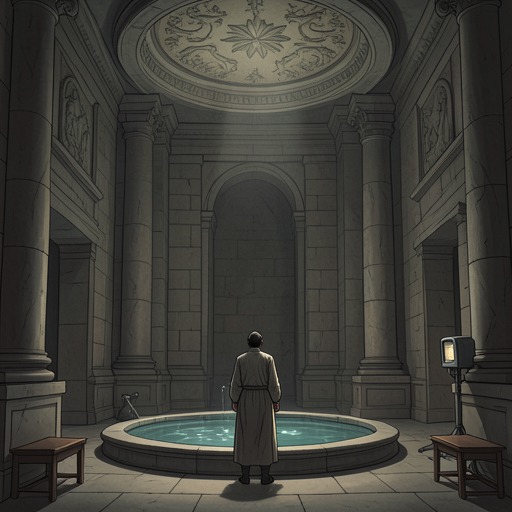
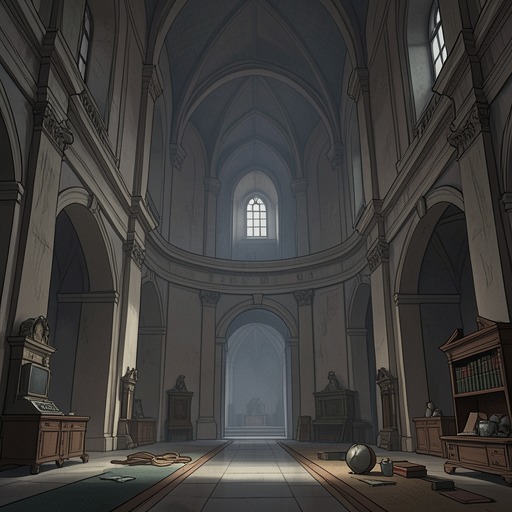
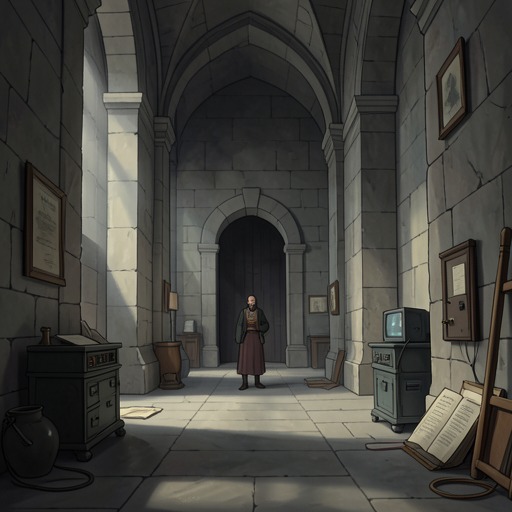
Matthew Rose Sorensen leaves the labyrinth and returns to the real world
PiranesiMatthew Rose Sorensen’s departure from the House and return to the Other World is both a physical crossing and a decision about companionship. The House has become the world he knows, and leaving it means surrendering its familiar halls and statues; remaining, however, would mean knowing himself to be alone. He chooses to go with Sarah Raphael, steps with her into the passage between the Minotaurs, and reappears in the world he had lost.
The decision to leave
The choice grows from an altered understanding of solitude. While living in the House, Matthew had thought that the Other was simply elsewhere within it whenever he disappeared. The discovery that the Other returned to his own world changes the meaning of those absences: the apparent presence of another inhabitant had made Matthew feel less lonely, but now he knows that Raphael, too, will eventually return to the Other World. She has promised to visit, and he regards her as a genuine friend, unlike the Other, whose feelings toward him had been mixed. Even so, a promise of future visits cannot make staying feel like shared life. Matthew concludes that if he remains, he will be alone, and decides to leave with Raphael.
The decision follows an earlier conversation about his family. Raphael asks whether he would be willing to let Matthew Rose Sorensen’s parents and sisters see his face again, so they can know that he is alive; she says it would help them even if he later returned to the House. Matthew cannot do so immediately. His eventual departure is therefore not a simple return to a settled family life: it begins as a choice to accompany a friend, with the question of how to face his family still present.
The House he leaves
Matthew’s hesitation carries the weight of a life built through repeated attention to the House. He has explored far beyond its familiar center: west to the Nine-Hundred-and-Sixtieth Hall, north to the Eight-Hundred-and-Ninetieth, and south to the Seven-Hundred-and-Sixty-Eighth. He has climbed into Upper Halls where clouds move and statues emerge from mist, visited Drowned Halls carpeted with white water lilies, and seen the eastern Derelict Halls broken by collapsed ceilings, floors, and walls. Looking from doorways into the distance, he has never seen the World ending, only halls and passages continuing onward.
That expansive world is also his intimate home. Statues fill most halls, and the occasional empty plinth, niche, apse, or blank patch of wall is as mysterious to him as the figures themselves. Before leaving, he returns the Dead to their allotted places and walks among the statues he loves, wondering whether each face will be the last he sees. His farewell is not to a mere obstacle or prison: it is to the place he has observed, cared for, and understood as a world in its own right.
Crossing with Raphael
On the day of departure, Matthew prepares to enter the New World by restoring the ornaments he had hidden. He takes a small cardboard box marked AQUARIUM, decorated with an octopus, which had originally held shoes given to him by Dr Ketterley. After being told to hide from 16, he had put his ornaments in the box; now he spends two or three hours putting them back into his hair. The seashells, coral beads, pearls, tiny pebbles, and fishbones are things he found or made in the House. Raphael is astonished by his pleasant appearance when she arrives.
Matthew carries a messenger bag containing all his journals and his favourite pens. Together they walk toward the two Minotaurs in the south-eastern corner, where the shadows between the statues shimmer and suggest a narrow corridor. At its far end are lights and flashes of moving colour his eye cannot interpret. He takes one last look at the Eternal House and shivers. Raphael takes his hand, and the two walk into the corridor together. The passage makes departure visible as a crossing, while the handclasp makes clear that he does not cross alone.
Reappearance and its limits
The later account confirms the crossing’s outcome in the concise declaration that Matthew Rose Sorensen has reappeared. On 27 November 2018, his mother, father, sisters, and friends ask where he has been. He tells them that he was in a house with many rooms, that the sea swept through it, and that sometimes it swept over him but he was always saved. The account preserves the central features of his experience—an inhabited house, recurrent water, danger, and survival—without suggesting that his listeners accept the House as a literal place.
His family and friends instead understand the story as a description of a mental breakdown from the inside, an explanation they find reasonable and perhaps reassuring. They have Matthew back, or believe they do: a man with his face, voice, and gestures moves among them, and that is enough. The ending therefore joins return to estrangement. Matthew has physically reappeared, but the people around him place his account within a different explanation of what happened; the narrative leaves that divide intact rather than resolving it.