Matthew Rose Sorensen takes James Ritter back to the labyrinth
PiranesiMatthew Rose Sorensen takes James Ritter back to the labyrinth after leaving it himself, turning a route out of the House into a means of return. The reunion reveals both the labyrinth’s continuing hold on its former captive and the practical limit of that longing: Ritter is overjoyed to be home, but cannot survive there without someone to care for him.
A Route Made Reversible
In the world beyond the House, Matthew decides to write a book about Laurence Arne-Sayles, a project shared by his former self and his present one. Raphael has also taught him what Arne-Sayles taught her: how to find the path to the labyrinth and how to find the path out again. Matthew can now come and go as he pleases. The route is no longer only an exit from captivity; it gives him the ability to return by choice and to bring someone else across the boundary.
That knowledge makes possible his journey to James Ritter. Matthew travels by train to Manchester, takes a bus to Miles Platting, and walks through a bleak autumn landscape to a flat in a tower block. The ordinary sequence of public transport and a walk to a flat stands in sharp contrast with the shadowy passage into the House that follows. The labyrinth has not vanished from Matthew’s life, but access to it now depends on learned directions rather than on being trapped inside it.
Finding James Ritter
At the flat, Matthew meets a thin, ravaged-looking man who smells strongly of cigarettes. He asks whether the man is James Ritter; after Ritter confirms that he is, Matthew tells him he has come to take him back. The brief exchange carries the weight of a long separation without explaining it away: the man Matthew finds bears the marks of life outside the House, while the place he is offering is the one where Ritter once lived and slept.
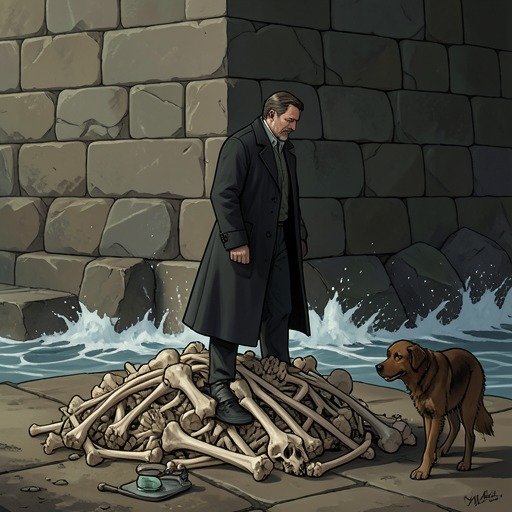
Matthew leads Ritter through the shadowy corridor. In the First Vestibule, the noble Minotaurs rise around them, and Ritter begins to cry—not from fear, but happiness. He goes straight to the great marble sweep of the staircase, the place where he used to sleep, and closes his eyes to listen to the sounds of the tides. His response makes the return more than a visit to a strange interior: familiar surroundings and familiar sounds restore a sense of home that the outside world has not supplied.
Home and Its Limits
When it is time to leave, Ritter begs Matthew to let him remain. Matthew refuses, not because Ritter’s joy is doubtful, but because joy cannot meet the material requirements of survival. Ritter never learned how to feed himself; without Matthew providing food, he would die in the House. Matthew also cannot take on the responsibility of feeding him indefinitely. The reunion therefore reverses the usual measure of freedom: the place where Ritter feels most at home is also a place where he cannot safely live alone.
Matthew offers a qualified promise rather than a permanent rescue. He will bring Ritter back whenever Ritter wants, and if Matthew ever decides to return for good, he promises to bring Ritter with him. The promise preserves Ritter’s access to the House without pretending that his longing cancels his dependence. Return becomes possible, but permanent residence must wait on a change in Matthew’s own decision and circumstances.
Return Without Restoration
The episode brings the House back into Matthew’s life as a place he can enter and leave, while showing that the same choice is not yet available to Ritter. Earlier, the labyrinth’s routes could be dangerous and laborious: passage through the Seventy-Eighth Vestibule, for instance, might leave a traveler picking carefully through sharp debris washed up by the tides. Elsewhere, 16’s careful yellow-chalk marks beneath doorframes show how route knowledge can preserve a path through a shifting environment. Matthew’s return depends on a different kind of guidance—what Raphael has taught him—but it likewise makes movement through the labyrinth possible.
The scene also stands against Matthew’s earlier fear that the Other may have set a trap for 16, perhaps by promising to meet her and reveal how to find Matthew. At that point he wants to reach 16 before she reaches the Other, even though approaching the Other himself is dangerous. His later journey to rescue Ritter uses the capacity to cross between worlds not to pursue or control someone, but to offer a return and then set a necessary limit. That distinction does not make the House harmless: Matthew’s refusal rests on the danger of leaving Ritter unable to feed himself there.
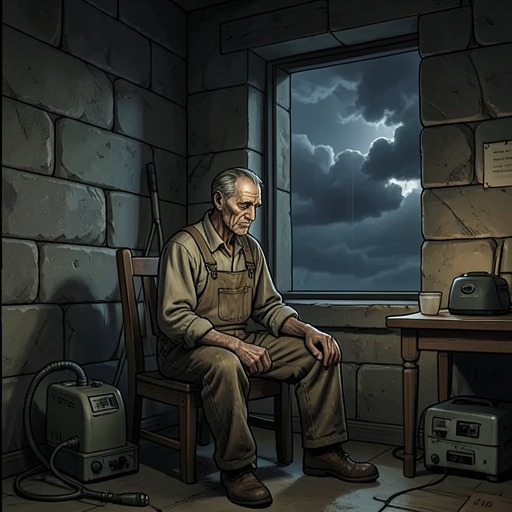
The House’s vastness remains part of the meaning of the reunion. Matthew had once explored halls extending hundreds of rooms west, north, and south, climbed to cloud-filled Upper Halls, and seen the flooded and derelict regions without finding an end to the World. Yet the return narrows that immense geography to a few intensely particular places: the corridor, the First Vestibule, and the staircase where Ritter used to sleep. Matthew’s journey restores Ritter’s contact with the tides and the House, but not the lost years or the self-sufficiency required to stay. Its ending is therefore a promise of repeated visits, not a completed restoration.