Matthew Rose Sorensen disappears during the ritual
PiranesiMatthew Rose Sorensen disappears from ordinary reality during a ritual performed by Valentine Ketterley, entering the labyrinth that the journal’s narrator knows as the House. The passage is decisive not simply because it marks Matthew’s arrival in an impossible world, but because its later recollection reveals that Ketterley used the ritual to entrap him: the apparent invitation to investigate the labyrinth was a means of securing someone else to explore and document it.
Background and the Ritual’s Rationale
The account belongs to a later retrospective section concerning the events of 15 November 2012. By then, the narrator is reviewing an encounter whose significance he could not understand at the time. Ketterley’s former teacher, Laurence Arne-Sayles, had claimed that a person could reach the labyrinth by adjusting his frame of mind and recovering a childlike, prerational openness to wonder. Since most of his students could not do this unaided, Arne-Sayles devised a ritual for them, presenting it as a concession to their lack of ability rather than as his own preferred method.
Ketterley draws on that history when he proposes that he and Matthew perform the ritual. Matthew has asked to understand Laurence and the hold he had over his students; Ketterley makes the ritual the condition of pursuing that understanding. His stated connection to Arne-Sayles’s ideas gives the procedure an intellectual pretext, but the scene’s outcome exposes the gap between its professed purpose and Ketterley’s private objective.
Preparation and Crossing
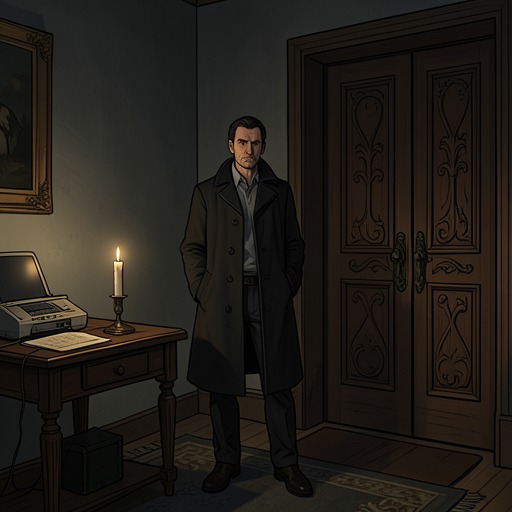
Ketterley prepares the sitting room by lowering the blinds and clearing a space facing the door to the hall. He lights a candle in an old-fashioned brass candlestick with a square base, a conspicuous object among the house’s otherwise modern, minimalist European furnishings. He also puts Matthew’s messenger bag on his shoulder. It contains Matthew’s journals, index, and pens, and Ketterley explains that the notebooks will be needed in the labyrinth. The bag’s presence anticipates the practical work Matthew will be made to perform there: observation and record-keeping.
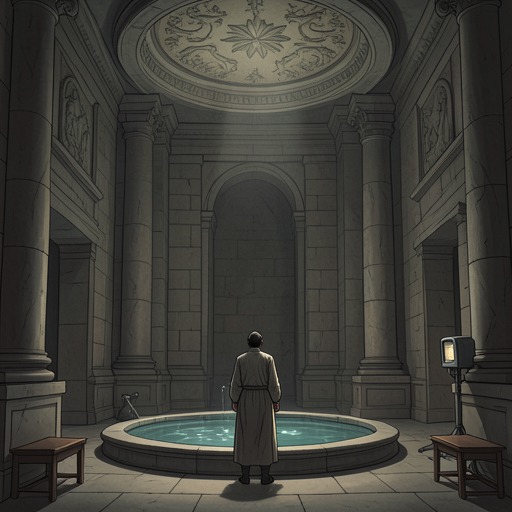
The transition comes abruptly after the ritual has begun. The world seems to stop; Ketterley falls silent, and the Berlioz playing in the room is cut off in mid-chorus. With his eyes still closed, Matthew senses that the darkness has changed, becoming greyer and cooler, while the air grows colder and damper. The ordinary hum of London vanishes. In its place he hears waves striking walls, and when he opens his eyes he finds himself in a vast room surrounded by imposing statues of minotaurs.
Ketterley is already at ease in the new setting, standing in his shirtsleeves and smiling at Matthew as if a successful experiment has just confirmed its result. He says that he is delighted to see him and that a young, healthy man is just what he wanted. Matthew’s demand that Ketterley put him back meets laughter, not an attempt to reverse the crossing. That response makes clear that Matthew’s arrival is not a shared expedition with an agreed return: Ketterley has brought him into the House for his own ends.
Betrayal and the Hidden Purpose
The scene’s full meaning emerges only after Matthew has spent time in the House and become known as Piranesi. When the remembered identity of Matthew Rose Sorensen returns, he realizes that he had once known Ketterley was his enemy. His amnesia had erased that knowledge along with his former name, allowing him to mistake Ketterley for a friend. Ketterley, by contrast, remembered their earlier relationship and had called him Piranesi, avoiding the name that might have led him back to his past.
The recovered memory also recasts the ritual’s practical arrangement. Matthew had carried his notebooks into the labyrinth because Ketterley expected him to gather information there. Piranesi concludes that Ketterley needed another person to live in the Halls and collect data, while avoiding the risk that prolonged exposure to the House might make Ketterley himself forget. In this interpretation, the ritual is both a literal threshold into another world and an instrument of exploitation: Matthew is made to cross it so that Ketterley can obtain knowledge without bearing the same cost.
Consequences and Narrative Significance
The crossing establishes the unequal relationship that governs Matthew’s life in the House. At first, he cannot retain the knowledge that Ketterley is his enemy; the name Piranesi and his new life obscure Matthew Rose Sorensen, while his work of measuring, photographing, and collecting information serves Ketterley’s purpose. The later recollection reverses that apparent companionship. What had seemed like an eccentric scholarly undertaking is recognized as a calculated act of entrapment, and the ritual’s promise of access becomes inseparable from the loss of freedom and identity.
The book presents the event through retrospective disclosure rather than as a fully understood turning point in the moment itself. The sudden sensory break—the interrupted music, the vanished sounds of London, the cold damp air, and the minotaur statues—records the physical passage; the later recovery of memory supplies its moral explanation. Together, those layers make Matthew’s disappearance more than a change of setting. It is the beginning of the long division between Matthew Rose Sorensen and Piranesi, and the concealed origin of the labor Ketterley expects from him.