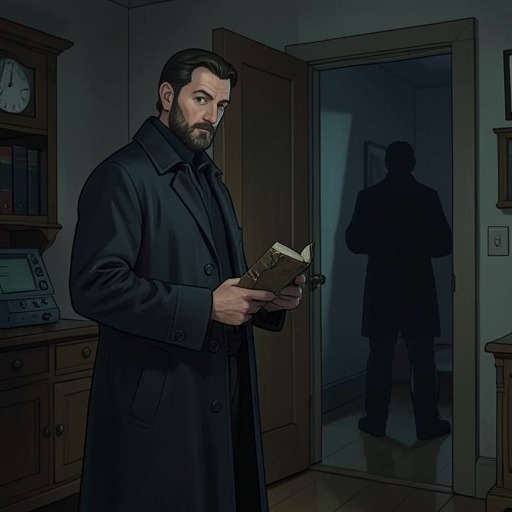
Laurence Arne-Sayles—Val Ketterley
PiranesiLaurence Arne-Sayles and Val Ketterley are joined by a teacher–student history and divided by competing claims to intellectual authority. Arne-Sayles presents Ketterley as a plagiarist who inherited his ideas, including the belief that knowledge capable of creating the House might be found inside it; he rejects that belief as a misunderstanding of how the world came into being. Their relationship therefore reflects a deeper conflict between possession and understanding: Ketterley seeks knowledge for use, while Arne-Sayles insists that the House cannot be reduced to a store of exploitable answers.
Teacher and Student
Arne-Sayles identifies Ketterley as one of his former students and describes him as a charlatan whose intellectual manner conceals a lack of originality. He goes further than accusing him of influence or imitation: Arne-Sayles claims that Ketterley’s ideas are his own, and that Ketterley is permanently overshadowed by others. This is Arne-Sayles’s account, delivered in a self-aggrandizing speech, rather than an independently established history of every idea they shared.
Their association was not merely academic. In the summer of 1987, Ketterley joined Arne-Sayles’s inner circle at Casale del Pino, a farmhouse twenty kilometres from Perugia that Arne-Sayles had rented for his favored students. The shared setting places Ketterley among the group gathered around Arne-Sayles’s great experiment, even as tensions within that circle were beginning to surface.
A Shared Discovery, Unequal Claims
Arne-Sayles takes credit for theorizing that the House existed and that a way to reach it could be found. He says that he came there, sent others there, kept the matter secret, and required those involved to maintain that secrecy. His account casts him as the originator of the project and Ketterley as a student who later appropriated its intellectual foundations.
That claim of shared history does not amount to shared purpose. Arne-Sayles says he was willing to disregard morality but drew a line at bringing about the collapse of civilization, describing himself as having a sentimental streak. He also acknowledges that he was imprisoned for the acts attributed to him, and admits to having done more than his accusers knew. The account gives the relationship a moral dimension: Arne-Sayles’s stated limit distinguishes him from an unrestricted pursuit of power, but his candid admission of extensive wrongdoing makes that limit far from a simple vindication.
Disagreement over the House
The clearest intellectual divide concerns whether the knowledge that created the House remains inside it, waiting to be recovered. Arne-Sayles says he once believed it might, before seeing the world for himself. He compares the House’s creation to water slowly wearing channels through stone: the resulting cave system remains, but the water that formed it has long since seeped away. In his view, Ketterley retained the earlier assumption even after it had become untenable.
Arne-Sayles explains Ketterley’s persistence as a consequence of egotism and utility-mindedness: Ketterley, he says, cannot imagine why anything would exist if he could not make use of it. The contrast sharpens the meaning of their estrangement. For Arne-Sayles, the House’s existence need not serve as a promise of recoverable knowledge; for Ketterley, its value is tied to what it can provide. Their teacher–student bond thus survives in the form of an argument over whether the world is valuable in itself or chiefly as an instrument.