Piranesi—Folded-Up Child
PiranesiPiranesi’s relationship with the Folded-Up Child turns an imagined bond into a sustained practice of care: he treats the child’s remains as a companion’s, sharing the provisions and discoveries of his life in the House. His belief that the House intended her to be his wife links private tenderness to his conviction that the House needs a living witness to its beauty and mercy.
The Folded-Up Child
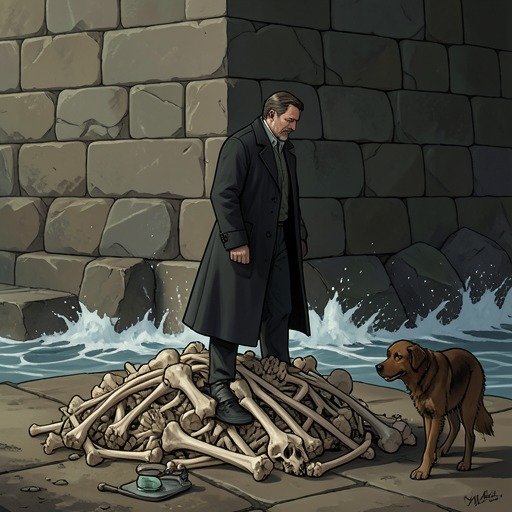
The Folded-Up Child is a skeleton that Piranesi believes to be a girl of about seven. She rests on an empty plinth in the Sixth South-Eastern Hall, her knees drawn to her chin, her arms clasped around them, and her head bowed. A necklace of coral beads and fishbones encircles her neck. Her compact, withdrawn pose gives Piranesi a particular person to address among the dead, rather than an undifferentiated set of remains.
An imagined kinship
Piranesi reflects that only he and The Other are alive in the World, and both are male. He asks how the World will have an inhabitant after they die, and reasons that the House—or, as he sees it, effectively the same thing as the World—wants an inhabitant to witness its beauty and receive its mercies. On that basis, he imagines that the House intended the Folded-Up Child to be his wife, but that something prevented this future. The belief is his own hypothesis, not a confirmed history of the child; nevertheless, it becomes the premise for how he treats her.
Care for the dead
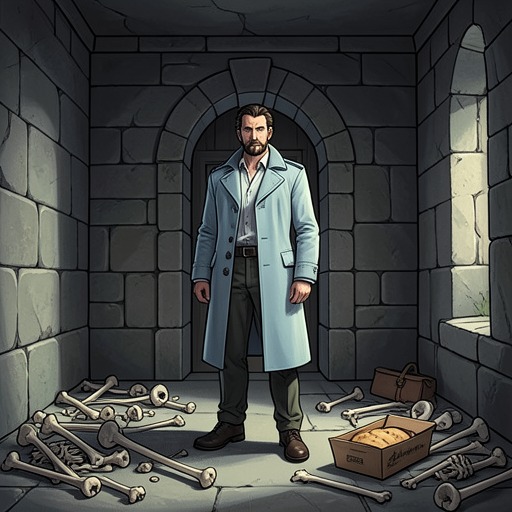
Piranesi visits all the dead, bringing them food, water, and water lilies from the Drowned Halls. He gives the Folded-Up Child particular attention, telling the dead what he has been doing and describing the wonders he has encountered in the House. He understands this practice as a way of ensuring that they are not alone. His care is practical as well as conversational: provisions and flowers connect the dead to the living world of the halls, while his spoken accounts make them recipients of its ongoing events.
Contrast and significance
Piranesi notes that The Other does not visit the dead and, as far as he knows, has no religious practices. The contrast makes Piranesi’s visits more than a private expression of affection: they are part of his distinctive way of recognizing and tending to the dead. Elsewhere, he observes that people who came after the Fish-Leather Man patiently gathered his bones and laid them with their own dead, treating the preservation of remains as an expression of reverence for human life. Piranesi’s attention to the Folded-Up Child belongs to the same ethic, but adds a personal and prospective dimension: he imagines her not only as someone deserving care, but as the companion who might have shared the House with him.