Piranesi—House
PiranesiPiranesi’s relationship with the House is a reciprocal bond of trust and care: he believes it wants an inhabitant to witness its beauty and receive its mercies, and understands himself as that beloved child. The bond gives meaning to his life among the Halls, shapes his response to forgetting, and makes leaving a painful choice rather than a simple escape.
A World Worth Revering
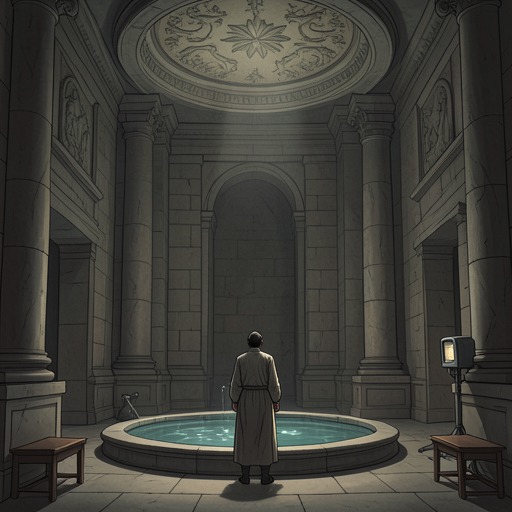
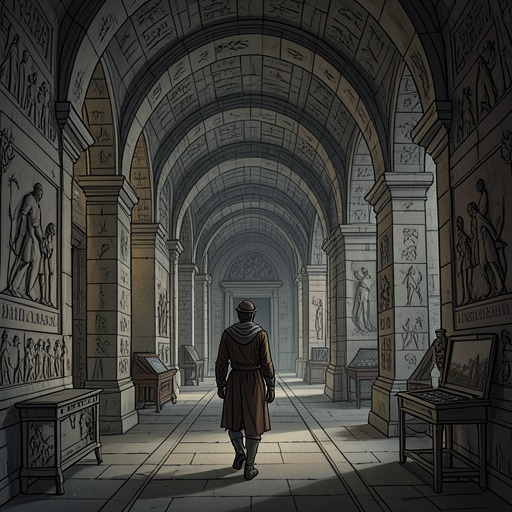
Piranesi’s devotion begins with his perception of the House as a living, varied world rather than an empty architectural maze. When The Other dismisses it as a succession of dreary rooms filled with decaying figures and bird droppings, Piranesi silently counters that the Lower Halls teem with sea creatures and vegetation, the Middle Halls hold birds and people, and the Tides move with power. Even the droppings testify to life. The Halls differ in their columns, niches, doors, windows, and unique statues; to Piranesi, their particularity makes the Other’s contempt not merely mistaken but a failure to see what is present.
That reverence is crystallized in his declaration that the House’s beauty is immeasurable and its kindness infinite. His faith is not simply an abstract belief about architecture: the House is the world in which he lives, and its beauty and mercies form the conditions of his existence. The relationship is expressed as both devotion and belonging, with Piranesi treating the House as a presence worthy of trust even when he cannot explain its purposes.
The contrast also touches the theory of the world associated with Laurence Arne-Sayles. Arne-Sayles argued that the ancient world was not merely perceived by people but answered them: rivers, stars, and other parts of nature participated in an actual dialogue, and reality could be persuaded. Piranesi’s attentive response to the House resembles this sense of a world that speaks and acts, though his own account is grounded in his intimate experience of its Halls, tides, statues, and living creatures.
Belonging and Witness
Piranesi reasons that the House wants an inhabitant who can witness its beauty and receive its mercies. Because he believes the House and the world are, for practical purposes, one and the same, this imagined wish gives his presence a purpose: his life is not incidental to the place but a form of companionship with it. The idea becomes particularly vivid in his reflections on the Folded-Up Child, whose skeleton he visits and cares for. He imagines that the House intended her to be his wife, and that something prevented this; he consequently shares with her what he has, bringing food, water, and water lilies, speaking to the dead, and telling them about the wonders he has seen. His care for the dead extends his sense of witness into an act of keeping others from being alone.
The possibility of leaving therefore carries an ethical and emotional weight. Piranesi once feared that if he departed, the House would have no inhabitant and would be empty. His attachment is not only to shelter or familiarity: he feels responsible for the House’s need, as he understands it, to be witnessed. In the closing decision, he acknowledges that remaining would mean living alone. Raphael has promised to visit, but unlike Piranesi’s earlier understanding of The Other’s departures, he now knows that Raphael will return to another world and that he will be alone in the Halls between visits.
Trust Through Forgetting
When Piranesi learns that both The Other and the Prophet regard the House as a source of madness and forgetfulness, he accepts their conclusion that it causes his forgetting. Yet accepting that account does not destroy his trust. He asks himself whether he trusts the House and answers yes; if the House has made him forget, he reasons, it must have had a good reason, even though he does not know what that reason is. The comfort lies not in understanding the House’s action but in believing that his relationship to it remains benevolent.
This faith is tested by the possibility that forgetting could return him to dependence on The Other. Piranesi fears becoming The Other’s friend again, helping him measure the Halls, take photographs, and gather information while unaware that he had been tricked into the House for The Other’s advantage. To protect his memory, he resolves to learn from 16 and make enormous warnings out of marble pebbles: The Other is not his friend, and brought Matthew Rose Sorensen into the world for his own purposes. The act shows how the House-bond coexists with suspicion of the human visitor who treats the place instrumentally. Piranesi’s reverence is not a passive refusal to see danger; it is a commitment to the House that can sharpen his resistance to exploitation.
The Beloved Child and Departure
When Raphael asks who he is, Piranesi answers that he is the House’s beloved child. Asked what the House is, he spreads his arms to indicate the First Vestibule, the Halls beyond it, and everything. The gesture makes the scale of the relationship plain: “the House” is not one building among others, but the entirety of the world he inhabits. The name he gives himself expresses both personal identity and a relationship of care, one that remains meaningful even after he understands that Matthew Rose Sorensen’s memories and his own are not identical.
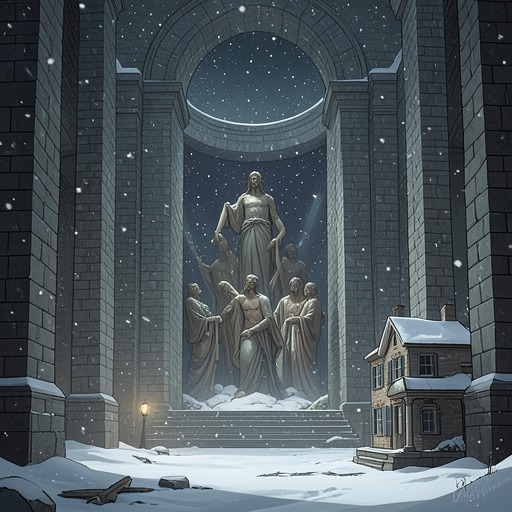
His decision to leave does not cancel that bond. Piranesi returns the dead to their allotted places, walks through the Halls, and says goodbye to the statues he loves, wondering whether each face will be the last he sees. He chooses to go with Raphael despite having once dreaded an empty House and despite knowing that his departure will leave him alone there. The choice changes the form of his attachment: he no longer treats remaining as the sole way to honor the House’s wish for a witness. His farewell preserves the relationship as gratitude and love, while accepting that the life he has chosen now requires departure.