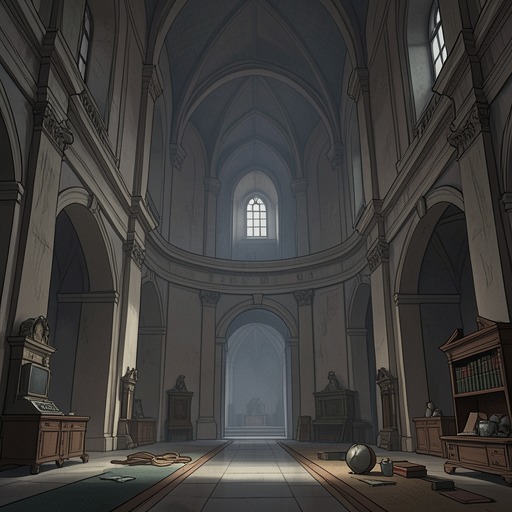
Matthew Rose Sorensen—Piranesi
PiranesiMatthew Rose Sorensen—Piranesi names the divided yet enduring identity that takes shape when Sorensen enters the House and loses his former memories. Piranesi is not merely a disguise or a mistaken name: he becomes a distinct presence within the returning person, while Sorensen’s buried experience can surface as anguish and later be reconstructed from journals and possessions. Their eventual coexistence makes identity less a recovered single past than an ongoing relation between memory, care, and the world each has known.
Identity and Emergence
Before the identities can be understood as coexisting, Sorensen’s disappearance into Piranesi’s life creates an asymmetry. Piranesi recalls that Sorensen was shocked and frightened on arriving in the House, then fell asleep, after which Piranesi was born. The account does not describe a simple change of name: Sorensen’s memories become inaccessible, while Piranesi’s consciousness and understanding take shape under the House’s different conditions.
The divide is also a divide between worlds. Piranesi’s journals contain accounts of people and experiences he first believed he had written while mad; he later understands that Sorensen wrote them in a different world, where different rules and circumstances applied. The identities are therefore linked not only by one body but by distinct histories and forms of knowledge. Piranesi can read Sorensen’s record without initially recognizing it as his own past.
Memory, Recognition, and Distress
The revelation that the Other was Sorensen’s enemy exposes how thoroughly the loss of memory had altered Piranesi’s understanding. Sorensen had once known the danger, but when Piranesi forgot Sorensen, he forgot that enmity too. The Other, by contrast, remembered; he used the name Piranesi rather than Sorensen’s name and tested for recognition with the word Battersea. What Piranesi dismissed as nonsense belonged to Sorensen’s history. A single word thus marks the distance between the identities: it carries meaning for the person whose memory is absent, but not for the person currently speaking.
That suppressed past returns not as calm recollection but as distress. After learning what the Other had done, Piranesi wakes exhausted and at times cries out, understanding the grief as Sorensen’s anguish emerging from within him. Sorensen had been alone with his enemy and unable to bear what he suffered. He tore up the journal description of his enslavement and scattered its pieces in the Eighty-Eighth Western Hall. The House then caused him to sleep and placed him inside Piranesi; later, seeing Sorensen’s name written in pebbles in the Twenty-Fourth Vestibule stirred him uneasily. Each trace can disturb the boundary that has kept the painful past dormant.
Piranesi responds to that return by placing a hand on his chest and reassuring Sorensen that he is safe, telling him to sleep and promising to care for them both. The scene makes their connection an immediate practice rather than an abstract explanation: one consciousness recognizes another’s suffering and takes responsibility for it. Piranesi believes Sorensen falls asleep again, and fears that waking fully would make the anguish begin anew.
Shared Body and Reciprocal Care
When Sarah Raphael asks whether Sorensen’s feet and body are present, Piranesi distinguishes physical presence from possession of a mind or memories. Sorensen is there, he explains, but asleep; he touches his breast as he says so and asks Raphael not to worry. Piranesi identifies himself as the Beloved Child of the House. The exchange gives the coexistence a precise, embodied form: Sorensen is not absent, but neither is he simply awake and restored as the person he was before.
Piranesi’s care also extends to his understanding of their shared record. He recalls reading journal entries about Giussani, Ovenden, D’Agostino, and James Ritter and believing that he must have been mad to write them. He now recognizes that Sorensen wrote them, and that the writing described a different world. In this revised understanding, neither man was mad. The journals cease to be evidence of Piranesi’s supposed disorder and become evidence of another self’s experience under other conditions.
That recognition also changes Piranesi’s interpretation of the threat surrounding him. He concludes that it was the Other, not 16, who wanted him to be mad, and that the Other had lied about 16 trying to drive him insane. The distinction matters to the shared identity: Piranesi’s recovered understanding is not a mere return of Sorensen’s memories, but a new judgment made from what Piranesi has lived and what Sorensen’s history reveals.
Coexistence After Return
In the later account, the speaker describes a life in which Piranesi remains continually present, while Sorensen is available only as hints and shadows. The speaker pieces Sorensen together from the objects he left behind, other people’s accounts, and especially his journals. Those journals cover June 2000, when Sorensen was an undergraduate, through December 2011. Without them, the speaker says, he would be all at sea. The archive does not erase the gap between the identities; it makes the gap legible and supplies materials for an ongoing reconstruction.
The outward signs of Sorensen’s former life return, but they do not settle who the speaker is. He now wears clothes taken from storage by Sorensen’s sisters, including a wardrobe of more than a dozen carefully maintained suits. Their care for clothing links Sorensen and Piranesi: Piranesi had repeatedly written about Dr Ketterley’s clothes and contrasted them with his own ragged garments. Yet the speaker says that he himself does not care much about clothes, distinguishing his present perspective from both. He is neither simply Piranesi nor simply Sorensen, even as both remain within him.
Everyday memory likewise returns unevenly. The speaker remembers Manchester, the police, and how to use a smartphone, and can pay with money, though the transaction still feels strange and artificial. Piranesi’s strong dislike of money persists as a counterpoint: he would prefer people to give one another what they need directly. The speaker understands that this simpler arrangement would probably not be accepted. The contrast shows the identities continuing to shape the same consciousness through different instincts and assumptions, rather than resolving into a seamless restoration.
Narrative Significance
The relationship is revealed through delayed recognition. First, the journal entries seem to belong to a madness Piranesi fears; later, their authorship and world become comprehensible, and Sorensen’s distress is recognized within Piranesi. The reader’s understanding changes alongside Piranesi’s: apparent confusion becomes evidence of two connected histories, while missing memory proves consequential rather than empty.
The final arrangement holds together intimacy and irreducible difference. Piranesi promises to care for both, and the later self confirms that Piranesi is always present. Sorensen, however, remains less directly accessible, reconstructed from documents and testimony. Their bond is therefore neither a clean recovery of the past nor the disappearance of one identity into the other. It is a continuing coexistence in which care can cross the divide even where memory cannot.