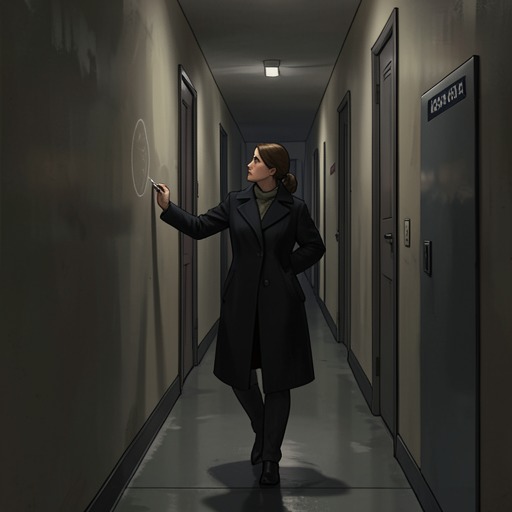
Sarah Raphael—Laurence Arne-Sayles
PiranesiSarah Raphael’s relationship with Laurence Arne-Sayles is an investigative alliance under coercive conditions: she seeks to understand Matthew Rose Sorensen’s disappearance, while Arne-Sayles turns that search into an invitation to repeat Matthew’s attempt to enter another world. His guidance helps Raphael reach the labyrinth, but it also places her inside the theory and method of the man she is investigating.
How Raphael’s Investigation Begins
Raphael explains that Angharad Scott, who had written a book about Arne-Sayles, first alerted the authorities to a possible connection. Six years earlier, Matthew had contacted Scott, said he was considering writing a book about Arne-Sayles, and had spoken with her at length; she then heard nothing further from him. When Scott contacted the London college where Matthew had worked in May, she learned that he was missing and had apparently been so for most of the time since their conversation. Because she knew that other people had disappeared around Arne-Sayles, Scott contacted the police. Her account identifies the missing Matthew as the fourth person in that pattern, or the fifth if James Ritter is included.
The inquiry brought Raphael and her colleagues into contact with people remaining from Arne-Sayles’s circle: Bannerman, Hughes, Ketterley, and Arne-Sayles himself. Raphael describes the encounters as suggestive but difficult to interpret. Tali Hughes repeatedly cried and apologized; Arne-Sayles welcomed the attention; and Ketterley, in Raphael’s assessment, lied whenever he spoke. The group’s investigation thus begins not with a clear explanation but with a network of evasions and an unexpectedly useful source: Arne-Sayles’s willingness to talk.
Arne-Sayles as Informant and Guide
Arne-Sayles had told the investigators that Matthew was in a labyrinth, but Raphael’s colleagues treated this as an attempt to provoke them rather than a credible disclosure. Raphael adopted a different tactic. Since Arne-Sayles liked talking, she let him continue in the hope that he would eventually say something useful. His recorded remarks establish a limited but consequential account: Matthew attempted to enter another world, and something about that attempt caused him to disappear. Arne-Sayles insists that the disappearance was not a simple fall during a ritual, and leaves open whether the process Matthew used should even be called a ritual.
When Raphael asks why Matthew would have tried it, Arne-Sayles supplies a self-aggrandizing explanation. He claims Matthew recognized his greatness and wanted to understand his thinking; in this account, Matthew attempted to reach another world not because he believed Arne-Sayles’s theories, but because he thought the attempt itself would reveal how Arne-Sayles’s mind worked. Arne-Sayles then makes Raphael the next subject of the same argument: she will supposedly attempt the passage for the same reason Matthew did, in order to understand Matthew. He offers her instructions and promises that following them will show her what happened to Matthew.
The guidance is therefore also a form of pressure. Arne-Sayles presents the dangerous procedure as a route to knowledge and frames Raphael’s own curiosity as the motive that will lead her to perform it. His confidence that he can direct her does not make his explanation neutral: he is both the source of information and the person prescribing the means by which she is to test it.
From Instructions to the Labyrinth
Raphael decides that attempting to understand Matthew’s state of mind is not a bad idea. Arne-Sayles tells her how to return to what he calls a pre-rational mode of thought and describes paths that will appear around her, including which path to choose. Raphael initially understands the paths metaphorically; she is startled when she discovers that they are literal. The move from a recorded conversation to an actual route makes Arne-Sayles’s account more than speculative background: his directions have brought Raphael to the labyrinth where Matthew vanished.
Her arrival also establishes a sharp contrast with Matthew’s earlier experience. Raphael hears that Matthew was shocked and frightened when he first arrived, then fell asleep, after which Piranesi was born. The old journal entries that had seemed to record madness are now understood as Matthew’s descriptions of a different world. Raphael’s effort to reconstruct Matthew’s thinking thus converges with the distinction between Matthew and Piranesi: what Arne-Sayles presented as a way to understand Matthew becomes an entry into the place and experience that divided his identity.
Limits and Consequences of Their Connection
Raphael’s account makes Arne-Sayles important to the investigation without making him a reliable guide in any ordinary sense. His claim that he had told the truth about Matthew’s location was dismissed by the other investigators as provocation, and Raphael herself recognizes that his talk may be designed to wind people up. Yet she listens strategically, preserves his remarks on a device, and extracts a practical set of instructions from them. The relationship rests on this tension between deliberate use and exposure to manipulation: Raphael needs what Arne-Sayles knows, while Arne-Sayles uses her desire to understand Matthew to recruit her into his procedure.
The labyrinth’s spatial logic gives that dependence material consequences. Matthew’s path is not an abstract puzzle but a route through named halls and vestibules, where flooding, debris, and jagged marble can make travel dangerous. Elsewhere, 16’s route is traceable because he marks doorways in yellow chalk and repeats directions beneath the doorframes so that a tide or mishap will not erase every copy. Against this precarious system of paths, Arne-Sayles’s promise to show Raphael which way to go carries real force: directions determine access, and access can lead into danger as well as knowledge.
The relation’s final movement is not a completed explanation from Arne-Sayles but Raphael’s use of his instructions to reach the world he described. Later, she accompanies Piranesi toward a corridor whose shadows lie between two Minotaurs; he takes his journals and pens, looks back at the House, and Raphael takes his hand as they enter together. Arne-Sayles has helped set Raphael’s inquiry in motion, but the concluding act belongs to Raphael and Piranesi. His guidance leads toward an answer about Matthew, while the decision to cross the threshold is made by those who must live with its consequences.