Piranesi's rediscovery of his journals
PiranesiPiranesi’s rediscovery of his journals is a destabilizing encounter with evidence of a life that his present self cannot remember or comprehend. An index entry for Stanley Ovenden refers to a journal he believes never existed; examination of the books reveals that the first three were renumbered, and their earlier pages recount people, places, and events that now seem meaningless to him. The journals make his lost past materially undeniable without making it mentally accessible, turning an act of reference into a crisis over memory, identity, and sanity.
The Index and the Impossible Journal
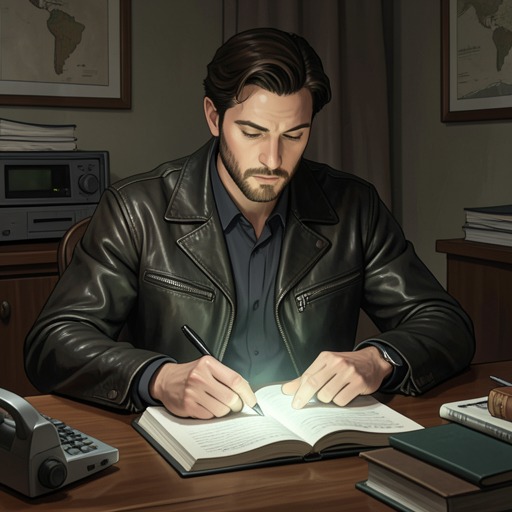
The discovery begins as a routine effort to add individual names to the index of the journal Piranesi is writing. While entering Stanley Ovenden under O, he notices an earlier entry identifying Ovenden as a student of Laurence Arne-Sayles and directing the reader to Journal no. 21. Piranesi is stunned: the Prophet had recently spoken Ovenden’s name, but it had meant nothing to him. The index shows that the name had already been written into his records, even though he cannot recall it.
The reference to Journal no. 21 makes the discrepancy harder to dismiss. Piranesi knows the volume he is currently writing is Journal no. 10, and believes there is no Journal no. 21 and never could have been one. He sees the entry clearly but struggles to form a coherent thought about it. The index therefore presents two problems at once: an unexplained gap in the numbering of the journals and a gap in Piranesi’s own recognition of a name already recorded in his handwriting.
The page contains numerous entries concerning The Other, whose presence in Piranesi’s life is familiar, alongside references to the Prophet and 16, about whom he knows little. But other indexed subjects point beyond the life he believes he has lived. As he forces himself to keep reading, their strange references suggest not a single mistaken entry but a larger record whose contents his present understanding resists.
Evidence in the Journals
The index cites additional volumes that Piranesi believes do not exist: Journals 11, 17, 18, and 20. Even references to Journals 3 and 5, which do exist, become suspect. He wonders whether those numbers refer to different volumes from the ones he currently calls Journals 3 and 5. The writing appears to be his, yet differs subtly from the hand he now uses: the letters are rounder and fuller, the ink thinner and more fluid, and the pen nib broader than any he possesses.
To test the evidence, Piranesi retrieves his journals from the brown leather messenger bag kept by the Statue of an Angel caught on a Rose Bush in the North-Eastern Corner. He finds nine volumes, not the much larger collection he might have expected if the other journals had simply been overlooked. Their covers are black, and he numbers them in white gel pen at the bottom of each spine. Close examination reveals that the first three were originally numbered 21, 22, and 23. Someone scratched away the initial numeral 2 to make them read 1, 2, and 3; the alteration is incomplete, leaving the former number visible as a faint trace.
The physical volumes confirm that the impossible references are not merely errors in the index. Piranesi opens what he calls Journal no. 1, now marked by the remains of its original number, and turns to page 154. There he finds the entry for Stanley Ovenden, dated 22 January 2012 and titled “Biography of Stanley Ovenden.” The journal’s altered labels have concealed the route from the present numbering back to the records that the index cites.
A Past He Cannot Read
The biography describes Ovenden as born in Nottingham, England, in 1958, the son of a father who owned a sweet shop. It records that he studied mathematics at the University of Birmingham, began postgraduate research in 1981, and attended one of Arne-Sayles’s lectures that same year. Shortly afterward, Ovenden abandoned mathematics and began a PhD in anthropology at the University of Manchester under Arne-Sayles’s supervision. These details give the unfamiliar name a specific history, but their places and institutions do not restore Piranesi’s memory. Instead, they belong to a world he can no longer recognize.
Piranesi turns next to page 186 and an entry titled “The disappearance of Maurizio Giussani.” Giussani was never seen again. Arne-Sayles said he knew nothing of what had happened, while the other people present—Ovenden, Bannerman, Hughes, Ketterley, and D’Agostino—reported that Giussani had declined a lift and set off on foot shortly after midnight. The entry adds that the night was warm and moonlit and that Giussani lived about three kilometres away. It then records that, ten years later, after Arne-Sayles was convicted of kidnapping another young man, Italian police reopened the case, before the account breaks off.
The archival account thus widens the discovery beyond Piranesi’s personal history. The journals contain named people, institutional settings, and an unresolved disappearance, all set down in a hand he recognizes as his own. Yet when he reads words such as Birmingham, Perugia, and university, he cannot connect them to anything in his present world. The written record supplies information without supplying comprehension: the pages testify to a former life while remaining opaque to the person who wrote them.
Recognition, Crisis, and Refuge
Piranesi stops reading and stands, shaken by the recognition that his own handwriting contains what he experiences as meaningless material. The Other had warned that he would kill Piranesi if he became mad; the discovery makes Piranesi fear that he may already be mad, or may have been so when he wrote the entries. That conclusion does not resolve whether the journals reveal recovered history or illness. It records the immediate interpretation available to someone confronting evidence his mind cannot absorb.
He does not throw the journal away. He drops it on the pavement and walks off, trying to put physical distance between himself and the evidence. As he moves rapidly through several halls without caring where he is going, the unfamiliar names and places continue to occupy his thoughts. He senses that ideas may be close to entering consciousness, but cannot tell whether they will bring further distress or understanding. The discovery leaves him suspended between rejection of the record and the possibility that it contains a truth he has not yet recovered.
The sequence ends at the Statue of the Faun, the statue Piranesi loves above all others. He has previously understood its finger pressed to its lips as a warning; now he reads the gesture as reassurance. He climbs onto the plinth, embraces the statue, and weeps for what he believes he has lost. The journal has not given him a stable account of who he was. Instead, the contrast between the legible entries and his inability to understand them turns the statue into a place of comfort at the moment when the written evidence makes his own mind seem unfamiliar.