the Prophet's appearance
PiranesiThe Prophet’s appearance is a decisive encounter between Piranesi and Laurence Arne-Sayles: the first time Piranesi meets the old scholar in the House, and the moment he learns that 16 is looking for him. Arne-Sayles offers a theory of the labyrinth’s origin, but his personal hostility toward Ketterley shapes what he does with that knowledge. The meeting is therefore both an intellectual revelation and an act of interference that makes Piranesi’s position more dangerous.
A meeting in the light
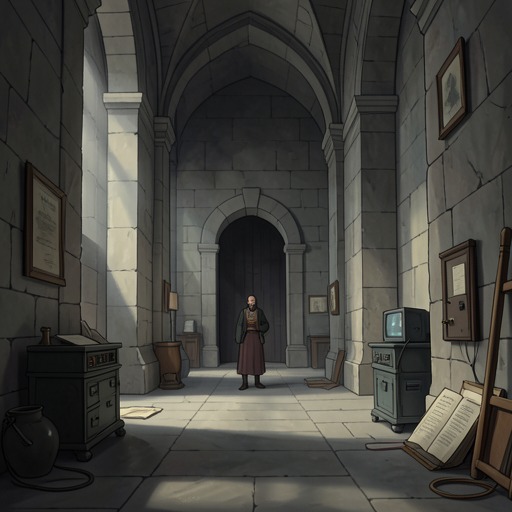
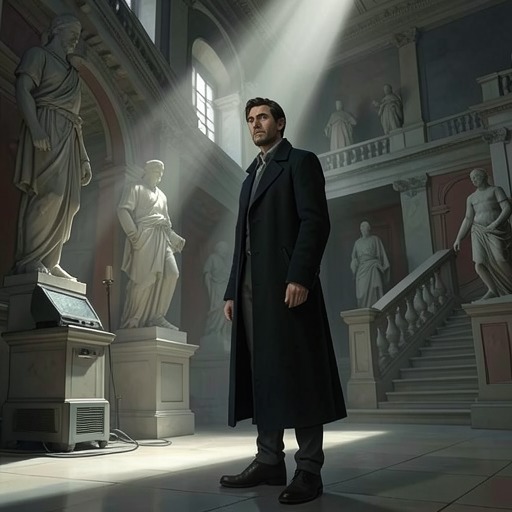
In an entry dated the twentieth day of the seventh month in the year the albatross came to the south-western halls, Piranesi records entering the First North-Eastern Hall through one of its western doors. Shafts of light fell from the windows onto a man standing motionless before the statues, his back turned. The stranger was not The Other: he was thinner and somewhat shorter. Piranesi recognized him as 16, the person he had been warned about, before the man turned to face him.
Piranesi had promised The Other to avoid 16, but the suddenness of the encounter left no time to hide. Rather than run, he approached and slowly circled the stranger, taking in his appearance: an old man with papery skin, thick veins in his hands, large dark eyes, and a long, mobile mouth. His Prince of Wales check suit fitted closely despite its age, sagging and wrinkled from wear. Piranesi had imagined 16 as young, like himself; the reality unsettled that expectation even before the conversation began.
The scholar’s account of other worlds
The man’s explanation begins with his account of an intellectual discovery. As a young scholar, he believed that humanity had lost capacities once possessed by the ancients: transforming into eagles, communicating with rivers and mountains, and feeling the movement of the stars within the mind. He rejected the assumption that whatever was new must be better than what came before. To him, knowledge did not simply vanish; he pictured it as energy flowing out of the world and asked where it might go.
That question led him to suppose that other worlds must exist, and he claimed to have found one: the House. He called it a Distributary World, created by ideas flowing out of another world and dependent, at least in its origin, on that prior world. Whether it still depended on the first world’s continued existence remained uncertain. He said that he had written a book setting out the theory and praised it as a work Piranesi would like, though Piranesi had not read it.
The theory also becomes a way of interpreting the statues. When Piranesi asks whether they might embody ideas and knowledge that flowed from the other world, Arne-Sayles responds with delight, admitting that he had not considered the possibility and judging it highly likely. He imagines that statues of obsolete computers might be coming into existence somewhere in the labyrinth. The suggestion joins the House’s endless statuary to the scholar’s account of knowledge migrating between worlds: the statues may be more than decoration, though the conversation presents this as speculation, not established fact.
Warnings, rivalry, and a redirected search
Arne-Sayles knows the House as a place that can destroy the minds of those who remain too long. He names amnesia and total mental collapse as consequences, and compares Piranesi’s coherence with James Ritter’s severe deterioration after a shorter stay. Yet he has come not simply to discuss his theory. He grips Piranesi’s hand with a cold, bony one, jerks him closer, and delivers the news: someone is looking for him.
Piranesi assumes the searcher is 16, but Arne-Sayles initially treats the number as something he needs to be reminded about. He then confirms that 16 is indeed the person in question and corrects Piranesi’s understanding of the search. According to the Prophet, 16 is not looking for Ketterley, as The Other had said, but for Piranesi. The correction shifts the central danger: 16’s approach is not merely an extension of the feud between the two men Piranesi knows as The Other and 16; Piranesi himself is the intended destination.
Arne-Sayles says that 16 has asked him how to find Piranesi. He has no particular wish to help 16, but is equally eager to injure Ketterley, whom he hates for spending twenty-five years slandering him. His decision to provide 16 with copious, minute directions is thus openly personal. He wants to set the two against each other, despite Piranesi’s plea not to do it and his warning that The Other has described 16 as malevolent. Arne-Sayles dismisses that judgment and acts on his resentment rather than Piranesi’s concern.
Routes into the House and consequences
The Prophet’s account makes clear that entry into the House is not equally accessible to everyone. He says that very few people can reach it unless someone shows them the way. Sylvia D’Agostino, he recalls, seemed able to slip between worlds without equipment; Ketterley, by contrast, struggled even after being shown how and needed candles, uprights arranged like a doorway, and a ritual. That contrast places the House’s thresholds within the encounter’s immediate stakes: directions can enable a search, but passage itself depends on capacities or methods not shared by all.
The wider geography Piranesi has explored gives that problem material weight. He has travelled as far as the Nine-Hundred-and-Sixtieth Hall to the West, the Eight-Hundred-and-Ninetieth Hall to the North, and the Seven-Hundred-and-Sixty-Eighth Hall to the South; he has also seen the cloud-filled Upper Halls, the lily-covered Dark Waters of the Drowned Halls, and the collapsed eastern halls. Yet even after looking through many doorways, he has found no sign that the World ends, only more halls and passages receding into the distance. A set of precise instructions in such an immense place could be consequential precisely because its spaces are extensive, but its routes are also vulnerable to tides and debris.
Piranesi’s own later efforts to follow 16’s path show how directions become usable traces. From the Sixth North-Western Hall toward the First Vestibule, he follows yellow chalk marks placed below his eye level and estimates that 16 is twelve to fifteen centimetres shorter than himself. Beneath each doorway, 16 has recopied the directions so that a tide or mishap destroying one mark will not erase the route. Piranesi admires the methodical care of this redundancy. The meeting’s revelation that 16 is searching for him thus becomes part of a larger contest over route knowledge: the House’s distances can conceal people, while marks and instructions make pursuit possible.
That pursuit carries practical dangers as well as uncertainty. On the path toward the One-Hundred-and-Ninety-Second Western Hall, Piranesi explains that the route passes through the Seventy-Eighth Vestibule, where tides scatter debris from the Lower Halls. Jagged fragments of broken marble can cut feet and lead to infection; passage is possible, but slow and laborious. When The Other asks what has changed since Piranesi crossed there before, Piranesi explains that he once had shoes and now has none. The detail underscores how route knowledge alone cannot guarantee safety: the physical cost of crossing depends on the traveller’s condition and equipment.
Later, when Piranesi’s priority becomes ensuring 16’s safety, he fears that The Other has arranged a trap. He reasons that The Other may have promised to meet 16 at a particular hall and time and to tell her how to find Matthew Rose Sorensen. Piranesi considers searching for The Other the most reliable way to locate 16, but wants to avoid him; he remembers the Prophet’s warning that the closer 16 gets, the more dangerous Ketterley will become. His hope is to find 16 before she reaches The Other. The encounter therefore resounds beyond its immediate scene: Arne-Sayles’s disclosure and deliberate directions shape a later effort to reach 16 first, while the warning turns distance into a measure of escalating danger.
Narrative significance
The encounter is narrated through Piranesi’s journal, so the reader receives the Prophet first as a striking figure in a shaft of light and only gradually as a scholar with a theory, a history of rivalry, and actionable information. That order matters. Piranesi recognizes the number 16 before he understands who the man is, and the physical approach that violates his promise to The Other opens the way to a correction of what The Other has told him. Knowledge arrives through a person whose account is both revealing and compromised by longstanding animosity.
The scene’s central reversal is simple but consequential: Piranesi believes 16 is looking for The Other, then learns that 16 is looking for him. Arne-Sayles’s explanation of the Distributary World broadens the possible meaning of the House, while his personal decision to guide 16 converts speculation and grievance into a route through the labyrinth. The Prophet is not a neutral messenger. His appearance gives Piranesi a more accurate account of the search, but also helps set in motion the pursuit he fears.