The opening and reading of LaMotte’s letter
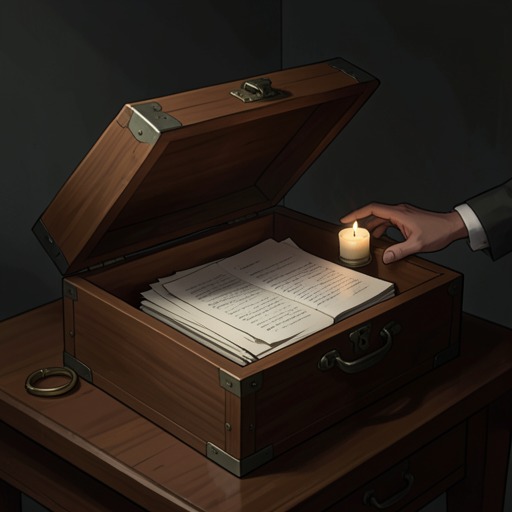
PossessionThe opening and reading of LaMotte’s letter is the decisive revelation in the grave-opening sequence: a sealed message preserved with Randolph Henry Ash’s buried papers tells him, too late to answer, that Christabel LaMotte bore his daughter. The scene makes a private confession public, discloses Maia’s parentage, and brings the pursuit of the correspondence to a human consequence beyond scholarly possession.## Recovery and Opening The discovery begins with Mortimer Cropper working oil into the join of the container and loosening rust with his knife. Beneath the lid lies Ash’s glass specimen container, cloudy and stained but intact. Inside it, the group finds an oiled-silk bag containing a hair bracelet with a silver clasp shaped as two joining hands, a blue envelope holding a long thread of finely plaited pale hair, and another oiled-silk package with a thick bundle of ribbon-tied letters. A separate, once-white envelope is sealed and addressed to Randolph Henry Ash, under cover.
Cropper recognizes the bundle as the love letters LaMotte had described. The sealed envelope, however, raises a question that the group cannot settle: Euan MacIntyre observes that an unopened letter might belong to its sender because it was never received, or to its addressee because it was found in his grave. Before anyone can decide what that uncertainty requires, Cropper takes the envelope and cuts beneath its seal. The act turns the legal and ethical question of ownership into an irreversible disclosure.
The envelope contains both a letter and a photograph. The photograph is damaged and marked: silvery dashes and sooty circles partly obscure a veiled bride carrying lilies and roses beneath a heavy crown of flowers. Leonora Stern associates the image with Miss Havisham and the Bride of Corinth, but Maud begins to understand that its significance is not exhausted by literary resemblance. Euan recognizes that Maud knows the handwriting and urges her to read the letter.## The Letter’s Delayed Confession The reading takes place in a hotel room, by candlelight, before a disparate gathering of seekers and hunters. Outside, wind howls and flying debris rattles the windowpanes as it races over the downs. The storm frames the reading as a moment of exposure: a message hidden for decades is brought into the hearing of people whose separate investigations have converged on Ash and LaMotte.
Addressing Ash as “My dear—my dear—,” LaMotte begins by acknowledging that he is very ill. She says she does wrong to disturb his peace with memories that have arrived unseasonably, but insists that she has something she must tell him. She anticipates his judgment: the truth should have been told twenty-eight years earlier, or perhaps never. She explains that she could not or would not speak then, and that she has thought of him continually and prayed for him. She has known for years that she wronged him.
The central disclosure is direct: Ash has a daughter. LaMotte says the daughter is well, married, and the mother of a beautiful boy; she sends Ash the daughter’s picture. The daughter resembles, LaMotte likes to think, both parents, though neither parent is known to her as such. The revelation joins a concealed past to a living family, while making clear that the truth has been withheld not only from Ash but also from their child.
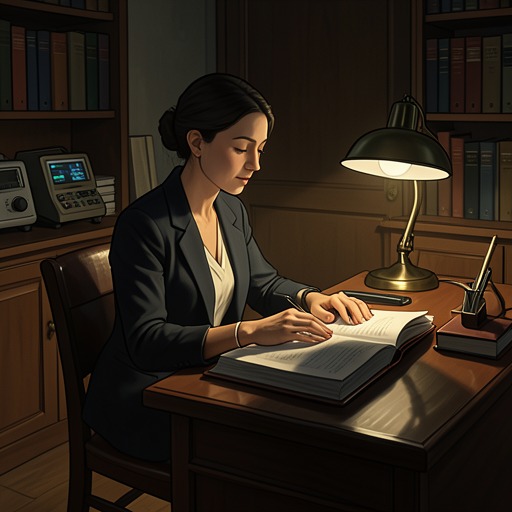
LaMotte distinguishes the bare fact from the account owed to explain it. She says that the history is harder to write than the simple announcement, and frames her obligation as one owed both to Ash and, perhaps, to herself. She has sinned against him, but says there were causes. Her reflection that history consists of hard facts and something else—passion and colour lent by people—makes the letter itself an answer to the novel’s division between documentary evidence and imaginative interpretation. She promises to tell him at least the facts, while the act of writing also supplies the feeling that facts alone cannot contain.## Reading as Public Witness Maud reads aloud in a voice that begins clear and expressionless, like matt glass, but ends with suppressed feeling. The shift registers the passage from handling an artifact to hearing a personal confession. The letter’s words are LaMotte’s, yet their force now passes through Maud’s voice and reaches a roomful of people who have approached the past through research, competition, and pursuit.
At the end, LaMotte asks Ash to send a sign if he is able or willing to do so. She does not dare ask whether he forgives her, then signs her name. The request leaves the letter suspended between confession and unanswered appeal: its intended recipient lies beyond the possibility of reply, and its readers cannot restore the lost exchange. Silence follows the reading. Leonora exclaims in astonishment; Cropper declares that he knew the discovery was something vast. Their reactions establish the scale of the revelation, but the pause also belongs to what cannot be repaired by discovery.## Consequences and Significance The letter resolves the central question of Maia’s ancestry by identifying Ash as her father and LaMotte as her mother. Its account also clarifies the circumstances of Maia’s concealed parentage: she grew up without knowing either parent’s identity, while LaMotte’s message reached Ash only after the long interval she names. The daughter is no longer merely an implication hidden among documents; she appears in the letter as an adult with a husband and child, evidence that the secret has shaped a family across generations.
The setting of the disclosure intensifies the tension between possession and knowledge. Cropper’s handling of the containers and his decision to break the seal produce access to the truth, but access comes through an act that overrides the unresolved question of who owns an unopened letter. The discovery is therefore not a simple triumph of scholarship. It makes private words available to witnesses, while exposing the cost of turning intimate correspondence into evidence.
As a narrative event, the reading converts an archive into speech without dissolving the distance that separates the living from the dead. LaMotte’s letter supplies the facts she says she owes, and it stages her effort to give those facts a history marked by guilt, love, and belatedness. Yet the request for a sign cannot be answered. The disclosure changes what the gathered researchers know about Ash, LaMotte, and Maia; it cannot give the dead couple the conversation the letter was meant to begin.