Theft of Ash’s letters
PossessionRoland Michell’s theft of two letters by Randolph Henry Ash is the novel’s first breach in the archive’s apparently settled order: moved by the letters’ urgency, Roland removes them from the London Library rather than returning them to the book where he found them. His act is at once a scholarly violation and an attempt to protect what feels private from rival claimants. As the papers pass from concealed originals to photocopies, and later into a legal dispute over ownership, the episode opens the novel’s larger question of whether intimate writing can be treated as evidence, property, or a living voice.
Discovery and Removal
Reading Ash’s annotations to Vico, Roland encounters two letters whose urgency unsettles his familiar picture of Ash as a guarded, courteous poet who had lived an apparently peaceable married life. He wonders whether the correspondence continued, whether Ash ever sent a final draft, or whether the effort to write had faltered. The uncertainty matters: the letters may reveal a new aspect of Ash’s meanings, but even their place in a sustained correspondence is not yet certain.
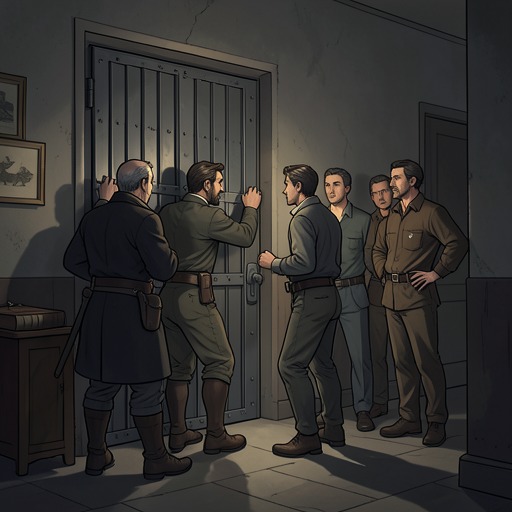
Roland reads the letters again and cannot bring himself to put them back into page 300 of the Vico volume and return the book to its safe. With nobody watching, he slips them between the leaves of his own copy of the Oxford Selected Ash. He then resumes taking notes on the Vico annotations until the library bell ends the study session. The ordinary routine around the theft sharpens its transgression: the staff know him, the notices warn against mutilation and theft, and he leaves as usual, carrying the letters concealed among his books.
The act is not presented as a carefully planned acquisition. When Maud Bailey later asks where the originals are, Roland admits that he took them from a book and did so without thinking. He says that they seemed alive and urgent, that he felt compelled to act, and that he meant to return them. His account does not erase the theft; it identifies the conflict that drives it. Roland recognizes that the letters are not his, but resists treating them as the property of Mortimer Cropper, James Blackadder, or Lord Ash, and insists on their private character.
Copies, Secrecy, and Scholarly Access
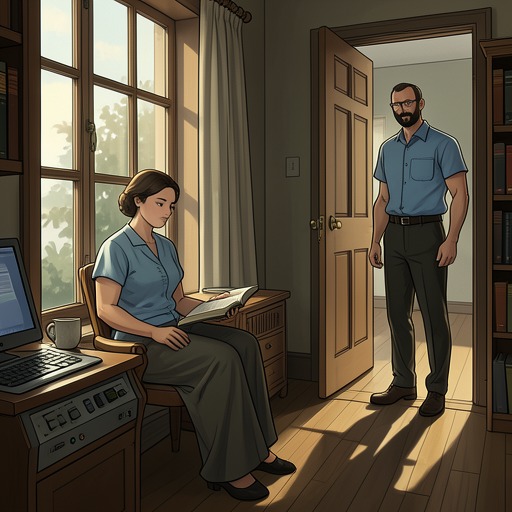
The next morning Roland cycles from Putney to his precarious teaching quarters in Bloomsbury, where he uses the department’s photocopier to reproduce the two letters. He records the copying cost in the departmental notebook, a small act of procedural honesty set against his continuing concealment of the originals. The copies are edged by black fields of empty space, echoing the century’s dust at the edges of the originals; their fresh, gleaming ink makes the absent originals more vivid rather than less desirable.
Although the photocopies give Roland a legible record, he does not regard them as a sufficient substitute. He reflects on his dislike of people enchanted by objects merely because a famous person touched them, recalling Mortimer Cropper’s habit of consulting Ash’s gold watch. Yet Roland himself wants the original letters. His distinction between scholarly reading and the possession of an author’s relic proves unstable: he wants to do the work, to preserve the secret, and to keep the material objects close, all at once.
Roland does not immediately show the find to James Blackadder, whose name he uses to gain access to Crabb Robinson’s diary. He wants to satisfy his own curiosity first and intends to restore the papers, but he also admits that he does not yet want to reveal what he has found. When he finally shows Maud the photocopies, he says that he has shown them to no one else and that no one knows they exist. Their discussion recognizes the stakes: the dates could support a consequential account of Ash and LaMotte, but without further evidence such a story might also be invented. The copies make collaborative inquiry possible while preserving Roland’s unilateral control over the originals.
Ownership, Copyright, and the Letters’ Return
The theft’s ethical and scholarly questions later intersect with a precise legal distinction: ownership of a letter as a physical object is not the same as copyright in its text. Maud explains that her family holds the copyright in Christabel LaMotte’s poems and stories, while LaMotte’s manuscripts—including Melusina, The City of Is, two books of fairy tales, and scattered lyrics—have been deposited at the Women’s Studies Resource Centre in Lincoln. Her family has few letters; one exception is Blanche Glover’s journal, acquired secretly at a Sotheby’s sale before its importance was recognized.
A document discovered among Sophia Bailey’s accounts changes the basis of the claim. LaMotte’s will, dictated to her sister on May 1, 1890, leaves her books, papers, and copyrights to Maia Thomasine Bailey, in the hope that Maia may become interested in poetry. It also records particular gifts of money and property, including a bequest to Jane Summers of Richmond. Euan MacIntyre reports that the accounts show Sophia found Jane and paid the bequest, then retained the will. The document gives Maud’s family a testamentary claim to LaMotte’s manuscripts and copyright, but it does not by itself settle the physical ownership of every letter.
Euan states the governing distinction plainly: the recipient owns the physical letter, while the sender retains its copyright; if a letter is returned, its physical ownership changes accordingly. He argues that LaMotte requested the return of her letters and Ash complied. Roland and Maud, having seen the full correspondence, support that account. Euan therefore presents Maud as heir to the LaMotte letters and almost certainly to the manuscripts of both sides of the Ash correspondence, while copyright in Ash’s letters belongs to Ash’s heirs. The division complicates any simple claim that one person or institution owns the correspondence in every sense.
Consequences and Narrative Significance
When Euan addresses the assembled scholars and family members, he explains that Maud’s father has already given her the manuscripts that came to his ancestress, and that she has deposited them at the Women’s Resource Centre in Lincoln. He also notes the competing pressure created by Mortimer Cropper’s offers to Sir George Bailey and the possibility that Hildebrand Ash has promised Cropper both letters and copyright. The question raised by Roland’s private removal thus becomes a public contest over custody, inheritance, reproduction, and the papers’ future.
The episode establishes a pattern that recurs throughout the novel: access to a document is never merely access to its words. Roland’s photocopies preserve a readable image, but not the original; the original’s possession carries an emotional and scholarly charge that he cannot dismiss. At the same time, the legal history shows that a manuscript can be divided among physical ownership, copyright, testamentary transfer, and institutional deposit. The theft begins as a solitary, impulsive act, yet it anticipates a collective struggle in which claims to private correspondence must be tested against both documentary evidence and the obligations of scholarship.