Hella Lees’s séance and Ash’s confrontation with LaMotte
PossessionHella Lees’s séance and Ash’s confrontation with LaMotte is a pivotal encounter in which Ash’s skepticism collides with the séance’s claims of spiritual communication and with the private grief surrounding a child. The scene’s apparent exposure of trickery does not resolve what Ash hears: the phrase “There is no child” leaves him uncertain about the child’s existence and LaMotte’s meaning, while her later account reveals that her accusation concerned Blanche Glover’s death.
Background and Stakes
Séances had already brought Ash and LaMotte into an uneasy conversation about belief. At a breakfast party hosted by Crabb Robinson, Miss Glover affirmed that spiritual manifestations could occur, while Ash demanded experimental proof. He argued that historical imagination required a poetic belief in the mental worlds of its subjects, a disposition that could leave him with no beliefs of his own. LaMotte declined to state an opinion on spirits. The difference between conviction and uncertainty therefore preceded their later encounter.
Ash’s own position was not simply indifference to the bereaved. In a letter to Priscilla Penn Cropper, he condemned the idea that Samuel Taylor Coleridge’s spirit should be made to perform tricks, and described séances as likely mixtures of fraud and collective agitation. Yet he acknowledged the grief that could make people long to see and hear the dead. LaMotte, by contrast, wrote of the comfort that Mrs Lees’s sittings offered mourners, recalling a mother and father who believed they had held and touched their dead infant. The séance carried both a claim to consolation and the possibility of exploitation.
The Séance and Ash’s Intervention
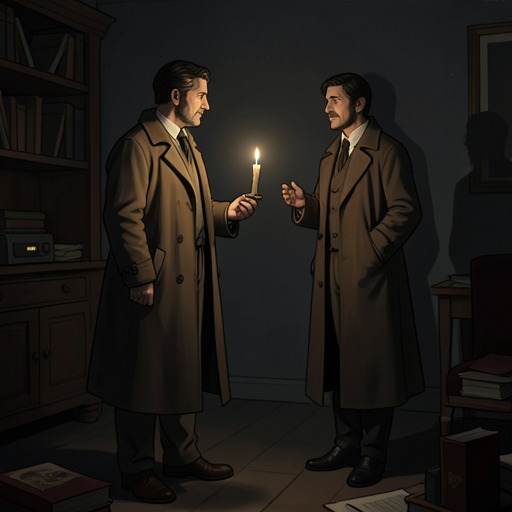
Ash came to a sitting at Olivia Judge’s drawing room after being told that he was wanted there, with his identity and purpose kept from the other participants. Mrs Lees later described feeling his skeptical presence as a chill, while also sensing an unusual spiritual force beneath his skepticism. Ash told her that spirits spoke to him through language. The circle included LaMotte among the women of the Vestal Lights; the participants sat around a table in near darkness, holding hands.
According to Judge’s notes, the sitting turned unsettling. A voice refused to identify itself, denied that a child was present, and made other taunting remarks. The participants reported noises and apparent touches. A voice then offered gifts of reconciliation, and a white hand appeared with a wreath. As Mrs Lees moved toward an inner room with two women, Ash cried out and reached for the supposed manifestation, demanding light. The medium collapsed, and Ash was found holding her wrist. His action interrupted the séance and exposed what he believed to be a performance, but the episode’s records preserve conflicting accounts rather than a final, independent explanation of every manifestation.
Ash later described his intervention as his “Gaza exploit.” He said that he had seized a floating wreath and found himself holding Mrs Lees’s hand, then pulled at the apparatus and brought down the séance’s effects. In his account, the incident revealed concealed means behind the manifestations. Its force for the plot, however, lies not only in Ash’s skeptical demonstration: his interruption also made the séance a direct encounter with LaMotte and with the question of the child.
The Accusation and Its Misreading
The words spoken through Mrs Lees—“There is no child”—became inseparable for Ash from the unresolved question of whether LaMotte had a child and whether the child was his. He could not determine whether the utterance arose from cunning, involuntary speech, or telepathy. In a letter that he did not send, he recalled another terrible sentence from the séance: “You have made a murderess of me.” He feared that he himself might become a murderer, and understood the words through the pressure of guilt and uncertainty.
LaMotte’s later explanation changes the meaning of that accusation without making the séance less consequential. She wrote that she had spoken of Blanche, whose death tormented her, not of a child she had killed. She also recognized that Ash had interpreted her words as an accusation about their child. Rather than correct him at the time, she allowed the misunderstanding to stand, acknowledging that her illness, anger, and residual love had shaped that choice. The séance thus turned an ambiguous utterance into a lasting separation between what LaMotte meant and what Ash believed he had heard.
Consequences and Significance
The encounter belongs to the history of Ash and LaMotte’s estrangement, but its consequences exceed their disagreement over spiritualism. In LaMotte’s account, the séance occurred after their last meeting; she remembered Ash as angry and herself as wounded by his response. She connected her accusation to Blanche’s death and admitted that she let Ash mistake its target. Ash, meanwhile, carried the words as evidence of a possible catastrophe involving their child. The same scene consequently held grief for Blanche, uncertainty about the child, and the lovers’ unspoken accusations.
Later, James Blackadder conjectures that Ash’s poem Mummy Possest was directed at LaMotte’s association with Hella Lees and that Ash thought she was trying to communicate with her dead child. This remains an interpretation rather than a settled account, and the séance’s layered testimony sustains that uncertainty. The scene makes the limits of both scientific skepticism and spiritual belief visible: Ash may expose a mechanism, yet the human meaning of the words spoken in the dark remains unresolved. Its decisive revelation comes through LaMotte’s later letter, which identifies Blanche as the subject of her accusation while showing how the séance helped preserve the misunderstanding between them.