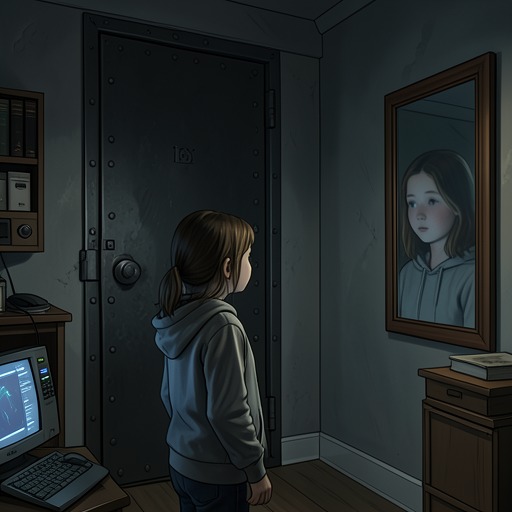
Emsie St. Juarez Children's Hospital
REEmsie St. Juarez Children's Hospital is the decisive site of Tabitha Moore’s time-displaced return to 1998. Its prototype MRI device first appears as a supposedly proven medical technology and then becomes the mechanism of an impossible temporal rupture: a sixty-year-old Tabitha, suffering persistent migraines in 2045, is sent back into the body of the thirteen-year-old girl undergoing examination after a middle-school head injury. The hospital therefore anchors the book’s central paradox. It is meant to diagnose damage and restore certainty, yet within its walls technology makes identity, chronology, and even legal death unreliable.
Setting and First Medical Crisis
The hospital is introduced through the prototype MRI room, whose copper-lined walls are designed to shield the scanner from radio interference. The room’s technical insulation does not protect its occupants from catastrophe. The machine produces an extraordinarily loud screech, compared to scraping glass and nails on a chalkboard, before an electrical breaker blows out; the disturbance is powerful enough to make people within a quarter-mile flinch and to cut power across Jefferson County. The event gives the hospital a civic scale as well as a medical one: an apparatus intended for one patient disrupts the surrounding county. The immediate physical conditions turn the examination room into a trap. When backup generators restore power, the enclosed space has risen more than thirty degrees in temperature and is filling with smoke. Tabitha remains inside the scanner, screaming, while the fire alarm activates and the people outside force open the door. A familiar male voice orders that she be removed, and several people pull the examination table from the MRI’s cylindrical opening. The scene converts a clinical procedure into an emergency rescue, with the hospital staff and family compelled to respond to the machine as a dangerous object rather than a neutral instrument.
Temporal Displacement and Recognition
The hospital’s most consequential event is not merely the MRI malfunction but the temporal displacement that follows it. Tabitha initially experiences the aftermath as a bodily transformation, finding her fingers swollen and her entire body seemingly shrunken and misshapen. The apparent physical distortion becomes intelligible only when the clues converge: she has not been deformed but made younger. She recognizes herself as the thirteen-year-old version she remembers as “TUBBY FUCKING TABBY,” a self associated with shame, weight, and the social identity of “trailer trash.” The hospital’s outdated surroundings help make the displacement legible. Tabitha expects the University of Louisville Hospital of her own era, but the sterile plastic panels and other old-fashioned features reveal that she is somewhere historically earlier. Alan Moore identifies the facility as Emsie St. Juarez Children’s Hospital and recalls its large sculptures in the fountain. When Tabitha asks for the date, a doctor checks her chart and gives it as Thursday, May seventh, 1998. The institution thus supplies the first external confirmation that her private impossibility is real: the architecture, the family member before her, the chart, and the date all contradict the future she remembers.
Medical Authority and Unstable Diagnosis
The hospital also establishes the book’s recurring conflict between lived bodily experience and institutional description. After the MRI accident, medical staff consider whether trauma might have caused short-term memory loss, while Alan Moore angrily describes the machine’s violence and Tabitha’s exposure to it. Tabitha, however, understands that the central problem is not memory failure but comprehension of a situation that medicine has no category for. Her adult consciousness is present inside a child’s body, yet the surrounding adults must interpret her through ordinary assumptions about concussion, confusion, and age. The same institution becomes important again when Tabitha’s later injury is misread as irreversible death. After the hospital treats her head trauma, she is declared brain dead and believed to be in a permanent vegetative state. Life support is withdrawn, and her family waits for her to die while she receives final visitors. The apparent certainty of the diagnosis is overturned when she begins to move, furrow her brow, quicken her breathing, and whisper for help. A doctor tells her that she has been legally dead for two days and treats the resulting death certificate as an extraordinary medical record. The hospital therefore preserves an official account that cannot contain what happened to her: Tabitha has been classified as dead while still capable of suffering and communicating. The clinical history later supplied to Tabitha makes the contradiction more precise. Blood from the injury has clotted, and the clot is considered dangerous, but the swelling and its position make invasive surgery unfavorable. An endoscope and a small incision allow a surgical bypass to drain excess fluid. The clot disappears, but so does the brain activity visible to observers, producing the fear that she has been lost permanently. The hospital’s procedures save her body while its measurements lead others to mistake the state of her consciousness. Diagnosis remains necessary, but it is repeatedly shown to be partial and vulnerable to the extraordinary conditions surrounding her.
Later Meaning in Tabitha’s Life
When Tabitha explains her history to Alicia Brooks and Elena Seelbaugh, she identifies the MRI as the link between her two lives. In her remembered future, she studies at Northern Kentucky University, works for years at the Safety plant in Fairfield, and eventually develops persistent migraines. After Springton repeatedly prescribes medications without resolving them, she insists on a more thorough examination in Louisville and enters a large custom MRI machine at age sixty. Something in that later procedure sends her mind backward to the earlier machine at Emsie St. Juarez, where her thirteen-year-old self is being examined for the concussion caused by being pushed from a trampoline. The explanation gives the hospital a doubled temporal identity. It is both the origin point perceived by the younger Tabitha and the destination toward which the older Tabitha’s memories travel. Alicia interprets the discovery as evidence that the MRI is a time machine, while Tabitha cautiously limits the claim, saying that it has at least sent her mind backward and that the process may depend on her past self having interacted with the machine. The hospital is consequently less a completed explanation than a site of unresolved causality, where technology, memory, and bodily matter intersect without becoming fully intelligible.
Narrative and Thematic Significance
As a location, Emsie St. Juarez Children’s Hospital concentrates several of the novel’s central reversals. The children’s hospital contains an adult mind in a child’s body; the diagnostic machine produces injury instead of clarity; the medical chart records a date that overturns the protagonist’s understanding of reality; and the institution later declares Tabitha dead before she returns to consciousness. Each reversal makes the hospital a place where official categories lag behind experience. Its significance also extends beyond the MRI itself. The hospital is where Tabitha’s body becomes the contested evidence through which other people decide whether she is injured, confused, comatose, legally dead, or alive. Her later identity crisis arises from being thirteen in the past while carrying memories of an adult future, and the hospital provides the technological and narrative condition for that mismatch. Even after she leaves, the institution remains present as a source of medical records, disputed diagnoses, and the unanswered possibility that her neurological signals have crossed time. Emsie St. Juarez Children’s Hospital is therefore not simply the setting of an accident; it is the novel’s threshold between treatment and harm, childhood and adulthood, memory and history, and biological life and the categories used to define it.