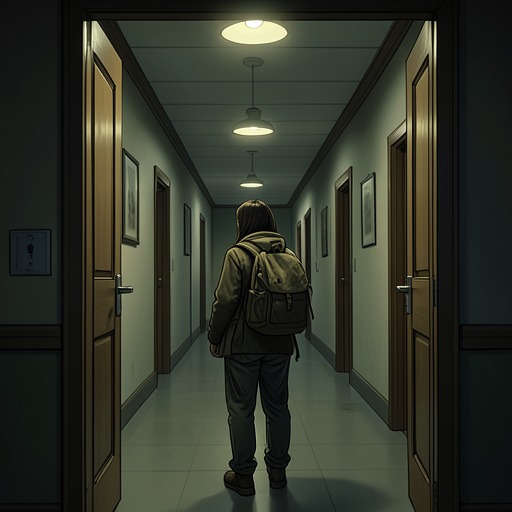
Ireland Army Hospital
REIreland Army Hospital is the military hospital approximately fifty minutes outside Springton where Ashlee Taylor and Brittney Taylor are taken for psychiatric treatment after the Taylor family’s abuse and instability come to light. Rather than serving as a distant European setting suggested by its name, it is an “ugly army hospital” reached by a long drive, and its repeated appearance gives the Taylor family’s crisis a concrete institutional setting.
Setting and Function
Ireland Army Hospital becomes part of the family’s weekly routine. Ashlee and her sisters are driven there by Aunt Kimberly, sometimes with Brittney accompanying them and sometimes without her, for appointments with a psychiatrist or another mental-health professional. The visits consist of long, tedious drives, waiting, and awkward sessions in which the clinician tries to make Ashlee discuss the experiences and problems shaping the Taylor family. The hospital therefore functions less as a single dramatic destination than as a recurring checkpoint in the family’s uncertain movement away from abuse.
The location also sharply contradicts Ashlee’s childish misunderstanding of its name. She initially imagines the green countryside of Ireland, but the actual destination is a plain military hospital outside Springton. That mismatch reinforces the book’s habit of replacing imagined explanations with uncomfortable local realities: the hospital is not an escape into another country, but a nearby institution where the consequences of the Taylor family’s situation must be confronted.
Treatment After the Family Crisis
The hospital is associated with Erica Taylor’s psychiatric intervention and with the family’s attempt to understand what has happened to her. Ashlee hears that Erica has been started on lithium to stabilize her moods and briefly misunderstands the treatment as something like a lobotomy or a “mind-wipe.” Brittney makes the same cruel comparison after speaking with Erica, describing her confusion and difficulty putting on her pants as evidence that she has become childlike. Aunt Kimberly corrects the misunderstanding, explaining that Erica is not lobotomized and that initial confusion or sluggishness can occur while treatment begins.
The hospital’s role is consequently double-edged. It provides medical care intended to stabilize Erica, while also exposing how poorly the family understands psychiatric treatment and how readily fear becomes ridicule. The girls’ language reduces complex symptoms to insults, but the repeated journeys and clinical sessions establish that the family’s problems require sustained intervention rather than a quick punishment or a simple return to the old household arrangement.
Ashlee Taylor’s Experience
For Ashlee, Ireland Army Hospital is a place of enforced testimony. She hates the drives, the waiting, and the sessions in which the child psychologist tries to draw out what is wrong. She wants to be left alone, yet she also recognizes that returning to the previous family arrangement would be impossible and dangerous. The hospital thus occupies an uncomfortable middle ground: the old life is no longer acceptable, but the new one has not become reassuring.
The psychologist’s office intensifies that uncertainty. It is several floors up and windowless, decorated with toys and children’s posters despite the clinician’s professional clothing, and even contains a green plastic sandbox shaped like a turtle. The setting makes Ashlee feel that she is being treated as a child while being asked to speak about adult failures and family violence. When the psychologist asks whether Ashlee still considers Tabitha Moore her friend, Ashlee cannot give a settled answer, showing how the surrounding crisis has unsettled not only family relationships but also her understanding of loyalty and identity.
Institutional Care and Unresolved Consequences
Ireland Army Hospital does not erase the damage created by the Taylor sisters’ abuse of Ashlee Taylor and Tabitha Moore. Instead, it marks the beginning of a prolonged and awkward process of assessment, medication, and conversation. Ashlee remains frightened and uncomfortable, while Erica’s altered behavior makes the family unsure how to relate to her. The hospital’s recurring journeys therefore register change without promising immediate repair.
In the wider structure of the novel, the hospital contrasts with the medical institutions connected to Tabitha Moore’s time displacement and brain injury. Tabitha’s experiences involve an MRI accident, brain death, legal death, and unexpected recovery, while the Taylor family’s visits involve psychiatric diagnosis and the slow work of making trauma speakable. Both strands question who has the authority to name a person’s condition: doctors and institutions supply diagnoses, but the affected characters continue to experience pain, confusion, and identity disruption that medical language cannot fully contain. Ireland Army Hospital’s significance lies in this tension between necessary care and the alienating procedures through which care is delivered.