University of Louisville Hospital
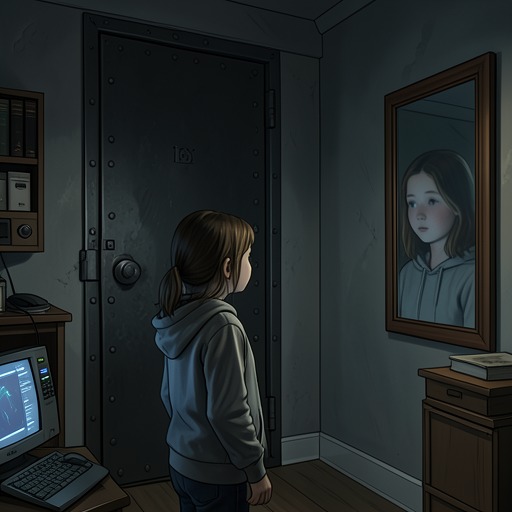
REUniversity of Louisville Hospital is the 2045 medical complex where Tabitha Moore’s recurring headaches lead to the examination that sends her consciousness back to 1998. Its most important feature is an exceptionally old prototype MRI, a machine whose apparent diagnostic superiority and unexplained history make the hospital both a center of medical expertise and the gateway to the novel’s time-displacement crisis.
Definition and Setting
University of Louisville Hospital appears first as a hypermodern hospital complex in 2045, with glossy white walls, futuristic fixtures, and holographic menus projected by a nurse’s wrist ring. The setting’s technological confidence contrasts sharply with the enormous old-fashioned MRI at its center. Although the machine is nearly half a century old, the nurse claims that it can read extremely fine deep-tissue electrical activity and detect individual neurons as they fire, producing more comprehensive scans than newer equipment.
The machine remains in service because its patent holder has not released the technology’s rights, while University of Louisville Hospital possesses a legal loophole allowing continued use. This combination of advanced capability, restricted ownership, and institutional exception gives the hospital an atmosphere of technical brilliance surrounded by unresolved legal and historical limits. The device is not presented as an ordinary obsolete object: its age is precisely what makes it unusually powerful and ominous.
The Prototype MRI and the Forty-Seven-Year Echo
The hospital’s MRI has a recorded history of one serious mishap forty-seven years before Tabitha’s 2045 examination. That seemingly reassuring interval becomes a temporal clue. Tabitha first hears the incident described as an isolated accident, but the number prompts her to recognize a connection with the 1998 prototype MRI incident at Emsie St. Juarez Children’s Hospital, where her thirteen-year-old self is undergoing examination after a concussion.
In the earlier incident, the prototype MRI emits a tremendous screech like scraping glass before an electrical breaker blows. The disturbance is painful to people within a quarter-mile of the children’s hospital and causes a power failure across Jefferson County. The MRI room rapidly overheats and fills with smoke while young Tabitha remains trapped inside, screaming as the equipment fails around her. The parallel establishes that the University Hospital machine is not merely old; it belongs to the same dangerous technological history as the device that first fractured Tabitha’s life.
A Hospital at the Center of Time Displacement
Tabitha’s 2045 scan becomes the mechanism through which her mind returns to her childhood body in 1998. She later explains that the large custom MRI sent her mind backward in time, into the same machine during the earlier examination. Her interpretation is cautious rather than triumphant: she believes the transfer required her past self to have interacted with the machine at that earlier moment, and she is unsure whether the process moved only consciousness, memories, or some form of neural and electrical signal.
The hospital also returns during the second MRI crisis, when Tabitha’s experience becomes unstable and dreamlike. In a distorted flight through a junkyard F-22, the aircraft’s canopy transforms into the cylindrical opening of the prototype MRI at University of Louisville Hospital. Medical personnel struggle to pull her from the failing machine while the fighter’s engine noise becomes the MRI’s metallic shriek. Her old body is shown with blood flowing from her nose as black smoke clogs the enclosure, linking the hospital’s technology to both physical injury and the collapse of ordinary space and time.
The hospital therefore functions as a recurring threshold rather than a stable destination. It is where future medicine investigates Tabitha’s migraines, where the machinery reproduces the sound and danger of the 1998 accident, and where her memories, dreams, and bodily states become impossible to separate. The hospital’s apparent modernity cannot contain the event it produces; its most sophisticated instrument instead exposes the limits of medical certainty.
Diagnosis, Brain Death, and Medical Authority
The hospital’s significance is also defined by the conflict between clinical description and Tabitha’s lived experience. After the later MRI disaster, Tabitha is declared brain dead and believed to have no possibility of recovery. She is described as being in a permanent vegetative state, removed from life support, and visited by a grieving family waiting for her death. Yet her body begins to move, her expression becomes troubled, and she eventually whispers for help.
A doctor tells her that she has been legally dead for two days, even though she has returned to consciousness. The statement creates several competing identities for the same patient: a living adolescent, a legally dead person, a brain-dead body, and a speaker capable of answering questions about pain. University of Louisville Hospital’s authority is therefore powerful but incomplete. Its doctors can name and manage Tabitha’s condition, but the narrative repeatedly demonstrates that their categories cannot fully account for her survival or for the memories carried across timelines.
The hospital’s medicine is nevertheless concrete and consequential. Tabitha’s intracranial bleeding has clotted before her arrival, but the clot is dangerously positioned amid swelling caused by the head trauma. Doctors use an endoscope through a small incision and perform a surgical bypass to drain excess fluid, then observe her while determining what will happen to the clot. The clot disappears, but her apparent brain activity disappears with it, producing the fear that she has been lost permanently. Tabitha later suspects that the abnormal circumstances of her time displacement somehow carried the clot into another timeline, an idea she recognizes as impossible by ordinary standards but consistent with the fact that time travel has occurred.
Place, Memory, and Narrative Significance
When Tabitha later returns to University of Louisville Hospital in 1998 with Sandra Williams and Hannah MacIntire, the location becomes a physical measure of time’s alteration. The hospital grounds look ancient to her because the buildings she remembers from 2045 do not yet exist. The Cardiovascular Innovation Institute, the Clinical Translational Research building, and other modern structures are absent, leaving her confronted with an earlier version of a place she had visited only months before in her original life.
That recognition gives the hospital an unusual double status. It is both a familiar location from Tabitha’s future and an unfamiliar historical site in her new present. She can navigate it through memories that no one else possesses, yet those memories do not make her secure; they intensify her awareness that she has lived a life that the surrounding world has not reached. The hospital becomes a landmark of temporal dislocation, preserving the continuity of the machine while exposing the discontinuity of Tabitha’s identity.
The location also remains connected to public witnessing. After Tabitha and Alicia Brooks rescue Officer Darren MacIntire from a shooting, the injured officer is airlifted from Springton General Hospital to University of Louisville Hospital and remains in critical condition. The hospital thus receives not only Tabitha’s impossible medical case but also the consequences of ordinary violence, serving as the larger regional institution to which endangered bodies are transported.
University of Louisville Hospital ultimately embodies the book’s uncertainty about progress. Its futuristic environment, holographic interfaces, and legally protected scanning technology suggest medical advancement, yet its decisive instrument is a decades-old machine that repeats catastrophe. Its diagnoses are authoritative but revisable; its procedures save Tabitha’s body without explaining her mind; and its buildings change across time while the MRI remains a fixed point. The hospital is therefore the novel’s most important meeting place between technology and trauma, where the promise of scientific knowledge opens into a mystery that medicine can record but not fully explain.