Springton General Hospital
RESprington General Hospital is the setting in which Tabitha Moore’s medical story changes from presumed death to inexplicable survival. More than a backdrop for treatment, it is the institutional space where her body is classified, mourned, examined, and gradually returned to speech and relationship. The hospital’s rooms and corridors hold competing versions of the same girl: a patient declared permanently comatose, a living teenager struggling to communicate pain, and a time-displaced survivor whose experience cannot be fully contained by clinical language.
Definition and Setting
Springton General Hospital serves as the local hospital connected to Tabitha Moore’s recovery after the prototype MRI incident and the later stages of her rehabilitation. Its wards include small patient rooms, bright hallways, reception and waiting areas, examination facilities, and rooms where doctors and nurses monitor patients whose conditions remain medically uncertain. The hospital is also a social setting: family members wait there, friends visit, staff mediate access to patients, and conversations that could not occur elsewhere are forced into the controlled atmosphere of medical care.
The hospital’s importance is intensified by its contrast with the Emsie St. Juarez Children’s Hospital, where the prototype MRI accident begins. At Emsie St. Juarez Children’s Hospital, the MRI room becomes dangerously hot, fills with smoke, and loses power after a violent electrical disturbance. At Springton General Hospital, the aftermath is translated into diagnoses, observation, visiting hours, surgery, pain scales, and decisions about life support. The movement between the two hospitals therefore marks a movement from technological catastrophe into institutional interpretation.
Death, Diagnosis, and Reversal
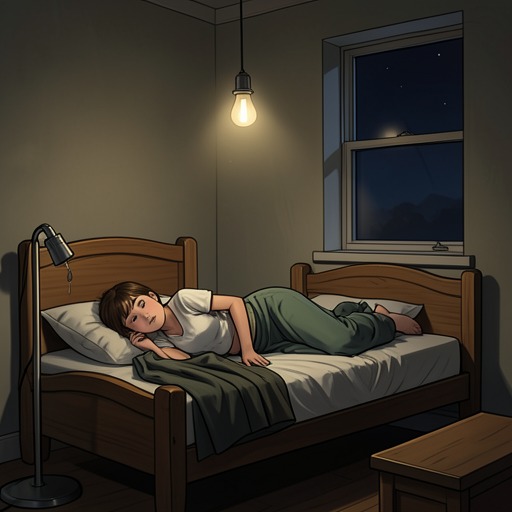
At Springton General Hospital, Tabitha Moore is treated as a patient who has already been lost. She has been declared brain dead, removed from life support, and placed in a persistent vegetative state that physicians and relatives believe will end only with her quiet death. For several days, her apparent serenity allows the Moore family to gather for final visits while grief settles around the expectation that she will not recover. The bandages around her head are nearly the only visible signs that a catastrophic injury has occurred, which makes the later disturbance of her body more alarming.
The expected ending is interrupted when Tabitha begins to jerk, furrow her brow, squeeze her eyes shut, and breathe more rapidly. Her lips tremble as she attempts to call for help, producing broken sounds that the people around her can barely understand. The scene turns the hospital’s previous certainty inside out: the body categorized as permanently unresponsive begins to assert a distressed, subjective experience. Her awakening is not presented as a clean miracle. It arrives through pain, confusion, and the difficult work of making a voice audible again.
A doctor explains that Tabitha has been legally dead for two days, a fact that makes her recovery both a medical anomaly and a legal contradiction. When asked to rate her pain, she answers six and warns that it is rising toward seven. The exchange gives her a measurable clinical identity while also demonstrating the limits of measurement: the number records intensity, but not the impossible fact that the speaker should not be speaking at all. Springton General Hospital thus becomes the place where legal death and lived consciousness occupy the same case.
Treatment and Rehabilitation
After regaining consciousness, Tabitha remains physically vulnerable. She has severe head trauma, a fractured wrist and hand, and a history of intracranial bleeding associated with the earlier trampoline injury. The hospital’s treatment accounts for the danger in precise medical terms. The clot had formed before she reached the hospital and was in an unfavorable position for a more invasive procedure; an endoscope and a small incision were used to create a surgical bypass and drain excess fluid. The clot eventually disappeared, but the apparent disappearance of brain activity led staff and family to fear that the operation had failed in the most final way.
Her later explanation of the injury shows how hospital care becomes part of her attempt to reconstruct what happened to her body. She describes the removal of cerebrospinal fluid, the small incisions, and the lifting of a tiny portion of impacted bone. The account refuses both melodrama and easy reassurance. Tabitha survived, but survival includes observation, pain, restricted movement, a wheelchair, and the need to have a proper cast placed back on her wrist for several months so that the hand will heal correctly.
The hospital also records the social consequences of disability. Tabitha cannot simply resume ordinary movement or conversation; she depends on staff, relatives, and visitors while her body remains slow, painful, and unreliable. During one visit, Karen Williams is present when a nurse arrives to take Tabitha for another procedure. Tabitha quickly identifies Karen as one of her mothers and asks her to accompany her. The statement transforms a clinical escort into an affirmation of chosen family, showing that rehabilitation at Springton General Hospital involves recognition and belonging as well as tissue repair.
Visitors, Witnesses, and Family Encounters
Springton General Hospital gathers the people who must respond to Tabitha’s changed condition. Her mother, Shannon Moore, is present when Tabitha opens her eyes and calls for her. Shannon rushes to the bedside, takes Tabitha’s heavy hand in both of hers, and reassures her that she is there. The scene reconnects mother and daughter through touch before either can make sense of the medical impossibility surrounding them.
The hospital is also where Elena Seelbaugh and Alicia Brooks visit Tabitha. Elena arrives burdened by guilt and uncertainty, convinced that some hidden truth must explain what has happened but unable to identify a secret that could excuse her own wrongdoing. Alicia refuses to disclose information that is not hers to reveal, leaving the explanation to Tabitha. Their walk through the bright hospital hallway turns the institution into a threshold between secrecy and testimony: Elena’s altered clothing and aggressive manner express a changing identity, while Tabitha’s room becomes the place where that identity will be tested against the truth.
Other encounters make the hospital a place of mutual witnessing. Karen Williams brings Tabitha to see Officer Darren MacIntire, who is still recovering with an IV stand beside his bed after the shooting. He looks older, bears a beard, and carries visible signs of what the ordeal has cost him. Tabitha, herself recovering from a life-threatening injury, sees the survivor behind the public image that had appeared repeatedly on the news. Their meeting links two damaged bodies and two recoveries without reducing either one to a symbol.
Pamela Cribb also visits and promises that she and others will take care of a distressed girl connected to the wider crisis. Her apology, concern, and promise to return reinforce the hospital’s role as a temporary community of responsibility. Patients do not recover there alone; their care is distributed among relatives, friends, staff, and witnesses who must decide how to respond when ordinary explanations fail.
Narrative Significance
Springton General Hospital concentrates the book’s conflict between medical authority and personal knowledge. At first, institutional language appears decisive: brain death, permanent coma, life support withdrawn, and legal death all define Tabitha from the outside. Yet her returning voice and self-report destabilize those definitions. The hospital does not simply reject medicine; doctors treat her pain, monitor her condition, explain the surgery, and support her rehabilitation. Instead, the narrative shows that clinical knowledge can be accurate within its procedures and still incomplete before an experience that violates its assumptions.
The hospital’s most important function is therefore epistemological. It is where a machine-generated catastrophe is converted into a medical case, where a family’s grief is organized around professional conclusions, and where the patient’s own testimony eventually forces a revision. Tabitha later explains that, at age sixty, persistent migraines led her to a custom MRI in Louisville, which sent her mind back to the 1998 machine while she was a thirteen-year-old girl receiving treatment for the trampoline concussion. Springton General Hospital cannot verify that account, but its earlier failure to distinguish legal death from returning consciousness prepares the reader to understand why ordinary diagnostic certainty may not be sufficient.
As a location, Springton General Hospital embodies both containment and passage. Its rooms confine Tabitha while she is weak, yet its doors repeatedly open onto family reconciliation, new forms of friendship, testimony, and future movement. The hospital is where death is announced and reversed, where injury becomes a story that can be told, and where recovery begins not as a restoration of the old self but as the first public evidence that Tabitha’s impossible second life has become real.