Springton High School
RESprington High School is more than the setting for Tabitha Moore’s brief return to formal education: it is the public institution that turns her unexplained transformation into spectacle, exposes her to organized cruelty, and then attempts—too late and imperfectly—to make itself accountable. Her first day promises intellectual ease and social possibility, but the school soon becomes associated with surveillance, rumor, stolen work, administrative crisis, and the decision to leave. Through Springton High School, the narrative examines how an institution can recognize a student’s value while failing to protect her until the damage has already become irreversible.
Setting and First Arrival
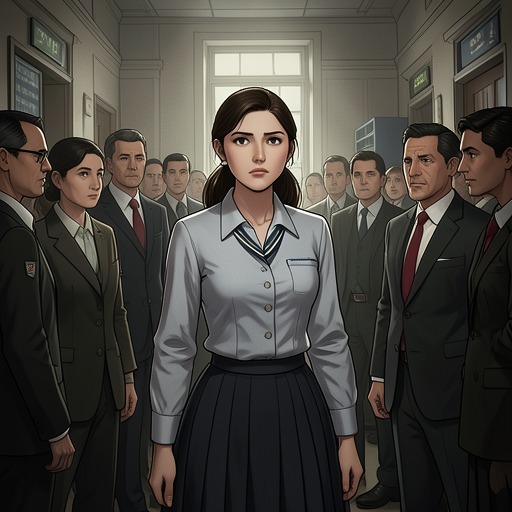
Springton High School is introduced through Tabitha’s arrival as a returning figure entering a place that is both familiar and estranged. She had hoped to experience the school as an old alma mater revisited, but stepping from the bus into the commons instead produces a sharp sense of stage fright. Students turn their heads, boys gesture to one another, girls assess her, and an older staff member offers a greeting that only intensifies her awareness of being watched. The building therefore functions immediately as a social stage: Tabitha is not allowed to enter anonymously, because her changed appearance and behavior make her conspicuous before she has spoken to anyone.
That attention is not uniformly hostile. During the first several classes, Tabitha thinks the day is going well. The coursework is vaguely familiar, and a small amount of review restores knowledge she already possesses. The textbooks, heavy and outdated from her perspective, seem like unnecessary remnants of a pre-digital era, but the academic material itself presents no serious obstacle. Springton High School is thus established as a place where Tabitha could excel almost effortlessly, even as her social surroundings remain unstable. Her intellectual advantage is real, but it also separates her from the ordinary expectations attached to a freshman.
Social Atmosphere and Emerging Isolation
The school’s attention develops into a social environment that is simultaneously curious, hostile, and hungry for explanation. Girls are often distant or openly antagonistic without an identifiable reason, while several boys make crude advances before most of them retreat into observation. Tabitha spends lunches with Alicia Brooks, briefly interacts with Elena Seelbaugh, and otherwise keeps to herself. Her limited social circle becomes part of the school’s mythology: because she does not behave in the familiar ways expected of a teenager, classmates fill the silence with speculation.
The rumor network grows especially powerful after Tabitha leaves. By the time Bobby Anderson encounters her at a convenience store, she has become known at Springton High School as the mysterious freshman dropout. Students circulate the theory that she withdrew because she was pregnant, treating that invention as an explanation for both the bullying and the violence directed against her. Other rumors connect her to Erica Taylor, Matthew Williams, occult interests, and supposed family influence. The competing stories do not clarify Tabitha’s circumstances; they make her absence more conspicuous. Her withdrawal transforms her from a student into an urban legend whose identity is controlled by people who barely knew her.
The school’s gossip also reveals a distorted form of institutional visibility. When students such as Chris Thompson, Kaylee Mendolson, Clarissa Dole, Brittney Taylor, and Erica Taylor are suspended or threatened with expulsion after targeting Tabitha, their punishment convinces some classmates that she must have powerful parents or special protection. This interpretation is as inaccurate as the pregnancy rumor, but it demonstrates how disciplinary action becomes another source of speculation. Springton High School’s response does not restore Tabitha’s privacy; it enlarges the mystery surrounding her.
Harassment, Investigation, and Institutional Response
The conflict becomes explicit when Tabitha is called outside by school officials and the school board begins addressing the conditions that made her withdrawal feel necessary. Pamela Cribb visits Tabitha and her mother on behalf of the board, while Tabitha explains that she had been distraught when she left and had not obtained the paperwork needed to withdraw properly. She seeks a lawful transition to home schooling and asks for help avoiding truancy. Her words frame departure not as a casual rejection of education but as a practical response to a school environment in which she no longer feels safe.
The investigation identifies Clarissa Dole as the student who stole Tabitha’s book or project binder while using a bathroom break as a distraction, then threw it into a nearby ladies’ room trash can. Clarissa is suspended pending an expulsion hearing, alongside Chris Thompson, Kaylee Mendolson, Brittney Taylor, and Erica Taylor. The act matters because the stolen material was not ordinary schoolwork to Tabitha: it was a personal project into which she had invested substantial effort. When Clarissa later apologizes, Tabitha acknowledges the apology without denying the injury. She explains that the theft, added to everything else happening in her life, made Springton High School feel unsafe.
Pamela Cribb’s response is unusually forceful. She insists that thirteen is far too young for this kind of bullying and orders close observation of Tabitha in classes, between classes, at lunch, and at the bus loop. Problems are to be sent directly to the office for suspension, with the possibility of bringing the entire student body into the auditorium for a lecture on acceptable conduct. The proposed measures show that the institution finally recognizes the harassment as systemic enough to require surveillance and collective discipline. They also carry an uncomfortable implication: safety would depend on placing Tabitha under constant protection rather than changing the peer culture that endangered her.
The school board attempts to retain Tabitha by emphasizing both her ability and the reforms being undertaken. An administrator reports that teachers have recommended advancing her a grade because the freshman curriculum does not challenge her, and offers the possibility of her returning after a short break as a sophomore. Springton High School presents itself as willing to create a completely safe learning environment. Yet this offer arrives after the theft, the harassment, and Tabitha’s emotional collapse have already altered her relationship to the school. Academic advancement cannot by itself repair institutional mistrust.
Public Crisis and the School’s Wider Meaning
Springton High School’s local significance expands when violence connected to its students becomes part of the news cycle. Channel 7 News reports that two students may have helped save Officer Darren MacIntire’s life after the Springton South shooting, while the officer remains in critical condition at University of Louisville Hospital. The school is therefore connected not only to ordinary adolescent conflict but also to public danger, police heroism, and the circulation of images and stories through local media.
Later, when assault and battery at a Halloween party leaves a teenage girl in a vegetative state, Channel 7 connects the incident with earlier events and draws on footage involving Tabitha’s role in the Springton South shooting. Several district schools remove their students from class for lectures on teen violence and introduce new zero-tolerance anti-bullying provisions in their student codes of conduct. Springton High School consequently becomes part of a broader institutional reckoning. The school’s response is no longer limited to one student’s complaint; Tabitha’s experience helps expose a climate that authorities can no longer dismiss as ordinary teenage behavior.
The irony is that public recognition arrives in forms that do not necessarily help Tabitha. News coverage and school-wide lectures convert private suffering into a civic lesson, while the rumor mill continues to treat her as an object of fascination. The institution can name teen violence after catastrophe, but naming the problem does not undo the fear that drove her away. Springton High School becomes a site where prevention is promised only after harm has become undeniable.
Withdrawal and Afterlife in Memory
Tabitha ultimately leaves Springton High School and seeks accreditation for home schooling rather than accepting the proposed return. Her withdrawal is both an immediate act of self-protection and a lasting rupture in the school’s social narrative. Alicia Brooks is desperate to know whether Tabitha will attend the school’s Halloween gathering, and Elena Seelbaugh maps childhood locations with friends while treating Tabitha’s attendance as a major question. These reactions show that Tabitha’s departure does not remove her from the school community; it creates an absence around which other students organize their expectations and anxieties.
For Bobby Anderson, Tabitha’s withdrawal makes her more rather than less memorable. He remembers walking her to the office on the day she left, when she was overwhelmed and crying, and is surprised when she recognizes him later. His recollection preserves a contrast absent from the rumors: the supposedly inaccessible dropout had once been a frightened student moving through the school’s corridors under pressure. The later encounter allows the school’s mythology to meet a person who can speak back to it, even though Tabitha remains uncertain that classmates could still be talking about her.
Springton High School’s ending is therefore not a clean institutional redemption. Officials investigate, punish offenders, promise protection, and offer academic accommodation, but Tabitha still chooses a different educational path. The school remains the place where her intelligence was recognized, her presence was scrutinized, her work was stolen, and her safety was finally treated as an urgent matter. Its narrative function lies in that contradiction: Springton High School can identify Tabitha as exceptional and still fail to provide the ordinary conditions—privacy, security, and belonging—that would have allowed her to remain.