Springton bus loop
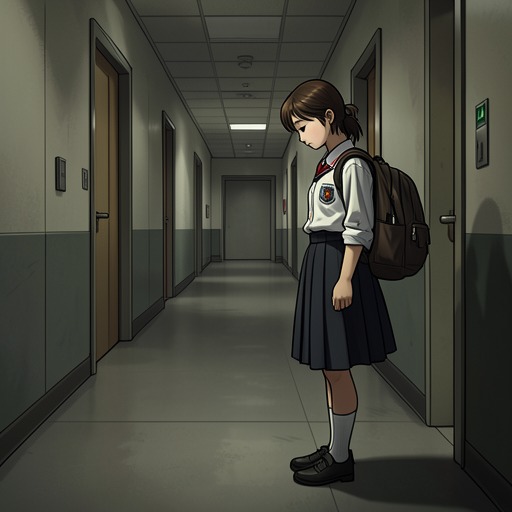
RESprington bus loop is the shared school-bus staging area outside Springton High, but its narrative importance exceeds its practical function. It is where Tabitha Moore discovers that becoming visibly noticeable can feel less like gaining the attention she once wanted than like being exposed to judgment, and where a routine wait after school becomes the scene of a deliberate assault. The loop converts movement through the town into a sequence of public confrontations: arrival makes Tabitha an object of collective appraisal, while departure places her among witnesses who must respond when bullying becomes bodily violence.
Setting and First Arrival
The loop first appears as the threshold between the school bus and the commons of Springton High. As students file out, Tabitha expects the return to her old alma mater to produce a pleasant sense of recognition, yet the space immediately makes her feel watched from every direction. Boys turn toward her, one student nudges another and gestures in her direction, girls assess her appearance, and an older school employee acknowledges her with a nod and a greeting. The transit area therefore functions as a social passage rather than a neutral entrance: before Tabitha reaches her first class, she has already been placed under the gaze of students and authority figures.
This attention exposes a contradiction in Tabitha’s changed social position. After a lifetime of being ignored, she had imagined that recognition would be desirable; the loop teaches her that visibility also produces awkwardness, embarrassment, and pressure. Her discomfort intensifies when another student introduces himself before the bus reaches the loop, making her realize that the attention she thought she craved is not easily controlled once it arrives. The setting gives physical form to her unstable sense of identity: crossing from the bus into school means crossing from private recollection into a public role she does not yet know how to inhabit.
The Assault at Dismissal
The loop becomes more dangerous at the end of the school day. Tabitha waits at the curb for bus fifteen, which is usually several minutes late and follows a particularly meandering route. Because Springton Middle and Springton High share buses and dismiss students an hour apart, bus fifteen serves the far edge of the district before returning along the town’s main route toward Tabitha’s trailer park. The delay leaves Tabitha standing among a small crowd with time to observe the departing students and study how their movements change after the final bell.
That observational pause ends with an abrupt shove. Someone forcefully pushes Tabitha forward from the curb, sending her more than horizontally onto the pavement. She twists in the air without time to think, throws out her arms instinctively, and lands on her chin, shoulder, and left hand. The hand is left in raw agony, and when she raises it for inspection, its outline looks wrong: swelling has distorted the area between her wrist and pinky. The injury turns the curb, previously an ordinary place of waiting, into the point from which a public attack physically displaces her.
The assault also gives the loop a collective dimension. A nearby girl crouches beside Tabitha, asks whether she is all right, and shouts for others to stop the person who pushed her. Students gather, talk, stare, and help lift Tabitha back onto unsteady feet; some appear to pursue the assailant, and Tabitha senses that a fight has broken out elsewhere in the loop. A stern older voice, probably belonging to the school dean, orders people to check on her. A bus driver then moves through the crowd, steadies her by the shoulder, and carefully examines the injured hand. The space becomes an improvised network of witnesses and helpers, even as Tabitha experiences the crowd’s attention as humiliating and overwhelming.
Institutional Response and Public Visibility
The school’s response begins in the immediate aftermath of the bus-loop assault. Elena Seelbaugh brings a plastic chair from the classroom to give Tabitha somewhere to sit, then returns inside and watches through the narrow glass panel in the door. Principal Edwards subsequently meets Tabitha with Mr. Thompson and Chris Thompson to discuss what happened. The loop’s open, public setting therefore leads directly into administrative investigation, linking student testimony and visible injury to the school’s disciplinary machinery.
The later handling of the case shows that the institution’s first claim of closure is contested. Pamela Cribb, a Springton school-board member who performs extensive oversight because the district is too small to have an assistant superintendent, rejects the suggestion that the matter has been resolved. Her exasperation reflects the widening scope of what began at the loop: the incident is no longer merely a quarrel among students but a serious failure of school safety and discipline. The bus loop is consequently the first visible site in a larger struggle over whether harassment should be minimized as ordinary adolescent behavior or recognized as a systemic danger.
From School Incident to Community Crisis
The loop assault is part of the book’s broader escalation from school bullying to public violence. High-school bullying initially escapes local news coverage, but the later Halloween-party assault that leaves Tabitha in a vegetative state draws Channel 7 News into the story. The station connects that crisis to Tabitha’s earlier involvement in the Springton South Main Shooting and reuses old footage, turning her into a highly visible hometown figure. The loop’s early scenes foreshadow this transformation: Tabitha is first unwillingly watched by students, then observed as an injured victim, and eventually represented before the entire community.
That progression changes how Springton understands student violence. Schools remove their student bodies from class for lectures on teen violence and introduce new zero-tolerance anti-bullying measures. Governor Paul E. Patton issues condolences while invoking national school-safety initiatives, and the community responds with anger, supportive calls, and letters to the Moore household. Erica Taylor is transferred to a juvenile detention center in Breathitt County while awaiting court proceedings. Although these later consequences extend far beyond the physical loop, they preserve its central pattern: an event witnessed in a shared public space forces private suffering into institutional and civic view.
Narrative Significance
Springton bus loop is a threshold, a stage, and a site of evidence. At arrival, it frames Tabitha’s uneasy passage into a school where her appearance attracts attention; at dismissal, it exposes how quickly attention can become aggression. The same public visibility that embarrasses her also makes intervention possible, since students, a bus driver, and school personnel can witness the injury and respond. The loop therefore holds together two opposing meanings of being seen: scrutiny can intensify Tabitha’s alienation, while witnessing can create the first conditions of protection.
Its importance also lies in the contrast between ordinary circulation and catastrophic interruption. Buses are supposed to carry students through predictable routes, and Tabitha’s bus fifteen is merely late and inconveniently circuitous. Yet the delay creates the circumstance for the assault, while the curb becomes the boundary across which she is thrown. The location’s everyday infrastructure cannot prevent violence, but it supplies witnesses, transport personnel, school authority, and a route into official action. In that sense, Springton bus loop represents the fragile social world around Tabitha: imperfect, intrusive, and sometimes cruel, but capable of turning an isolated injury into a recognized public wrong.