Sunset Estates
RESunset Estates is the dilapidated mobile-home park that defines Tabitha Moore’s home environment and much of the social meaning imposed on her. Its Lower Park becomes the site of a fatal police shooting, while the park’s physical deterioration and reputation for poverty shape how outsiders read Tabitha before they know her. The location is therefore more than a backdrop: it is a material home, a source of danger, and a mark of class identity that other characters repeatedly use to judge the Moore family.
Physical Setting and Social Image
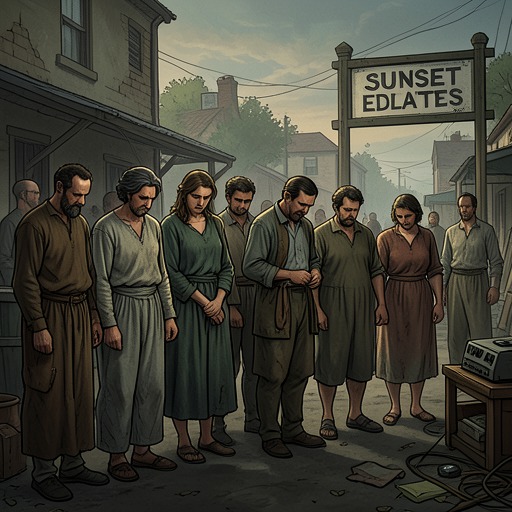
Sunset Estates is presented through Alicia Brooks’s uneasy first arrival. Tabitha brings Alicia home after they have been discussing designs for Tabitha’s goblin story on the school bus, and Alicia is startled to discover that the stop is a trailer park. Unlike the newer, orderly mobile-home lot associated with Alicia’s aunt in Georgia, Sunset Estates appears cramped, neglected, and socially abandoned. Dilapidated trailers stand in claustrophobic rows behind a gas station and a liquor store; garbage, waterlogged fast-food containers, broken plastic, rusting metal, weeds, bare dirt, cigarette butts, and gravel spread through the neighborhood. The landscape gives physical form to the phrase “trailer trash,” a stigma that the surrounding community applies to the people who live there rather than treating the park as a place shaped by poverty and neglect.
The location’s visual identity is repeated when Channel 7 News reports on the shooting. The television image shows a small two-lane street beside a hillside of decrepit mobile homes rising toward the same gas station and liquor store. The familiar view turns the park into a public spectacle: a neighborhood normally known through rumor is now displayed behind yellow police tape as the setting for violence. Its appearance helps explain why Sunset Estates has acquired such a powerful reputation, but the report also reduces the community to a recognizable image of disorder.
The Lower Park Shooting
The Lower Park, the lower end of Sunset Estates, is associated with a fatal shooting that Tabitha remembers from the future. In her recollection, a police officer will be shot in October and will bleed out on the way to the hospital. She cannot remember the officer’s name or the exact date, and she does not know how the event might be prevented without exposing her impossible foreknowledge or placing herself in danger. The shooting is not caused by a resident of the park: Officer Darren MacIntire pulls over a driver for a routine ticket, and the stop happens on the road alongside the Lower Park. The distinction matters because the event is associated with Sunset Estates even though the suspected shooter does not belong to its community.
A later news report identifies the officer as Officer Darren MacIntire and locates the traffic stop in the area residents call the Lower Park. The camera moves across a roadside median of weeds and gravel enclosed by yellow tape, converting an ordinary strip of road into a boundary between routine life and irreversible violence. For Tabitha, the coming event creates an ethical dilemma. Remaining uninvolved may mean allowing a known death to occur, but intervening directly could get her killed, and she doubts that she could provide useful first aid after the shooting. Sunset Estates thus becomes the point where future knowledge, physical vulnerability, and responsibility toward a stranger collide.
Home, Poverty, and Class Stigma
Tabitha’s residence in Sunset Estates governs how other people interpret her. She has noticed that people treat her differently when they learn where she comes from, as though living in the Lower Park means she was raised in a den of criminals. The shooting makes the neighborhood’s reputation worse, but the stigma predates the event and extends beyond any individual’s conduct. Tabitha fears returning to work at the Safety plant partly because she remembers the dirty looks directed at people from the park. Her anxiety shows how a location can follow its residents into institutions, workplaces, and relationships that lie beyond its streets.
The park also becomes a test of social boundaries between families. When Mrs. Seelbaugh drives Tabitha home, she leaves her in front of a worn-down mobile home and parks the family’s silvery-white minivan at the gas station overlooking the neighborhood. The family does not need fuel there, and Mr. Seelbaugh has already dismissed the gasoline as poor quality. That small refusal to use the station registers as another sign of status difference: the Seelbaughs can look down on the park from above, while Tabitha must return through its clustered streets to the trailer where she lives.
The location remains close enough to other family homes to make separation impossible. Tabitha argues that Grandma Laurie and the boys are only a walk away from Sunset Estates, and therefore Lisa should have been able to visit them herself rather than relying on others to transport her. Her father answers that the distance is greater and that Lisa is family, but Tabitha rejects family status as an automatic excuse for harmful behavior. The physical closeness between the park and the relatives’ homes intensifies the dispute: the problem is not absolute isolation, but the way poverty, dependence, and family obligation are used to draw people back into danger.
Conflict, Flight, and Narrative Significance
Sunset Estates is also the setting from which Tabitha tries to protect the four Moore cousins from Lisa Moore’s heroin use and neglect. Karen Williams tells Tabitha that heroin has no place around children and that people who use it should not remain around them. Tabitha agrees and explains that she called for help because she cannot allow Lisa to work her way back into the family, particularly through the settlement money, while treating the boys with indifference. The park’s proximity to the children’s relatives makes the threat immediate rather than abstract: Lisa can return to the family simply by crossing a short distance, and Tabitha believes that this access must be stopped permanently.
During the Thanksgiving crisis, Lisa leaves the Moore home in the family’s 1988 Oldsmobile Cutlass Supreme Classic after claiming that Tabitha has stolen her purse. The car, which supposedly has a bad alternator, is nevertheless taken from the house while the shower is left running. Its sudden departure turns the household into a search scene and links the mobile-home community’s cramped domestic space to a wider pursuit. Tabitha, fearing the consequences of the confrontation, calls Karen Williams, who comes to collect her and takes her away from Sunset Estates late at night.
Returning to the park afterward is emotionally more difficult than the short drive suggests. Sandra MacIntire drives Tabitha down the hill and through the clustered mobile homes, but Tabitha wishes the journey would last longer because she dreads the confrontation waiting at home. Her guilt about excluding her parents, anger at the situation, fear, and self-doubt feed one another as she approaches the trailer. Sandra knocks instead of forcing her forward and places a hand on Tabitha’s shoulder before the door opens. In that moment, Sunset Estates is not merely the place Tabitha is trying to escape; it is also the home to which she must return, carrying the consequences of what she has learned and done.
Sunset Estates therefore concentrates the novel’s conflicts over poverty, reputation, family responsibility, and physical safety. Its Lower Park is wrongly absorbed into the meaning of a shooting committed by an outsider, while its residents are treated as though the neighborhood’s decay proves something about their character. Yet the park is also where Tabitha’s knowledge, loyalties, and decisions acquire their greatest urgency. The same place that marks her as socially suspect becomes the ground on which she confronts violence, protects children, and begins to resist the idea that family or poverty can excuse abandonment and abuse.