Alcide Bolduc’s Plane Disappears
SatanAlcide Bolduc’s Plane Disappears is the February 1953 loss of a DC-3 on a supply flight between Sept-Îles and Schefferville. The aircraft never returned, and the disappearance left Alcide’s fate unresolved for more than two decades. For his son Loïc, the missing plane became both a family bereavement and an image shaped by illness: a father imagined inside a flying box, swallowed by the snowstorm that had hidden him from view.
Background and the Northbound Air Route
Alcide had gone north after years marked by his wife’s death, the dispersal of his children, and a dramatic confrontation with his brother-in-law. He had not recovered from those losses. Seeking oblivion, he took work connected to the vast railway project being built through northern Quebec and Labrador to exploit rich iron-ore deposits. The railway was intended to connect Sept-Îles and Schefferville by way of Labrador City, but the air service was already carrying people and supplies between the settlements day and night.
Johnny Parent, an experienced railway-industry man, had hired Alcide at Mont-Joli in the autumn of 1951. Alcide had initially offered his services as a mechanic to the Iron Ore Company of Canada; his piloting experience soon placed him in the air bridge operated by Hollinger Ungava Transport, commonly known as HUT. Flying above the remote northern landscape gave him long hours of work and a demanding undertaking in which to immerse himself. The flights offered an escape from domestic sorrow and disappointed love, though the account presents that escape as a diversion rather than a cure.
The assignment that became his last flight came while Alcide was drinking beer in an almost empty hotel bar near the port at Sept-Îles. Parent came over and told him that Bob was in bed with a severe flu and that a load had to reach Schefferville without fail. Alcide was the available pilot. The ordinary urgency of a replacement assignment thus set the loss in motion: the flight was necessary, and the job fell to a man already accustomed to spending his days and nights over the northern wilderness.
The Flight and Disappearance
On a cold, sunny day in February, Alcide took off from Sept-Îles in a DC-3 with a copilot. The aircraft was loaded to capacity with sacks of cement, mechanical parts, and food provisions. Some bad weather was forecast around Schefferville. The plan was to fly the outward leg in daylight and return at night, a round trip of five hours.
The aircraft did not come back to Sept-Îles. Radio contact was lost, probably at the moment the plane strayed into the storm. That probable explanation did not amount to a witnessed crash or a known location: the plane simply failed to return, leaving the flight’s final moments inaccessible. Its cargo, route, and timetable give the disappearance a concrete practical setting, while the silence on the radio marks the point where routine transport gave way to uncertainty.
After several weeks of searching, the company said the aircraft had disappeared in the frozen isolation of the Far North, perhaps wrecked in a remote lake or even in the ocean. Neither possibility could then be established. The company did, however, provide a generous pension for Alcide’s children. Among other uses, the money would help pay for Loïc’s education, so the consequences of the missing flight included material support as well as bereavement.
The Wreck and the Long Uncertainty
Speculation about what had happened to Alcide and his copilot lasted for more than twenty years. In the 1970s, during efforts to locate the wreck of the Titanic off Newfoundland, the remains of their aircraft were found on an isolated Labrador peak near the ocean. The scattered bones of the two men were found with it. The discovery gave a location and physical remains to a disappearance that had previously been explained only through possibilities: an unlocated lake, the ocean, or the broader frozen wilderness.
The recovery did not turn the flight into a narrated crash. The book gives no account of what Alcide and his copilot experienced after radio contact ended; what it supplies instead is the interval of uncertainty, followed much later by the discovery of the wreck and human remains. This delayed confirmation changes the status of the event from an open search to a death established through material traces, while leaving the final moments unknown.
Loïc’s Childhood Experience and the Event’s Significance
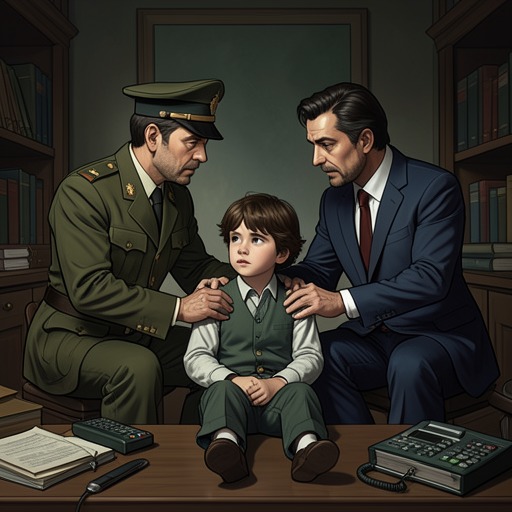
When Loïc learned that his biological father had disappeared in the North, he was confined to the house by a succession of infectious illnesses: measles, mumps, and jaundice. The diseases arrived one after another, leaving him little respite. During those weeks, his own bodily confinement and the report of his father’s absence seemed to gather into a single circle of illness and death. He brooded over Alcide’s disappearance while feverish and shut indoors.
At the frosted window, Loïc imagined his father enclosed in the plane, rising, descending, and turning through gusts of snow. The image does not disclose what happened in the aircraft; it gives shape to the child’s inability to know. Outside, the drifting snow seemed to take flight in the blizzard, while the missing pilot became part of the storm’s movement. Loïc’s thoughts then wandered through radio drama and biblical imagery, transforming the snow into manna for the Israelites escaping Pharaoh before falling under Babylon’s rule. The passage makes a local family loss reverberate through stories of flight, deliverance, and renewed captivity without resolving the mystery through the child’s imagination.
The event therefore operates on two timescales. In February 1953, it is a practical flight lost after contact with the aircraft ceases; for Loïc, it immediately becomes an absence he tries to picture from inside long, snowbound afternoons. More than twenty years later, the wreck and scattered remains provide confirmation that the disappearance ended in death. Between those points, Alcide’s missing plane persists as both a fact of family history and an image formed around the limits of what the family could know.