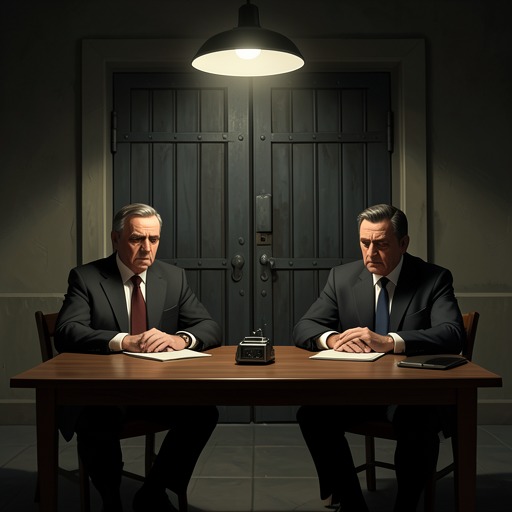
Parti Québécois Wins the 1976 Quebec Election
SatanThe Parti Québécois Wins the 1976 Quebec Election is both a decisive political turning point and a test of divided loyalty. On election night, Loïc remains inside the federal government’s Ottawa offices, helping prepare its response while inwardly wishing for a victory that his closest colleague, Régis, regards as a betrayal. When the sovereignist party wins, the public celebration in Quebec and the strained silence in Ottawa mark a change in Loïc’s sense of belonging: his private hope does not bring him back into a shared collective identity.
Background and Stakes
The scene is dated November 15, 1976. In the days before the vote, a poll had put the Quebec independentists at nearly half the expected support, an outcome that unsettled Ottawa’s political establishment and those whose work depended on Canadian federalism. The possibility of a Parti québécois victory had become a practical question for the prime minister’s staff: they had to prepare a response to a government that might have a mandate for sovereignty, even as many around Pierre Elliott Trudeau struggled to accept that prospect.
For Loïc, the election carries a more intimate weight. He is a close collaborator of Régis, his cousin, and has been chosen to work alongside him in the prime minister’s office. Yet their shared employment conceals opposing political commitments. Loïc sees Quebec independence as a possible means of reversing the contraction of French-speaking life in America and freeing Quebecers from a self-image shaped by defeat and contempt. Régis, by contrast, regards the Parti québécois program as a threat to the country and its political order. The election tests the relationship precisely because neither man openly discusses the depth of the disagreement.
The Election Night in Ottawa
Régis had spent the weekend preparing possible statements for the prime minister. On election day, he was summoned to a meeting with Trudeau and other senior advisers to discuss what to say in the event of a Parti québécois victory. He returned visibly angry after arguing against what he called the softer response. Trudeau agreed with his position, then tasked Régis and Loïc with drafting a telegram for the possible result. Its wording was to avoid both pointed criticism and congratulation, acknowledging only the legitimate election of a sovereignist government.
That assignment puts Loïc’s private allegiance inside the official machinery of response. While Régis sees recognition of the result as conceding ground to an evil cause, Loïc has to help formulate a statement that treats the election as legitimate. He does not disclose his own preference. His silence is not political neutrality: it is a way of remaining at his post, and of preserving a working relationship with Régis, while concealing the hope that divides them.
From seven o’clock onward, seven or eight francophone and anglophone advisers and assistants gathered around the televisions in the press office. The first reported lead belonged to a Parti québécois candidate. By about 7:30, roughly ten party candidates were ahead of their Liberal opponents, and unease spread through the corridors of Édifice Langevin. Loïc left to get a sandwich at the cafeteria in Édifice de l’Ouest. Away from his colleagues, he felt a deep, barely containable joy at the early results and read the moment against the Parliament buildings and the country’s history. The novel also associates that excitement with memories of the 1837 Patriote uprising and its failed challenge to colonial authority, whose aftermath brought repression and further pressure on francophone communities.
Victory and the Split Between Cousins
As the sovereignist lead strengthened, tension rose in the prime minister’s offices. Staff watched the results, while Loïc tried not to meet anyone’s eyes for fear of revealing what he felt. His colleagues’ alarm and his own growing happiness occupied the same rooms but belonged to opposing understandings of the vote. The closer victory came, the harder it became for him to maintain the appearance of shared purpose.
The decisive announcement came when René Lévesque, now the new premier, addressed his jubilant supporters at the Centre Paul-Sauvé in Montreal. He said he had never been prouder to be Quebecer. The crowd’s exultation sharpened Loïc’s estrangement rather than resolving it. He imagined himself as distant from his own place and time, and no longer felt part of the broad community of young Quebecers celebrating across the province. His earlier sense of a shared “we” had separated from his private “I”; the victory he had wanted did not make his identity uncomplicated.
Régis could not remain at Édifice Langevin for long. After trying to dull his anxiety and indignation with scotch, and after Radio-Canada announced that the Parti québécois would win a majority of seats, he briefly went upstairs to speak with Trudeau and then left without ceremony. Loïc had little time to say goodbye. Régis appeared pale and shaken, and said he had long sensed the approaching catastrophe. His departure gives the political disagreement an immediate personal consequence: the cousins do not openly settle their differences, but the result makes the distance between their convictions impossible to ignore.
Consequences and Narrative Significance
The government’s response was a restrained acknowledgment of the legitimacy of the newly elected sovereignist government, rather than a celebration or a denunciation. That formal statement could register the election without reconciling the people required to deliver it. Loïc and Régis had both served the same prime minister, but they interpreted the same result through conflicting loyalties: for Régis, a national rupture; for Loïc, a possible opening toward emancipation.
The novel places this federal crisis alongside an earlier provincial campaign in Touladi, where party organizing was entangled with family influence, public employment, and intimidation. That earlier episode does not cause the 1976 result, but it shows how political divisions reach beyond speeches and ballots into local relations and livelihoods. Against that wider pattern, the Ottawa election-night scene turns a public transition into a private threshold. Loïc’s concealed support and Régis’s openly anguished departure make the political divide legible as a break in kinship and belonging, while the victory itself leaves Loïc more isolated than before.