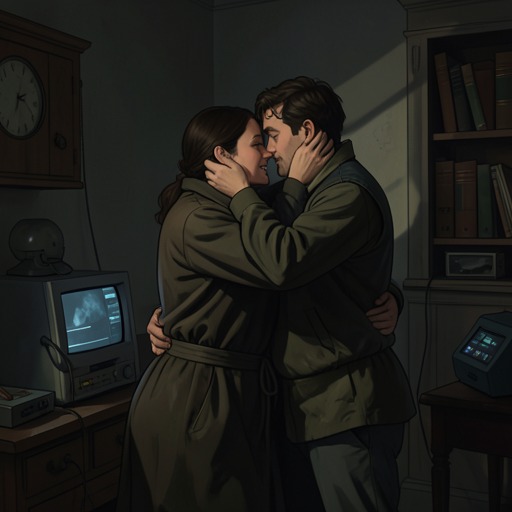
Loïc Meets Laurence
SatanLoïc Meets Laurence is the sudden encounter that opens a late-life love and redirects Loïc’s attention without severing it from the family cameo mystery. At a book launch in Montreal, he recognizes Laurence d’Albignac with startling familiarity, then resists the transformation he senses in their attraction and literally runs away. His eventual decision to write to her begins a relationship marked by laughter, mutual vulnerability, and a feeling of profound kinship; it also brings him closer to a lineage entangled with the history he has been investigating.
The Encounter and Its Shock
On a June evening when daylight lingered before nightfall, Loïc went to a book launch at the Maison des écrivains on rue Laval, attending more from social courtesy than genuine interest. Laurence stood near the bar among a small group, exchanging a few words with people as they passed. At first he noticed her gaze: clear and unshadowed. Then he took in her slender, relatively tall figure, fine features, oval face, and flexible dark-brown hair. What seized him most were her bright eyes, which seemed to illuminate him from within when they turned toward him.
The response was not simply attraction. Loïc felt that he had known Laurence for a long time, perhaps always, and that being drawn to her was as natural and self-evident as it was overwhelming. He feared losing his integrity and identity, as if the encounter might dissolve him or break apart the personality he had laboriously built. The novel renders this fear through images of an inner earthquake, an avalanche, and an explosion: the possibility of love arrives as both annihilation and rebirth. Loïc senses that Laurence could transform him so completely that he would no longer be the same person.
That intensity helps explain his retreat. After a few awkward conversational approaches, Loïc felt increasingly dazed and fled. He was afraid he could not live up to the metamorphosis he had glimpsed, and then afraid to believe in it at all. The impulse belongs to a familiar pattern of self-protection: confronted with a possibility beyond his control, he withdraws rather than risk disappointment. For several days he tried to persuade himself that desire had invented the experience, and that the attraction had been no more substantial than an illusion.
From Retreat to Contact
Loïc’s hesitation is sharpened by the contrast between this meeting and his earlier relationships, which had been painful and self-destructive: romantic exaltation gave way to falls that left lasting wounds. He was wary of being deceived again, and the security of familiar habits still exerted its pull. In the days after the launch, he considered arranging to see Claudine, his former partner. They had separated without ending their connection completely and met from time to time; her sensuality offered a known refuge from the risks of a new attachment. The choice before him was not simply between two women, but between the comfort of a bounded past and an unknown future.
The exchange of looks at the launch, described as taking place on the summer solstice, continued to trouble and attract him. At last, Loïc put his doubts, hesitations, and procrastination onto paper in his journal, then sent Laurence an email. He had found her address without difficulty in the directory of the Union des écrivains. His message was tinged with humor, and her reply came immediately, in the same warm, humorous spirit. The decision to act did not erase his fear; it turned inward indecision into the beginning of a conversation.
Shared Histories and a Sense of Communion
Laurence is forty-six, though she appears younger; Loïc is ten years older and likewise appears younger than his age. She comes from an old French noble family and had chosen to live in Quebec several years earlier. She writes books for young readers, combining humor, fantasy, and poetry. As they quickly tell one another their histories, she describes several painful relationships and the difficult separation from her first great love, whom she had known in France. The death of the child she had lost in early childhood and a miscarriage had contributed to the collapse of that relationship. Like Loïc, she is afraid of being hurt by love again.
Their physical approach is therefore cautious and gradual, as though they were trying not to startle a deer. The caution does not make their attraction less fervent; it allows it to gather force before either gives themselves over to it. In contrast with Loïc’s earlier destructive unions, the new connection is presented as a movement toward mutual recognition rather than a cycle of romantic heights and painful falls.
For the first time in his life, Loïc no longer feels alone. The idea of a soulmate unsettles him because he wonders whether Laurence might be the reincarnation of the twin sister who remained in their mother’s womb. The text does not establish this as fact; it presents it as Loïc’s way of understanding the depth of their connection. They often find themselves thinking the same thing at the same time, even arriving at the same phrase or expression. Their relationship becomes an exchange of thought and feeling, in which a smile or a glance can intensify the sense of communion.
Loïc is also struck by Laurence’s empathy for living things: people, animals, and plants. He sees her as unusually receptive to the suffering of others, and regards this compassion as one of her defining qualities. Their affinity thus extends beyond shared literary interests and humor. It appears to encompass an ethical sensitivity to life itself, giving the relationship a tenderness that distinguishes it from his earlier experience.
The Cameo and the Wider Story
For a time, this unexpected love draws Loïc away from the family cameo that has obsessed him for nearly a year. The reprieve is temporary. He is already pursuing the Castelmonts in Europe and considering possible links with the Chaussegros de Léry family, members of the New France elite who returned to France after the colony’s capitulation. Through correspondence in the Archives nationales du Québec, he has traced three sons of Gaspard-Joseph Chaussegros de Léry who pursued careers in France under Louis XVI and during the Revolution and Empire. One son, Louis-René, served in the king’s bodyguards at Versailles; Loïc wonders whether he might have encountered the Castelmonts at court.
Laurence’s background makes the personal encounter converge with this historical inquiry. Her family belongs to an old aristocratic lineage in southwestern France that has just celebrated a thousand years of history. Loïc does not yet know the full adventure their relationship will open, or the revelations buried in successive layers of the past. The narrative foreshadows that their lives will intersect with multiple histories, all connected to the cameo. Their meeting therefore does more than begin a romance: it brings a new person into the investigation and turns intimacy into a route toward historical discovery.
At the end of the summer, Loïc takes Laurence to the Bas-Saint-Laurent to show her the country of his childhood. The journey becomes a honeymoon before the fact, confirming their love and deepening their intimacy. At Notre-Dame-du-Lac, on the balcony of their inn overlooking Lake Témiscouata in bright moonlight, Loïc finally tells her the story of the cameo. Their relationship and the mystery that had briefly receded are now joined: the encounter that threatened to remake Loïc becomes the setting in which he shares the secret that has occupied him.