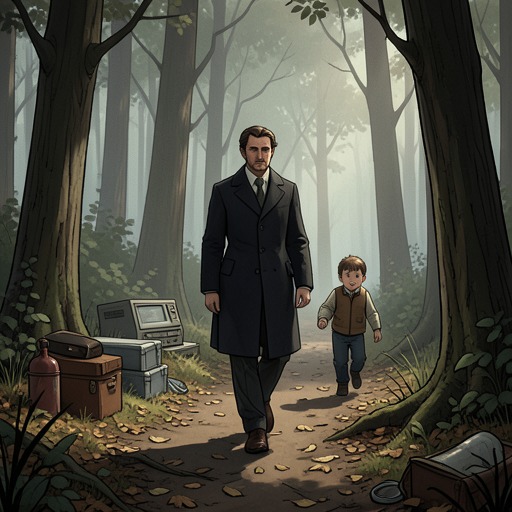
Guillaume D’Anjou’s Death in the Forest
SatanGuillaume D’Anjou’s death in the forest ends the life of the man who had adopted and loved Loïc as a son, and turns the woodland that defined Guillaume into the setting of a family echo. Found beside a deer he had shot, with his old hunting rifle fallen from his hands, Guillaume appears to have died of heart failure. The death brings Loïc back to Touladi and gives his last walk with Guillaume the weight of a farewell he did not know he was making.
The Death in the Forest
One autumn day, Guillaume went alone for a walk near the Sugarloaf Mountain forest and did not return. The next day, his jeep was found parked at the edge of the woods. Guillaume lay in the forest, his old hunting rifle fallen from his hands. About twenty metres away was a male deer, its antlers fully grown, killed by a shot to the chest. In Touladi’s local vocabulary, the animal had been brought down in full fale.
The circumstances point to a cardiac attack. Guillaume had long suffered from heart disease, and he had not brought the nitrate capsules he needed in case of a crisis. The account leaves open whether he forgot them or deliberately went without them; it does not settle the question. His death is quiet and hidden, in the landscape where he was most at home. The narrator suggests that an atavistic instinct may have drawn him to die in the woods, as his father Égide had done forty-four years earlier, almost to the day.
Loïc Receives the News
The news reached Loïc in Montreal, where he was completing his classical studies. By late October, cold rain, heralding snow, beat against the darkened trees and the closed façades near his college. Returning to his room in the Philosophy pavilion, he found a message under the door telling him to call his family in Touladi without fail. The instruction that he could telephone at any hour made the urgency unmistakable; he immediately feared that someone had died.
On the telephone, Marie-Louise told him in a broken voice that Guillaume was dead and had been found in the forest with his rifle. She hurried to explain that it was his heart, ill for so long, that had finally failed. Loïc was overtaken by tears, memories, and regrets over what he had never done or said. He left at once, travelling overnight by express coach to Rivière-du-Loup and then by local bus to Touladi. Under a leaden sky of rain and snow, he returned to the family’s heritage house, its encircling trees and familiar cherry orchard stripped by autumn.
A Farewell Understood Too Late
Two months earlier, Loïc had stayed at the house for several days before beginning his final year of college. He had walked with Guillaume, his mother’s brother and adoptive father, as he had in childhood. Only after Guillaume’s death did that outing become, in retrospect, a farewell. Loïc had then been old enough to recognize the depth of Guillaume’s knowledge of the natural world: not abstract expertise, but an instinct formed through long experience.
Guillaume read the forest through broken branches, torn bark, and twigs crushed or displaced on a bank. To him, such traces were signs in a book he knew by heart. He moved confidently along paths and animal tracks, noticed passages between the trees, and could sense an animal’s passage before seeing it. Loïc also recalled his attention to the forest’s smallest changes: the shifting sounds of leaves and branches and the life moving beneath the canopy and through the undergrowth. The account presents this knowledge as both practical skill and a finely developed way of perceiving the woods.
That understanding explains the respect paid to Guillaume by the forestry company’s managers and workers, who had travelled with him into the forest. They knew him as a true man of the woods and as a worthy grandson of Le Fondateur. He could locate good game and kill an animal cleanly, without needless suffering. The dead deer beside him thus belongs to the account of his final hunt, while also recalling the skill and care that had earned him the esteem of those who knew him outdoors.
The Funeral and Its Reverberations
Guillaume’s body lay in state for three days in the salon, beneath the imposing portrait of Le Fondateur that had frightened Loïc as a child riding his tricycle through the house. Relatives and neighbours came to pay their respects. Marie-Louise sat with dignity beside the coffin, with her daughter Laurette at her side; Laurette’s eyes were reddened by grief, and she had always been Guillaume’s favourite. Women spoke quietly around the bereaved, while the men stood silent and solemn, awkwardly crossing and uncrossing their hands.
Loïc withdrew to a corner after receiving condolences and looked at the still face of his adoptive father. He wondered whether concentrated thought could reach the dead and cross the barrier separating the living from the afterlife. The funeral sharpens his regret over words left unsaid, then widens into questions about his own place in the family: why tragedy had brought him, newly born, into this house, where he had been raised and loved. He also remembers the cameo kept there, hidden from view yet so present in his childhood that it seemed almost a character in its own right. He does not yet know how much of his future the stone will occupy.
The scale of the funeral confirms how widely Guillaume was known and loved. Visitors came from far away, and the morning of the service brought two limousines, one grey and one black, carrying senior Brunswick Company executives from Campbellton, Bathurst, and Saint John. They had shared many hunting and fishing expeditions with Guillaume. Among them, Loïc especially remembered Larry Durrell, a fluent French speaker who had once been superintendent at Cabano. Durrell’s affection for Guillaume had grown through countless trips and acts of care: when Durrell regularly drank too much on hunting outings, Guillaume watched over him like a guardian angel. Their arrival makes visible a life whose intimacy with the woods had also created lasting bonds beyond the family.