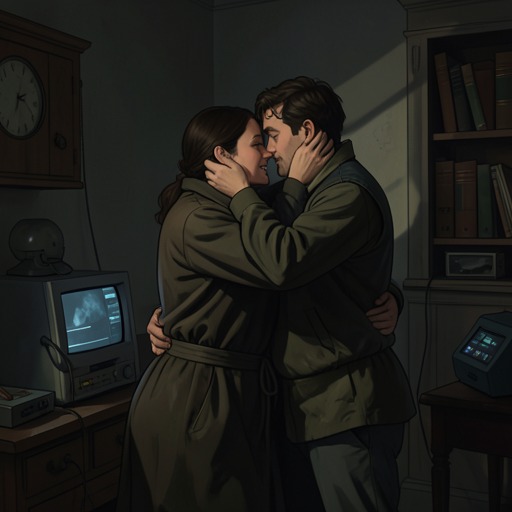
Loïc and Brigitte’s Unexpected Pregnancy and Abortion
SatanLoïc and Brigitte’s unexpected pregnancy and abortion become, in retrospect, an episode in which new life and approaching death occupy the same narrow span of time. The pregnancy, resulting from a double ovulation that had escaped the Ogino method, was quickly ended; its significance emerged later, as Loïc connected its timing with Laurette’s hospitalization and imagined the absent child as part of a larger, unquiet loss.
Circumstances and Delayed Recognition
The pregnancy began in circumstances that Loïc initially remembered as unremarkable. Brigitte had stayed home from her publishing-house job: after a morning at the dentist, she spent much of the afternoon browsing magazines on the living-room sofa and listening to Vivaldi. Near sunset, she came to Loïc’s desk while he was trying to finish an article. In the recollection, the encounter is part of an ordinary evening rather than an event either of them recognized as consequential.
Loïc later consulted his journal and noticed that the conception had occurred on the same day, almost at the same hour, that Laurette was rushed to hospital. On that evening, he and Brigitte were preparing to go to a restaurant when a cousin from Touladi called, around seven o’clock, to say that Laurette had suffered a medical crisis. The hospital diagnosed advanced cancer. The coincidence did not mean the two events caused one another; instead, it gave Loïc a stark temporal parallel to contemplate, joining the beginning of a pregnancy to news of a loved one’s grave illness.
The next hours passed without either of them knowing what was happening biologically. They went with friends to hear jazz at Le Sexe des anges, a club on rue Saint-Denis. Later, Loïc reflected that while a sperm cell was moving toward Brigitte’s ovum, the couple was absorbed in the evening and unaware of the process taking place within them. In his account, implantation followed around noon the next day, as he drove toward Rivière-du-Loup. The retrospective arrangement places an invisible beginning beside events that seemed, at the time, unrelated.
Pregnancy and Decision
The pregnancy was unexpected, the result of a double ovulation that had escaped the Ogino method. The decision was made quickly: Loïc and Brigitte did not want a baby, and the pregnancy was ended by abortion. The account gives no extended discussion of their deliberations or of Brigitte’s private response. It presents the decision as abrupt and settled, while leaving the later emotional weight chiefly within Loïc’s recollection.
That difference between the speed of the decision and the duration of its afterlife shapes the episode. Loïc could not later recover the sexual encounter as a uniquely memorable moment; among his memories of kisses and caresses, it blurred into others. The conception had not announced itself to him as an exceptional event. Its importance arrived belatedly, through the journal’s dates and through the knowledge of what followed. The ordinary character of the encounter therefore stands in contrast to the immense meaning he would attach to its consequences.
Retrospective Grief and Laurette’s Illness
Afterward, Loïc remembered walking through a freezing winter morning between rows of dark trees. He imagined them as mourners filing toward the nonexistent grave of an unknown child. That image gives form to a loss with no burial place and no public ritual in the scene: the child existed as a possibility, then as a memory that Loïc could only approach through absence. The passage describes grief through this imagined procession rather than through a formal account of mourning.
The loss also recurred in Loïc’s imagination. For a long time, he pictured children crying within him, as though their voices rose from a prenatal limbo. On certain nights during what he regarded as a cursed year, those imagined cries seemed to press against silence. These visions belong to his retrospective experience; they do not establish that the unborn child had a distinct voice or that the cries were heard by anyone else. They show how the abortion continued to occupy his inner life after the decision itself was over.
Loïc later recognized another parallel in the timing: the cell multiplication beginning in Brigitte’s womb seemed to echo the abnormal multiplication that would kill Laurette. The contrast is not a claim that pregnancy and cancer were equivalent, but a pattern Loïc drew between simultaneous processes of growth, one associated with a possible new life and the other with Laurette’s fatal illness. The coincidence made biological beginnings and endings feel disturbingly close, even as the two events remained separate in cause and outcome.
Narrative Significance
The episode is structured by belated knowledge. The couple’s evening, the call about Laurette, and the pregnancy’s beginning first pass as distinct facts; Loïc’s later reading of his journal makes their timing visible and changes how he understands them. Dates and ordinary circumstances become the means by which an event that was not recognized as momentous at the time acquires its retrospective force.
Loïc’s reflections widen from this particular pregnancy to the hidden processes of human and natural life. He considers reproduction as something that proceeds without conscious awareness, and sees the episode as one instance of a larger movement toward continued existence. Yet this expansive perspective does not resolve his grief. The imagined cries of the unborn and the memory of Laurette’s illness keep the story anchored in particular losses. The event’s significance lies in that unresolved tension: life’s continuation appears as an impersonal process, while Loïc experiences the ended pregnancy as a personal absence that returns in memory.