Querelle des deux pères (1951)
SatanThe 1951 quarrel between Alcide Bolduc and Guillaume D’Anjou turns a dispute over Loïc’s care into a public rupture between his biological and adoptive families. Beginning at a brush fire and spilling into the village street, the confrontation forces the child to choose between two fathers; its immediate aftermath is Guillaume’s collapse and Alcide’s disappearance by plane. Loïc remembers the night not only as a family crisis but as a wound that divides his sense of belonging.
Background and Stakes
The confrontation takes place on a chilly autumn evening in 1951. Children are carrying armfuls of leaves to a burning brush pile, where Alcide tends the flames. Loïc joins them, his load piled nearly to his chin, and pauses to watch the yellow, red, and orange fire. The scene’s warmth and activity give way to an abrupt summons: Guillaume calls Loïc from beyond the crackling blaze.
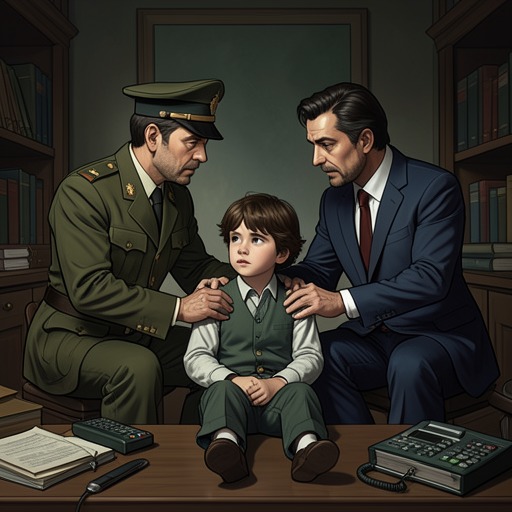
For Loïc, the call is not a simple instruction to go home. He fears displeasing Alcide, who claims the right to keep him, and fears Guillaume’s anger if he does not come. The two men’s competing claims make the boy feel physically fixed between them. The dispute exposes the instability of his place in the family: he is Alcide’s son by birth, but Guillaume is the adoptive father whose authority and home have shaped his daily life.
The argument also draws on older family and political resentments. Alcide insists that Loïc is a Bolduc, not a D’Anjou, and disparages the D’Anjous as red faction members and bastards. Guillaume answers with accusations of dictatorship and domination in the village. Their words make custody inseparable from inherited identity and local power: each father presents the boy’s affiliation as something that must be defended against the other.
From the Fire to the Street
At first, Alcide tells Guillaume that the work is nearly finished and Loïc can leave afterward. Guillaume repeats that it is late and that the child must return home. When Alcide asserts that he can keep his own son whenever he chooses, Guillaume calls Loïc again, more forcefully. The command breaks the child’s hesitation. Loïc runs toward Guillaume, seeing the man’s stern face and trembling moustache; the rest of the scene blurs, including his brother Maurice Bolduc, his cousins, and Clément Paquette, who has resumed harnessing a horse with visible embarrassment.
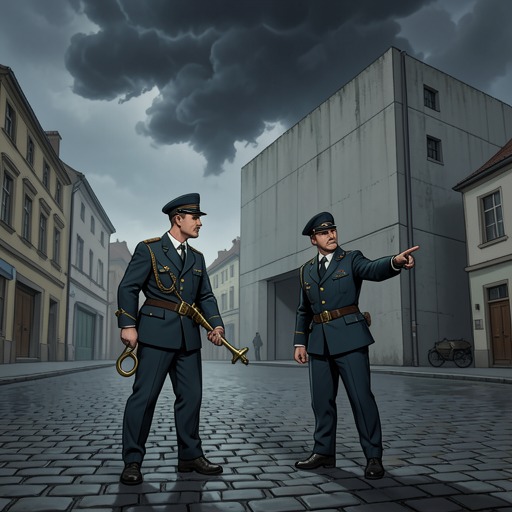
Guillaume takes Loïc’s hand and turns to go, but Alcide leaves the fire to provoke the quarrel further. Guillaume stops at Alcide’s insult, then resumes walking with the boy. The brothers-in-law continue shouting at one another as they move away from the brush pile. Alcide comes into the street to pursue the argument, while Guillaume repeatedly turns back to answer him. At several points, they nearly come to blows: Alcide quickens his pace, Guillaume wheels around with a raised fist, and Loïc remains held firmly by his adoptive father’s hand.
The argument becomes a village spectacle. At supper hour, the main street is otherwise quiet, with distant dogs, hammer blows, and occasional vehicles. The men stand in the roadway beneath the dark-red sunset as if facing off in a Western duel. A dozen houses lie along the route, and although the street seems empty, silhouettes move behind windows: the confrontation is being watched from indoors. Loïc lowers his eyes, registering those unseen witnesses as part of his shame.
A Child Caught Between Two Fathers
The quarrel’s force lies in the way public insults enter Loïc’s private sense of self. He is called toward Guillaume but held in place by fear of Alcide; when he finally runs, the choice is made under the pressure of a hard command, not from freedom from divided loyalties. He clings inwardly as Guillaume leads him away, feeling suspended over a void by a cord that might give way. The scene gives physical form to a divided belonging that the dispute’s language has already made explicit.
Alcide’s insistence on blood identity is particularly consequential. By contrasting Bolduc and D’Anjou, he turns the question of where Loïc should live into a declaration about which family he is permitted to be part of. Guillaume’s response invokes the D’Anjous’ treatment by local authorities and the family’s political antagonists, so the conflict reaches beyond two men’s tempers. In the boy’s experience, household allegiance, kinship, and village faction converge in a single frightening scene.
Loïc never forgets the sky that evening. The sunset clouds seem to form palaces above the street, a vision of beauty that briefly calms him even while the two fathers rage below. He cannot yet put his response into words, but the remembered contrast is lasting: splendor above, misery beneath. The memory gives the quarrel a scale larger than its immediate practical dispute, without making the beauty capable of stopping it.
Collapse and Aftermath
As Guillaume and Loïc reach the house, Alcide shouts a final insult about the D’Anjous’ alleged debauchery and bastardy. Guillaume turns sharply to answer, but his words fail in his throat. He puts a hand to his chest and makes for the door unsteadily. Inside, Marie-Louise, Laurette, and Élisabeth see him arrive with his head lowered and one hand pressed to his chest. He struggles across the threshold, cries out in pain, and collapses before they can reach him.
Clovis Lacroix arrives in time to help the women carry the unconscious Guillaume to the sofa. The doctor is away attending another patient, so Clovis seeks help from neighbors, relatives, and the priest. For hours, Guillaume lies between life and death while those gathered in the house try to keep him alive. Loïc cannot bear to look at his adoptive father’s pale face; instead, he stares at an image of the pierced Sacred Heart above the sofa and wonders whether Guillaume has been struck in the heart because of him.
During the vigil, an airplane’s rumble comes from the lake. The family initially thinks it is Alcide’s plane; they soon learn that he has taken off in the moonlight, with no clear destination and no known time of return. Guillaume has been taken to the nearest hospital, at Notre-Dame-du-Lac, while Alcide has vanished into the night. For Loïc, the quarrel ends not in a resolution of custody or reconciliation but in the sudden absence of both fathers: one carried away for treatment, the other gone on an uncertain flight.
That night, Loïc struggles to sleep and replays the day. He fears that a secret private desire may have brought divine punishment upon the family, and he scans the darkness anxiously for the devil. Just before sleep, he experiences a frightening yet compelling sensation of separating from his body, as if an inner airplane were carrying him upward. The image echoes Alcide’s departure while marking the child’s own response to the rupture: with both fathers beyond his reach, even his sense of himself seems to lift away.