Anjiro
ShōgunAnjiro is a fishing village in Izu, on the southeastern coast of Honshu, whose quiet routines are repeatedly made to serve the designs of powerful outsiders. Mura’s first responsibility for John Blackthorne places the settlement at the point where the foreign pilot enters the country; later, Anjiro becomes a site of coercion, military preparation, and political deception. Its village life is never merely background: the people are ordered to shelter, teach, and ultimately protect Blackthorne, while the same shore that received his ship becomes a gathering place for armies.
Setting and First Arrival
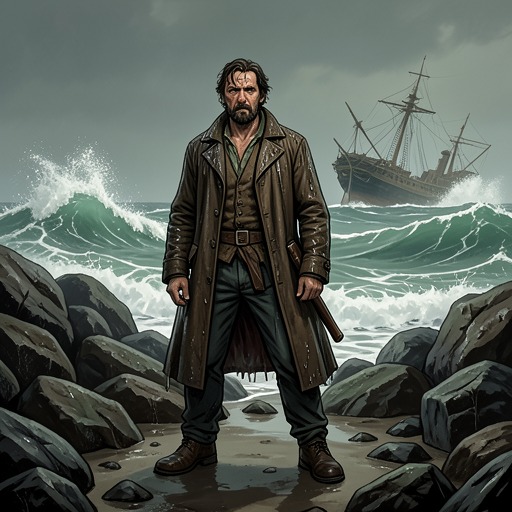
Mura remembers Anjiro as the village where his own name might live beyond his lifetime. He imagines telling and retelling the story of the strange barbarians who came out of the eastern sea, and of his good fortune—or burden—in being headman in the first year after the Taikō’s death. The incident is not only a personal adventure in his telling. It is a story to be passed on to children and grandchildren, fastening the village’s local memory to the arrival of a foreign ship and the upheaval it brings.
That arrival draws attention from beyond Anjiro. When a messenger reports the ship, Father Sebastio hurries from a mission in a neighboring province, sends an urgent carrier-pigeon message to his superior in Osaka, and reaches the village hoping the news will prove false. He is young, untried, and not yet ordained; the discovery that the ship is Dutch and its pilot English overwhelms his judgment as he confronts a Protestant presence in a region where the routes are secret and guarded. Anjiro is therefore an early meeting ground for competing religious and maritime interests, before Blackthorne has established what place he will occupy in either.
Village Under Pressure
The village’s ordinary labor changes abruptly around the ship. From the road above the shore, Kasigi Omi sees the vessel safely anchored, its lamps reflected among the smaller boats. Villagers continue unloading bales and crates; seven cannon have already been brought ashore, and another is being hauled up a ramp. Yet the village is silent. Every house is awake and every available hand is working, but the customary songs that help people labor together have stopped. The busy beach and hushed streets make Anjiro’s welcome feel less like a celebration than a community held under watch.
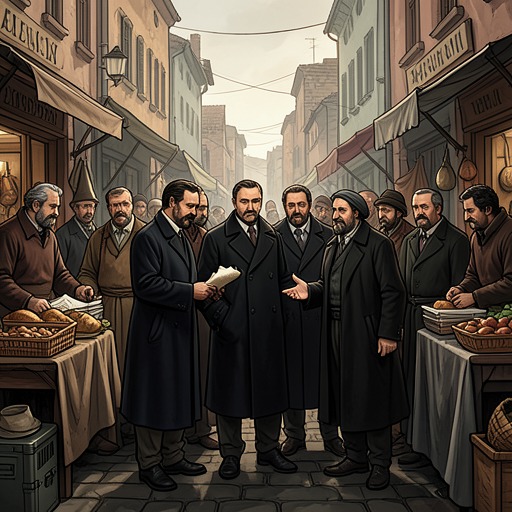
Religious authority is one of the pressures imposed on the settlement. After questioning Father Sebastio, Yabu tells him to leave and stay away, threatening to treat any future priestly presence as evidence that Christian peasants or vassals might be considering treason. He stresses that his fief extends twenty ri in every direction. The threat illustrates the uneven protection available to foreign priests and Japanese converts: the priest may possess a protected status, but those who follow the foreign faith in Yabu’s domain can be used as leverage.
Blackthorne’s presence brings a more immediate burden. When Yabu presents him to the villagers as an honored guest and a retainer of Toranaga, he also assigns the village responsibility for teaching him the language. The villagers are told that if Blackthorne has not learned satisfactorily within six months, the settlement will be burned and every man, woman, and child crucified. Hospitality has become a compulsory public duty backed by collective punishment. Anjiro’s people must make their guest’s progress their own condition of survival.
A Military Staging Ground
That imposed responsibility anticipates Anjiro’s conversion into a military camp. When Yabu and his forces are expected, Omi mobilizes the village and every able-bodied man within twenty ri. The foreshore is prepared almost ceremonially: villagers kneel in their best clothes, the settlement is swept and polished, fishing boats are marshaled, nets arranged, ropes coiled, and the beach raked. The orderly welcome is set against the strain of the preparations and the fear that a failure might bring destruction. Omi insists that the fief is his responsibility, while Igurashi warns that Toranaga may punish not only Anjiro but neighboring lands if anything goes wrong.
The military force that assembles there gives the village a scale far beyond its ordinary life. Three thousand samurai and five hundred cavalry are drawn up around the shore, square, and hillside. Later, three galleys bring Toranaga to Anjiro with Buntaro beside him; another thousand heavily armed samurai are aboard the two vessels waiting offshore. Toranaga demands an immediate exercise by Yabu’s original five hundred, rejecting the elaborate preparations and staged effects Yabu offers to arrange. The landing turns the beach into a place of inspection, where Yabu’s ability to command and Toranaga’s authority to judge are tested in public.
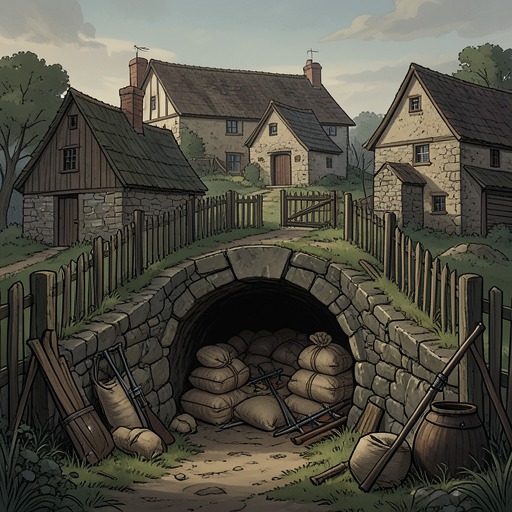
Anjiro is also where Blackthorne’s knowledge is turned into military instruction. Yabu orders him to begin teaching the men to shoot like foreigners and to explain how foreign armies fight. Although the new guns are not due to arrive for six days, Yabu insists that training begin the next morning with the weapons already available. The village that had been ordered to teach Blackthorne its language now sees him made an instructor in a different kind of exchange: his knowledge is to be converted into military power.
Memory, Fear, and Return
Anjiro remains inseparable from Blackthorne’s memories of what happened after his arrival. Much later, a smile and a stance from Yabu return him in thought to the beach, where Croocq was placed in a cauldron, Pieterzoon screamed, and the stench of the pit seemed to follow him. The remembered village is not a refuge from his later life but the site where captivity, terror, and responsibility first became inseparable. Blackthorne’s reaction shows how a place persists not only through its visible landmarks but through the experiences attached to them.
Another memory gives Anjiro a different meaning. Blackthorne recalls the night in the village when he intended to drive a knife into his heart. He later understands that his fear of death was changed by that moment, and that he awoke feeling reborn after Omi stopped the thrust. The village is thus connected both to his earliest ordeals and to a decisive alteration in his relation to death. Its importance to his character is not that hardship disappears there, but that he comes to live beyond the fear that once seemed to govern him.
In a later dream, the earthquake at Anjiro returns as a physical memory: the earth twists, Blackthorne leaps to save Toranaga and Mariko from being swallowed, and he recalls the cold wetness and the deathly smell of the fissure. The dream draws together the village, a natural catastrophe, and the acts of rescue that bind him to the people whose plans shape his life. Even when he is far from the scene, Anjiro remains a landscape through which danger and loyalty are remembered.
The Village in Toranaga’s Design
Toranaga’s final account of Blackthorne’s future gives Anjiro a new political function. He imagines Blackthorne safe and happy in a large fief there, with Mura guarding him from Christians and continuing to feed them misinformation at Toranaga’s direction. The plan depends on a secret identity: Mura, presented as fisherman and headman, is also Akira Tonomoto, a samurai spy who has served Toranaga for more than thirty years and is himself Christian. The village’s familiar local figure is therefore revealed as part of a concealed network, and its religious and civic identities prove less simple than they appeared.
This projected future completes Anjiro’s transformation without erasing its earlier meanings. It is at once the fishing settlement that preserved the story of Blackthorne’s arrival, the community threatened into serving him, the shore where troops and weapons gathered, and the place to which Toranaga intends to attach his future. The promised fief turns the site of Blackthorne’s first captivity into the foundation of a protected life, while Mura’s concealed service makes the village itself an instrument of the political design that has been unfolding around it.