Macao
ShōgunMacao is the Portuguese foothold on the southern China mainland that links Japan to the wider Asian trading system in the novel. Though described as a small permanent base granted by the Chinese Emperor, it becomes a powerful commercial and political hinge: the Portuguese carry Chinese silk to Japan, Jesuits mediate the exchange, and decisions about ships and priests passing through Macao shape the balance of influence inside Japan.
A Portuguese base in the China trade
Macao’s place in the story is established through the history of the trade that makes it valuable. China and Japan have long been at war, and China allows no trade with Japan; yet Japanese society depends on Chinese silk, a prized material for the country’s long, hot, humid summers. About sixty years before the events of the novel, the Chinese Emperor at Peking granted the Portuguese a small permanent base at Macao and permitted them to trade silk for silver. Japan had silver in abundance, and the arrangement grew into a flourishing exchange.
The Portuguese occupy the intermediary position between two countries that do not trade directly. Their ships carry silk south from Japan’s commercial network and bring the commodity that Japanese buyers need; the silver paid for it enriches the trading system. The Portuguese prosper as middlemen, while the scale of the annual trade makes the arrangement matter to Japanese samurai, not only to merchants. Macao is therefore more than a distant port: it is a point of access to goods on which the domestic economy depends and a channel through which foreign commercial power enters Japanese politics.
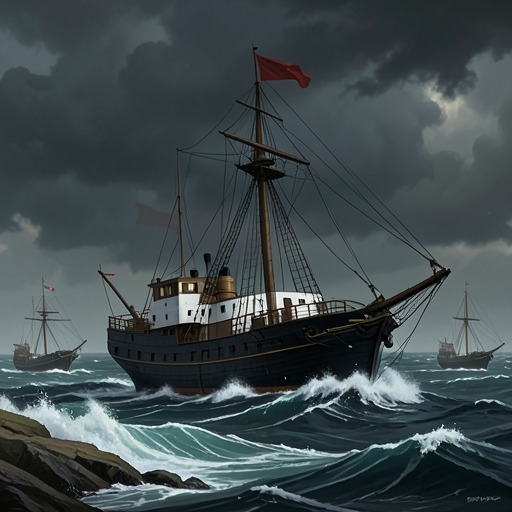
The yearly voyage follows the monsoon winds between Nagasaki and Macao, nearly a thousand miles to the south on the China mainland. The enormous, exceptionally rich trading ships on this route are known as the Black Ships. When Yabu hears that a strange vessel has reached Anjiro, he initially asks whether it is one of them. His question distinguishes the established Portuguese trade from the unfamiliar foreign ship that has arrived, and shows how readily Macao’s regular shipping route comes to mind as the source of wealth and maritime power.
Trade, language, and religious leverage
The trade depends on more than cargo. Jesuit priests have learned to speak both Chinese and Japanese, making them the people able to negotiate and interpret between the trading partners. As commerce expands, the priests become increasingly essential to it. Japanese rulers tolerate their presence and the spread of their religion in part because the Portuguese might otherwise withdraw, bringing the trade with them. The connection between Macao and Japan thus rests on a chain of commercial and linguistic dependencies: ships move the goods, while the priests make negotiation possible.
That dependence gives the religious institutions a bargaining position, but it also exposes their vulnerability to changes in policy. Toranaga promises that, on the forty-first day, the Jesuits may lay the foundation stone for the largest Christian temple in the Empire. In the same negotiations, the parties discuss Portuguese cannon and the removal of pirates from fishing boats. Trade privileges, religious permission, and military capability meet in a single political exchange. Macao’s commercial network is not separate from the contest for power in Japan; it supplies both the leverage and the practical resources that make such bargains matter.
The importance of the port is also apparent in Toranaga’s proposed use of the Black Ship’s outward voyage. He asks that ten thousand ducats of gold be carried to Goa and invested in the Indian gold market, offering Ferriera half the profit and Jesuit assistance through their usual sources there. The arrangement would give Ferriera a direct financial stake in the voyage. Its proposed six-month horizon also makes the bargain politically conditional: the Jesuits expect that Toranaga may either regain his position as President of the Regents or be dead by the time the ship returns. Macao is part of a larger route along which commercial investment and Japanese political uncertainty travel together.
A route for clergy and information
Macao also serves as a gateway for religious personnel. A papal order arrives from there by special messenger, bringing instructions issued with the formal agreement of the King of Spain. It requires priests of every religious order to reach Japan by way of Lisbon, Goa, and Macao; forbids travel directly from Manila on pain of immediate excommunication; and orders priests other than Jesuits to leave Japan for Manila. The ruling makes the route through Macao part of an institutional system of control, not merely a convenient passage across the sea. It directs how clergy may enter Japan and which order may remain there.
The order provokes disbelief when Friar Perez reads it, while its formal authority reveals how decisions made far from Japan can alter the religious landscape within it. The message’s arrival from Macao underscores the port’s role as a communications channel as well as a commercial one. Later, when Toranaga requests a report on an alleged gun-running incident, Father Alvito says that it will follow once the information has been obtained from Macao. The port is accordingly tied to the collection and transmission of intelligence about the foreign trade and its participants.
Macao within the struggle for power
Macao’s influence is exercised through people who hold overlapping commercial, religious, and political offices. Ferriera identifies himself as Captain-General, Governor of Macao, and Chief Officer of Portugal in Asia when he argues that Toranaga threatens the state, the Church, the Black Ship, and Macao. His list presents the port not as a neutral destination but as an interest to defend. When Ferriera attempts to act against Toranaga, the Father-Visitor threatens excommunication against him and his crew, and the musketeers back away. The confrontation makes visible the tensions concealed by the trade: Portuguese military command and Jesuit authority can cooperate, yet their priorities are not identical.
The novel consequently presents Macao as a strategic junction whose importance comes from what passes through it. Silk and silver sustain a profitable exchange; ships connect Nagasaki to the China mainland and onward to other Asian destinations; Jesuit interpreters help hold the trade together; clergy and papal instructions move through the port; and reports requested in Japan depend on information gathered there. These connections give Macao political weight without requiring it to become the scene of the central Japanese conflict. Its decisive power lies in controlling access—to commodities, maritime routes, religious institutions, and knowledge—that Japanese rulers and European authorities both seek to use.