Osaka Roads
ShōgunOsaka Roads is the open-water anchorage beyond Osaka harbor and the first measure of freedom for ships escaping the city. Reaching it does not end the danger: the harbor mouth and its approaches turn wind, speed, and maneuverability into immediate tactical questions, while the roads themselves offer a place to anchor offshore and regroup.
Setting and Maritime Context
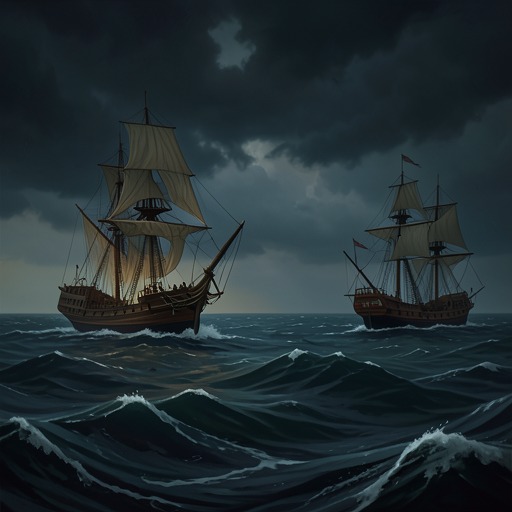
Osaka Roads lies beyond the harbor mouth, outside the crowded waterfront and its wharves. During the escape, Toranaga’s galley and the pursuing frigate pass out into the roads with the galley several cables astern; neither ship then hurries. Most of the galley’s oars are shipped, leaving only enough rowers to keep her moving calmly while the rest recover. The change in pace marks a transition from desperate flight to a brief interval in which the crews can catch their breath and the ships can hold position.
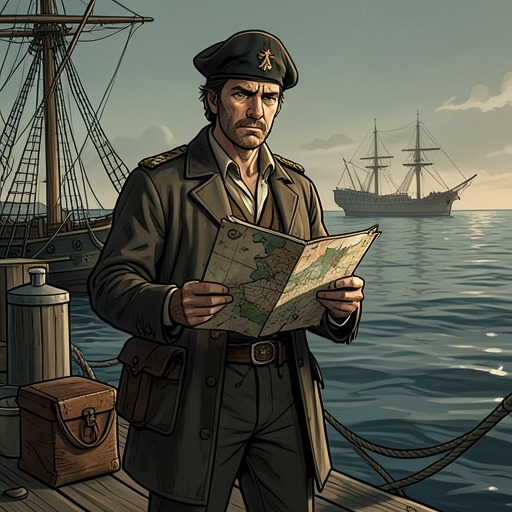
The roads’ value is bound up with a larger problem of navigation. Charts available to mariners are described as vague, and there is no reliable way to determine longitude. A rutter supplies practical, accumulated knowledge instead: compass courses between ports and headlands, depths and seabed, expected winds and currents, storm seasons, watering places, hazards, and safe harbors. Such directions make a voyage more legible, but not certain; they can contain copying or translation errors, even deliberate ones, and a pilot cannot fully verify them without sailing the route.
Approaches and Tactical Constraints
The escape route demonstrates how little room the harbor approach allows for error. Near the cliffs there is barely space between success and disaster. The frigate must tack to make the harbor mouth because of the wind, whereas the galley can maneuver more freely; in return, the frigate has the advantage of speed. Blackthorne calculates the next tack while urging the galley’s oarsmaster to quicken the beat, knowing that the two vessels’ different strengths make their courses difficult to predict.
The threat is not confined to the harbor entrance. In a hostile port, a European frigate can slip its moorings and move out into deep water, where it can anchor safely broadside to shore. Blackthorne recognizes this as a standard precaution and understands that the ship could be prepared for combat: cannon primed, muskets issued, ammunition and cutlasses ready, and armed men stationed aloft. From offshore, its stern chasers can be trained on an approaching galley. The anchorage therefore provides distance from shore without removing the danger posed by a well-armed ship controlling the water.
The Escape and Its Consequences
The escape begins at the waterfront. Toranaga and his companions study the galley and wharf from the shadows of a warehouse; a hundred Gray soldiers wait near the gangway across open ground, making a surprise attack difficult. Once the galley is under way, the contest shifts from guarded streets and wharf to the exposed harbor approach, where the frigate’s speed meets the galley’s freedom to maneuver.
After the ships reach Osaka Roads, Rodrigues turns his attention to Toranaga. During the race, Toranaga has watched the guns, gunners, sails, and fire party with close curiosity, asking through Mariko how the cannon work, how much powder they take, and what the ropes are for. The pause offshore thus carries more than the immediate relief of escape: it gives Toranaga an opportunity to study the naval technology whose threat has just shaped the flight. Osaka Roads serves as both refuge and vantage point, a space where survival at sea can become practical knowledge for future power.