CISG
StrangersCISG is a multidisciplinary think tank whose secret analysis turns first contact into a question of both planetary risk and political judgment. Its 1,220-page report, prepared years before the crisis in Nevada, projected radical change across human societies and millions of deaths in the first two years. The report helps explain why officials ordered a cover-up, but the story also puts its cautionary conclusions under challenge: Father Stefan Wycazik argues that humanity is ready to meet another civilization openly.
Composition and Report
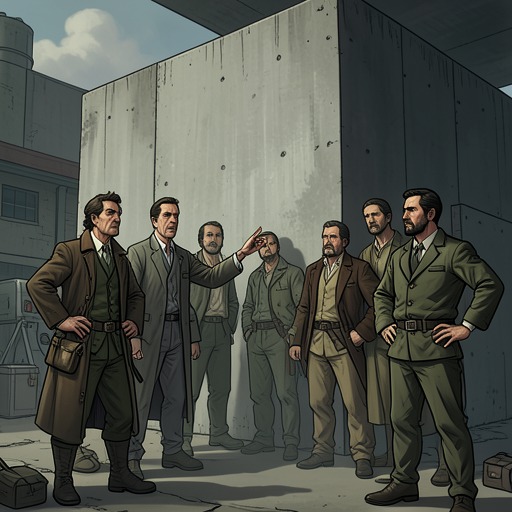
CISG brought together physicists, biologists, anthropologists, sociologists, theologians, economists, educators, and other specialists to consider the consequences of an event that had not yet occurred. The committee’s work was not a short emergency assessment: it produced a 1,220-page top-secret report, and Leland Falkirk, its military representative, knew the document by heart and had helped write several position papers included in it.
The report’s central premise was that contact would transform societies and cultures radically and permanently. Its projections included deaths in the millions over the first two years. The evidence does not present these figures as the consequences of a specific attack; they are part of CISG’s wider forecast of the upheaval such an encounter could unleash.
Risk and Government Secrecy
When the witnesses begin piecing together the cover-up, Miles Bennell summarizes CISG’s findings as an explanation for why concealment was ordered in the first place. The committee’s forecast gave officials a rationale for treating contact as a potential threat to the stability of the whole world, rather than as a discovery that could simply be announced.
That rationale sits within a much larger operation. The cover-up involved competing government institutions, and senior officials feared the political consequences of disclosure as well as the social danger described by CISG. The committee’s report therefore functions in two ways: it records an attempt to anticipate humanity’s response, and it becomes an intellectual basis for secrecy. The story distinguishes the report’s predictions from the decisions made in its name; the existence of a serious forecast does not itself settle whether concealment is justified.
The Disclosure Dispute
The report’s position, as Father Stefan Wycazik recounts it, was that contact should be concealed if possible and that news should be released to the public gradually over ten or even twenty years. Wycazik rejects that prescription. He argues that CISG has mistaken humanity for a primitive culture encountering a more advanced one: this contact, he says, is between an advanced culture and a super-advanced one, and people are ready for it. Parker Faine agrees with him.
Their disagreement changes the report’s dramatic role. CISG offers a grave, expert forecast, but its authority is not treated as final. The survivors’ experience of the arriving ship has shown them not only fear but a feeling of possibility: Jorja recognizes the encounter as a break from the old limits of human conflict, while the group begins to imagine a shared future beyond secrecy. The narrative thus places the committee’s language of projected catastrophe beside a lived response that can include wonder, solidarity, and hope.
Significance
CISG gives the cover-up a reasoned public-safety argument without making that argument an unquestionable verdict. Its predictions explain why officials feared disclosure; Wycazik’s refusal to accept the committee’s timetable exposes the political and moral choice embedded in that fear. The dispute is not simply between expertise and ignorance, but between two ways of interpreting humanity’s capacity: as vulnerable to contact and in need of protection from it, or as ready to meet another intelligence without being kept in the dark.
The committee’s long-range concern also contrasts with the witnesses’ emerging sense of a future shared across generations. Miles Bennell imagines humanity absorbing the visitors’ knowledge and, far in the future, sending a crew in suspended animation to return the call. That vision does not erase CISG’s projections, but it shifts the emphasis from predicted disruption alone to the possibility that contact may begin a long process of learning and reciprocal encounter.