United States federal government
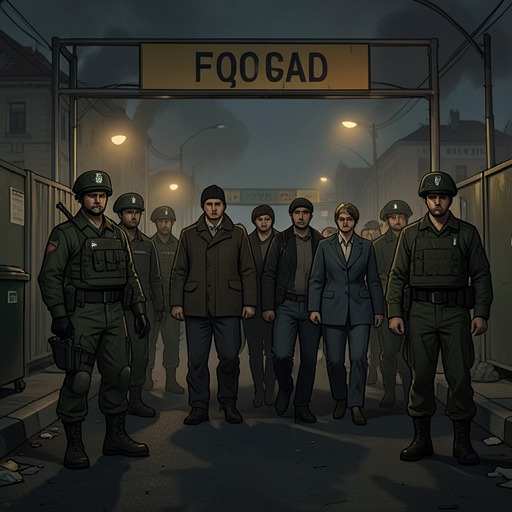
StrangersThe United States federal government becomes entangled in the attempt to conceal the events surrounding the Tranquility Motel, first as the object of the witnesses’ suspicions and later through agencies whose actions substantiate parts of their fears. The government is not portrayed as a single, coordinated mind: military leaders pursue containment, federal investigators and intelligence specialists take part in memory alteration, and senior officials eventually dispute whether the secrecy can or should continue. That division turns the cover-up into both an abuse of power and a contest over who gets to define the danger.
Suspicion and the Quarantine
The witnesses’ first explanation remains a theory, not a confirmed account. After Faye Block produces the motel registry from the summer before last, she and Ernie Block recall that a reported toxic spill had closed the highway and the motel. Dom Corvaisis wonders whether the Army and the United States federal government used that emergency to conceal contamination, treat the guests, and erase their memories. The possibility makes sense of their psychological problems and photographs of drugged people, but the group recognizes that it does not explain everything. Ernie also objects that the witnesses’ memories differ too widely for a single, carefully designed cover story.
The newspaper record gives their suspicions firmer ground about the military’s conduct. During the reported emergency on Nevada’s Interstate 80, Army units connected to Shenkfield closed a ten-mile stretch and established roadblocks before informing the Elko County sheriff or Nevada State Police. Local authorities complained that the Army excluded them from managing the crisis and took over functions beyond its proper authority. The Army also kept civilian police out of the quarantine line and contingency planning. The record documents a serious breach of ordinary procedure; it does not, by itself, establish what the Army was protecting.
Covert Operations and Memory Control
Dom reasons that the quarantine could have given officials time to gather the motel guests and keep outsiders away while their memories were altered. He suspects that the Army may have acted with the government or alone, but the available clues do not settle which institutions authorized the operation. The scale of the response, including the use of the Domestic Emergency Response Organization, strengthens Ginger Weiss’s suspicion that the patrols were guarding something classified rather than merely responding to a chemical spill.
The government’s later conduct makes memory suppression more than a conjecture. In Monterey, the Federal Bureau of Investigation and Central Intelligence Agency are illegally holding the Salcoe family incommunicado while subjecting them to another program of memory repression and alteration. The operation follows an earlier conditioning effort whose results are deteriorating, as the witnesses’ memories press against the implanted blocks. Although an FBI agent reports that the new effort is proceeding smoothly, Leland Falkirk considers the attempt to keep the secret futile. The agencies’ involvement is concrete; the full chain of authorization and responsibility remains less clear.
A Fractured Policy Debate
The novel emphasizes that participation in the cover-up does not produce agreement about what the events mean or what should be done. Foster Polnichev argues that containment has become too costly if it requires killing the Halbourgs, the Tolks, and the Nevada witnesses. He sees the healings associated with Brendan Cronin and Winton Tolk, and the emerging telekinetic abilities of Dom Corvaisis and Emmy Halbourg, as evidence that the July 6 events may benefit humanity. The FBI director and the president’s national security adviser agree with Polnichev that maintaining the cover-up is impossible.
Falkirk rejects that judgment. He treats the possibility of infection as an existential threat and believes that disclosure would invite political interference in a war he thinks the country must win. His position is not simply the government’s settled policy: it collides with officials who question both the danger and the wisdom of concealing it. The crisis exposes a system of competing agencies and decision-makers, with classified information, institutional loyalties, and incompatible risk assessments shaping what government action becomes possible.
Escalation and Accountability
After losing the conference call, Falkirk decides to act against the direction of senior authority. He plans to close Nevada’s Interstate 80 under the pretense of a toxic spill, take the Tranquility witnesses to the Thunder Hill Depository, and destroy everyone inside with two five-megaton backpack nuclear weapons. He intends to eliminate what he regards as the primary source of contamination, then expects Maxwell D. Riddenhour to continue the purge against other witnesses and families. The plan converts the language of public protection into a threat of mass killing, including Falkirk’s willingness to die in the explosion.
Other officials move toward disclosure and resistance rather than accepting Falkirk’s version of containment. General Bob Alvarado admits that he handled postcards with gloves and intended to direct Jack Twist toward the motel witnesses; Miles Bennell reveals that he sent photographs to Dom and the Blocks. Alvarado and Bennell recognize that Falkirk may intend to kill the witnesses and the Thunder Hill staff, and they prepare to oppose him. Alvarado anticipates the political consequences, including retaliation from Maxwell D. Riddenhour and higher authorities, but argues that the news must reach the public.
Institutional Significance
The government’s role therefore develops from a suspected architect of the witnesses’ memory loss into a divided apparatus whose actions range from unlawful detention and covert conditioning to an attempted nuclear purge—and whose members also help undermine the secrecy. The novel does not treat claimed public safety as sufficient justification: quarantine and concealment may protect classified information, but they also remove civilian oversight, deny people knowledge of what was done to them, and enable increasingly violent measures.
That conflict is central to the story’s inquiry into state power. The cover-up is neither an effortless conspiracy nor a policy shared by every official. It is sustained by secrecy and interagency cooperation, yet destabilized by deteriorating memory blocks, escaped witnesses, and disagreement among those responsible for controlling the story. The possibility of disclosure becomes a test of whether public authority can acknowledge uncertainty and accept accountability before the pursuit of security turns into the destruction of the people it claims to protect.