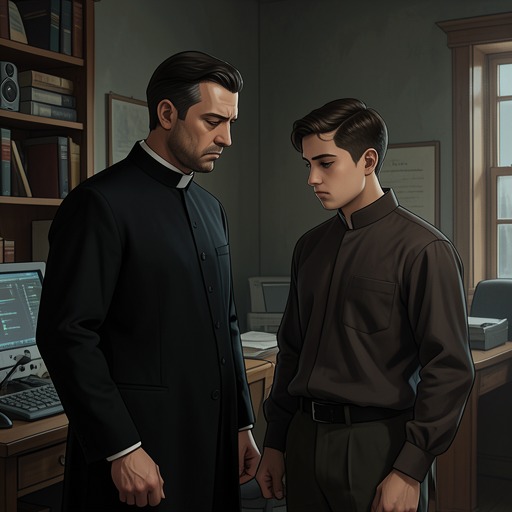
St. Bernadette Parish
StrangersSt. Bernadette Parish is a Catholic community in Chicago, Illinois, whose everyday religious life is shaken when curate Brendan Cronin publicly loses his faith. Under rector Father Stefan Wycazik, the parish has already been rebuilt from financial and physical ruin; the contrast between that hard-won stability and Cronin’s crisis gives the parish a central role in the novel’s questions about belief, suffering, and miraculous healing.
Parish and stewardship
The parish’s institutional recovery is closely bound to Father Stefan Wycazik’s long service. A priest for thirty-two years and rector of the Church of St. Bernadette for nearly eighteen, he had never experienced the kind of doubt that later overtakes Cronin. Before receiving his own parish, Wycazik served as the Cardinal’s troubleshooter for fifteen years and declined a promotion to monsignor, asking instead for a parish of his own.
That assignment was a substantial challenge. St. Bernadette Parish had $125,000 in debt, a church in urgent need of major repairs and a new slate roof, and a parish house so decrepit that it seemed at risk of collapsing in a strong wind. It had no parish school, and Sunday Mass attendance had been declining for almost a decade. Wycazik treated the work as a practical test of stewardship rather than a reason for despair.
The recovery proceeded in stages. Within four years, Wycazik had raised Mass attendance by forty percent, paid off the debt, and repaired the church. By the fifth year, the parish house had been rebuilt; by the seventh, attendance had doubled and construction of a school had begun. The Cardinal eventually named him permanent rector, securing his tenure at the parish he had brought back from both spiritual and financial decline. The figures matter not just as institutional milestones: they establish the confidence with which Wycazik approaches a later crisis that cannot be repaired by the same steady methods.
Cronin’s rupture with the church
On the first Sunday morning in December, snowfall threatened over the city, but in Catholic homes throughout the parish the day’s subject was not the coming storm. It was what Cronin had done at early Mass. During the service, in front of almost a hundred worshippers, he flung the sacred chalice across the chancel in despair and rage. The episode turned a private crisis of belief into a public rupture within parish life.
Cronin had arrived at St. Bernadette Parish more than a year and a half earlier. He had found satisfaction in the ordinary work of a curate, including its daily chores, and had not regretted or doubted his vocation. Now, as an altar boy went ahead into the sanctuary, Cronin hesitated at the door. The crucifix and altar, once understood as sacred, appeared to him as ordinary objects in an ordinary place. To proceed with familiar rites while feeling this way seemed dishonest: he believed he would be defrauding the congregation. His changed perception makes the Mass’s disruption more than an outburst; the familiar religious space itself has become strange to him.
Wycazik cannot readily understand the change. His own faith had endured war, mass death, and the fall of Saigon, during which he and Bill Nader escaped with thirteen nuns and 126 children. Even in the face of the subsequent slaughter, he had regarded those lives as significant and had not succumbed to despair. His certainty provides a sharp counterpoint to Cronin’s doubt, but does not give him an easy explanation for it.
Faith, suffering, and healing
The parish’s concerns extend beyond the sanctuary as Cronin’s work connects him to children at St. Joseph’s Hospital. Many of the children there retain strong faith despite severe suffering. Emmy Halbourg, whose legs are nearly useless and whose hands are twisted, continues to believe in God’s goodness and in the rightness of creation. Wycazik’s imagined challenge to Cronin is that such children might understand something he has lost. Their courage moves Cronin deeply, but it does not restore his belief: he is affected by their endurance, not persuaded that a compassionate God must exist.
Later, Wycazik interprets Cronin’s connection to healing as possibly more than human. Speaking with surgeon Bennet Sonneford about Winton Tolk, he argues that the apparent force behind events is concerned primarily with Cronin, the priest who first reached the wounded officer in a sandwich shop. Wycazik links this to the healing of Emmy Halbourg’s formerly crippled limbs. His account does not settle whether the healings are divine, but it shows how the parish’s religious understanding is tested by events that exceed its ordinary explanations.
When Winton asks whether Cronin is a saint, Wycazik answers that he is a good man, but no saint. The distinction preserves uncertainty rather than turning Cronin into a ready-made religious explanation. For the parish, his actions and the healings remain inseparable from questions of character, faith, and the source of extraordinary power.
From parish community to the wider crisis
The parish’s story ultimately intersects with the military effort to contain the witnesses’ knowledge. At the entrance to Thunder Hill Depository, seven witnesses and Parker Faine are taken from a transport and grouped in the snow while Lieutenant Horner’s machine gun prevents resistance. Wycazik is no longer simply the rector who once restored the parish: Leland orders DERO personnel to return to Shenkfield, bury him in an unmarked grave, and await further instructions. The account states the order, not its execution.
This fate places the parish’s religious life alongside a larger conflict over memory, authority, and contact with the unexplained. Wycazik’s record of practical restoration and steadfast faith cannot protect him from the forces bearing down on the witnesses. St. Bernadette Parish therefore anchors two different scales of the story: the local work of maintaining a church and caring for a community, and the far-reaching crisis that turns its priests, their beliefs, and their experiences into part of a government-suppressed encounter.