Catholic Church
StrangersThe Catholic Church shapes Brendan Cronin’s vocation, identity, and understanding of the extraordinary events around him, but the novel does not treat the institution as a single, settled answer to its mysteries. Through Brendan’s crisis and Father Stefan Wycazik’s response, priesthood becomes both a demanding office and a way of caring for others; through miracles and first contact, Catholic belief must contend with explanations that are at once spiritual, psychological, and extraterrestrial.
Priesthood and institutional vocation
Brendan’s commitment to the Church began early and, by his own understanding, was a calling rather than an attempt to satisfy his devout parents. He excelled in both religious and secular studies, completed his Catholic education at the North American College in Rome, and, after ordination and entering the Society of Jesus, spent two years at the Vatican assisting Monsignor Giuseppe Orbella, a senior speechwriter and doctrinal adviser to the Pope. A prestigious post with the staff of the Cardinal of the Archdiocese of Chicago might have followed. Instead, Brendan asked for an ordinary curacy, preferring the daily work of a parish priest at St. Bernadette’s. Until his loss of faith, he had taken pleasure in even the routine duties of that life.
That history makes his crisis more than a change in private opinion. By early August, a persistent doubt had begun to consume beliefs he had long regarded as foundational. Though faith seemed absent, priesthood remained central to his self-image. Brendan could not regard saying Mass, praying, and comforting the afflicted as neutral tasks: without belief, he feared, performing them would turn his ministry into a charade and deceive the congregation. At the church sanctuary, even the crucifix and altar seemed like objects in an ordinary place rather than signs of sacred ground. The institution’s rituals endured, but their meaning had become inaccessible to the priest expected to perform them.
Doubt, discipline, and pastoral care
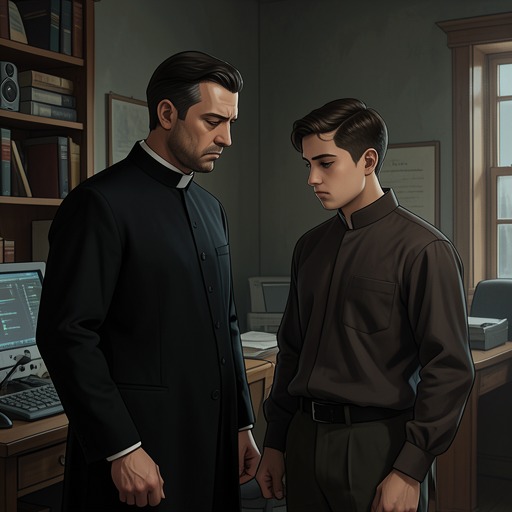
The Church’s hierarchy gives Brendan’s personal distress institutional consequences. Father Wycazik warns that the Prefect of Discipline could scrutinize him for years if he became suspected of unpriestly conduct, limiting his prospects even if he recovered. Wycazik nevertheless insists that Brendan may still serve the Church in an important capacity and undertakes to help him before referring him to a Jesuit psychiatrist if his distress remains severe. His support joins pastoral loyalty to concern about how institutional judgment might narrow Brendan’s future.
Wycazik’s unconventional first intervention sends Brendan, dressed in ordinary clothes and known simply by his given name, to work as an orderly at St. Joseph’s Hospital for Children. The work is not sheltered: Brendan empties bedpans, changes urine-soaked sheets, assists patients with exercises, feeds a partially paralyzed child, and cleans up after young cancer patients made sick by chemotherapy. The suffering of children with rheumatoid arthritis, muscular dystrophy, burns, and injuries inflicted by abusive parents overwhelms him. He twice retreats to a restroom stall to weep. The Church’s familiar account—that human beings bring evil upon themselves by turning from God’s grace—cannot, for him, explain the pain of these innocent children when encountered at close range.
The children’s faith does not resolve the conflict. Many remain convinced that a caring Father watches over them, and Brendan is moved by their courage, but their example does not restore his own belief. What changes is the form of his service: the patients call him Pudge after he shares an old nickname, and they respond to his stories, jokes, rhymes, and puns. By the third day, staff and children use the name alike; his ability to draw out a laugh or smile becomes a welcome part of his work. The episode distinguishes religious faith from the practical compassion a priest can still offer when certainty fails him.
Healing and competing explanations
Later, Wycazik interprets Brendan’s connection to miraculous events as evidence of a force beyond ordinary human agency. In conversation with surgeon Bennet Sonneford, he describes a Presence whose concern seems directed less toward Winton Tolk than toward Brendan, who first reached the wounded officer after a sandwich-shop shooting. He also relates the healing of Emmy Halbourg’s previously crippled limbs. Wycazik’s account is an interpretation, not a settled explanation, but it shows him reading Brendan’s acts through religious possibility.
That question sharpens when Brendan and Dom Corvaisis test whether they can move objects without touching them. Ginger Weiss’s test places a salt shaker before Dom and a pepper shaker before Brendan. Dom understands that Brendan hopes the power might draw him back toward faith: if the cures and apparitions are his own psychic abilities, and those abilities came from an infection, a divine explanation would seem harder to sustain. When the test and its chaotic aftermath make biological contamination seem less likely to Brendan, he is relieved. The gift remains unexplained, but a divine Presence becomes, for him, a viable possibility again. His renewed hope is not proof of Church doctrine; it is a change in what he can imagine.
Wycazik also holds together religious ideas that might otherwise appear opposed. During the same crisis, he explains that his belief in predestination does not prevent him from believing in free will. His ease contrasts with Dom’s fear that the newly discovered power could consume his identity. The narrative thus presents Catholic belief not only as a set of claims about miracles, but as one framework for living with uncertainty, fate, and responsibility.
First contact and a wider theology
As the group confronts the prospect of extraterrestrial life, Wycazik argues that a universe without other life would trouble his belief in a God who cherishes living creatures. He does not think physical difference would refute the idea that humanity is made in God’s image. For him, that likeness concerns minds and souls, including reason, compassion, love, and friendship, rather than appearance. He suspects that Brendan’s crisis may be connected to a suppressed memory of meeting a race so different and superior that Brendan unconsciously took the encounter as a challenge to religious teaching about humanity. Wycazik presents this as his own theory and intended message to Brendan, not as an established account of the priest’s crisis.
This theological openness puts Wycazik at odds with the caution of the Contact Impact Study Group, which recommended concealing first contact where possible and releasing information gradually over ten or twenty years. He rejects the comparison between contact with extraterrestrial intelligence and encounters between technologically unequal human cultures. He believes humanity can withstand contact with a vastly advanced civilization and is ready for it. His confidence joins spiritual hope to an expectation of historical change: the encounter may enlarge human understanding rather than simply threaten it.
The novel’s closing vision gives that hope a human scale. Sandy Sarver recalls that seeing the luminous ship changed the weight of her childhood abuse and fear; Jorja Monatella senses that extraterrestrial contact could make humanity feel like one vast family. The ship’s arrival becomes a dividing line between a frightening past and a possible new age, though the story does not claim that every religious tradition or institution will respond in the same way. Bennell imagines that, after centuries of learning and maturation, human descendants might launch a crew in suspended animation to return the call tens of thousands of years later. Ginger, meanwhile, imagines a world in which healing powers could make ordinary medicine unnecessary. These are hopes and predictions voiced by characters, not completed outcomes. Within that uncertain future, the Catholic Church’s significance lies in the questions its believers carry forward: what makes life sacred, whether compassion marks a divine likeness, and how faith can respond when the boundaries of the human world suddenly widen.