Contact Impact Study Group
StrangersThe Contact Impact Study Group (CISG) was a government committee established to study the consequences of humanity’s first contact with an intelligent species from beyond Earth. Its importance lies not only in its research but in the political struggle over what that research meant: its warnings were invoked to justify secrecy and extreme containment, while critics argued that the group’s conclusions overstated the danger and that contact might benefit humanity.
Mandate and Composition
The CISG began its research about nine years before the events surrounding the Tranquility Motel. It brought together specialists in biology, physics, cultural anthropology, medicine, sociology, and psychology to assess how face-to-face contact with an extraterrestrial civilization might affect human beings and their societies. The inquiry therefore crossed the boundary between the sciences of the body and those concerned with culture, institutions, and behavior.
Leland Falkirk was the committee’s only military member. The group’s work produced a classified report, known to personnel working with Falkirk, and its files received a new level of security restriction on July 8, two days after the Nevada events. The timing of that restriction, together with unusual leaves and furloughs among scientists who had served on the committee, became a clue that the July 6 incident had brought the CISG’s subject from hypothetical research into immediate government business.
Contact as a Social and Cultural Risk
The CISG was tasked with considering more than whether extraterrestrial visitors would be physically dangerous. Its central question concerned the effects of direct contact on human cultures and on people’s confidence in their own traditions and institutions. The argument relayed by Father Stefan Wycazik drew on anthropological comparisons: when a more technologically advanced culture encounters a less advanced one, the less advanced society may suffer a collapse of confidence, accompanied by damage to its religion, government, family structures, and social values.
That model made contact a potential crisis even in the absence of hostile intent. The concern was that the encounter itself could unsettle the foundations by which people understood their world. At the same time, the research left room for disagreement about whether such disruption was inevitable or whether the effects of contact could be beneficial. The group’s question was thus not simply how to repel an invader, but how human society might survive the arrival of a radically more advanced presence.
Classification and the Nevada Quarantine
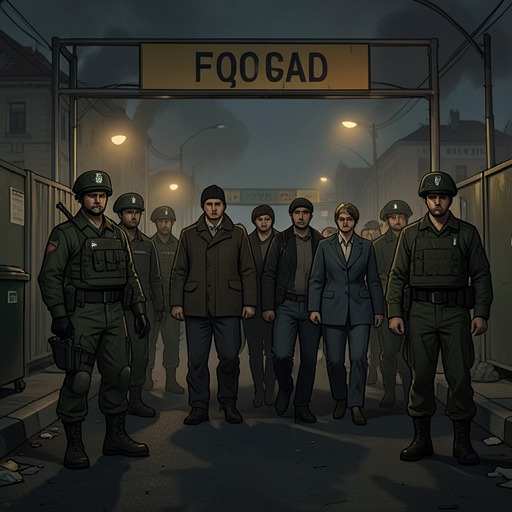
The events in Nevada were publicly presented as a toxic emergency. After a truck carrying dangerous chemicals toward Shenkfield was said to have spilled its cargo, the Army closed a ten-mile stretch of Interstate 80, established roadblocks, and imposed a quarantine. It did so before informing the Elko County Sheriff or Nevada State Police, and excluded local authorities from the quarantine and contingency planning. The military’s handling of the crisis therefore appeared less like routine cooperation with civilian emergency services than a deliberate effort to control access to the zone.
The use of a Domestic Emergency Response Force company sharpened that suspicion. Ginger Weiss reasoned that a DERO team would have been unnecessary for an ordinary chemical spill; its presence made sense if the personnel monitoring the zone might see something so highly classified that the Army would not trust ordinary soldiers to guard it. The Army’s advance readiness to man the roadblocks also suggested to her that officials had received warning before the supposed accident. These deductions do not establish that the CISG directed the operation, but they connect the government’s extraordinary secrecy around the Nevada incident to the same first-contact questions the committee had been studying.
Disputed Conclusions and Political Consequences
The CISG report became a fault line within the government. Some of the scientists associated with the work disagreed with its conclusions, regarding them as mistaken or excessively elitist and believing that public disclosure would not produce catastrophe. Their dissent mattered because the report’s warnings were being used to support an increasingly severe policy of concealment.
Falkirk treated disclosure as a threat to the survival of the species. He feared that public knowledge would provoke political interference just as the government might need to use force against what he considered an infection. Foster Polnichev took the opposing view: the cures performed by Brendan Cronin and Winton Tolk, and the telekinetic abilities of Dominick Corvaisis and Emmy Halbourg, suggested to him that the consequences of July 6 could be profoundly beneficial. He also argued that many researchers, including Miles Bennell, saw no threat in the first place. The disagreement was not merely over how to interpret a report; it was over whether the unknown should be treated as an enemy to contain or as a transformative encounter to understand.
The committee’s findings could not settle that dispute. Instead, the classified report supplied authority to both sides: Falkirk invoked its warnings to defend secrecy, while its scientific dissent and the visible benefits of the new abilities undermined the claim that catastrophe was certain. As the cover-up became harder to sustain and the government’s agencies divided over what to do, the CISG’s original speculative inquiry became a practical, urgent contest over disclosure, coercion, and humanity’s response to first contact.