Mafia
StrangersThe Mafia appears as an underworld organization whose narcotics profits travel through a coordinated financial network rather than remaining in the hands of individual couriers. Its reach is suggested by the volume of cash passing through a New Jersey warehouse and by the professional systems used to collect, count, transport, and invest it. When Jack Twist and his companions rob one of these way stations, the operation’s businesslike organization becomes a source of immediate danger: a cash hub can be hit, but the network behind it is prepared to respond.
Identity and Organization
The underworld refers to itself as the fratellanza, while the narrative also describes its criminal finances through the language of legitimate commerce. The warehouse is a major way station on the route of the Mafia’s cash train, a collection point for narcotics money drawn from half of New Jersey. The phrase evokes an organized flow of funds, not a single cache: cash arrives from couriers, is counted by accountants, and leaves for investment elsewhere.
The operation’s weekly rhythm gives that system a visible structure. Most couriers deliver suitcases, flight bags, cardboard boxes, and Styrofoam coolers of cash on Sundays and Mondays. On Tuesdays, accountants in Pierre Cardin suits calculate the week’s profits from what is called the pharmaceutical division. On Wednesdays, tightly banded sacks of greenbacks are dispatched to Miami, Vegas, Los Angeles, New York, and other financial centers. The Mafia’s hired investment advisers, with Harvard or Columbia MBAs, then put the money to work. The contrast between bulk cash, narcotics proceeds, and elite financial credentials makes the laundering network appear both criminal and deliberately integrated into respectable finance.
Methods and Reach
The warehouse functions as an intermediary point between collection and investment. Its contents are assembled from many couriers, processed on a schedule, and sent onward in heavy bags. That arrangement distributes the work across distinct roles: couriers bring in the money, accountants establish the weekly totals, and advisers handle its investment. The scale is conveyed not by a formal membership list but by the regular movement of funds and by the range of destinations served.
The organization also appears prepared to protect its business with communications and armed personnel. During Jack’s robbery, Mort Gersh warns that a van used on a narcotics run is likely equipped with radio communications and will already have called for backup. He expects that a delivery crew might include men in the rear carrying converted Uzis or worse. These are the characters’ assessments in a tense moment, not a complete account of Mafia procedure, but they show why a robbery of the warehouse is understood as more than a theft from the three men on site: the possibility of a wider response hangs over the scene.
The Warehouse Robbery
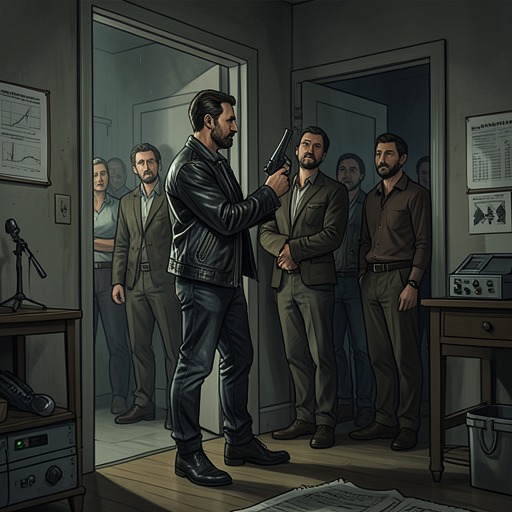
Jack, Mort, and Tommy Sung have taken four heavy bags of cash from the warehouse, stepping between the accountants and the investment advisers in the chain. Three thugs are tied up in the office. Jack treats the theft with sardonic humor, presenting the robbers as another layer of middlemen; Mort and Tommy had laughed at the line. The joke captures the scheme’s resemblance to the system they have interrupted, while the bound men and stolen money make clear that this is a violent criminal operation, not merely a financial satire.
The mood changes when a Ford van arrives. Jack reverses into the warehouse and shuts the door, then moves aside in case someone outside starts shooting. He estimates that at least two men are in the van. The three companions retreat into deep shadows between towering stacks of crates and cartons, among appliances, tractor parts, plumbing supplies, and other stored goods. Tommy admits that hitting the Mafia was a mistake; Jack answers only that Tommy is there. Mort, weary and dour, argues that the van may carry additional armed men and that backup is likely already on its way. Jack counters that the arrivals may proceed cautiously because they could believe the warehouse is defended by ten men and bazookas. The surviving evidence ends with the robbers still concealed inside, making the Mafia’s potential retaliation an unresolved pressure rather than a completed confrontation.
Significance
The Mafia’s portrayal rests on a pointed collision between corporate routine and criminal violence. Accountants, scheduled deliveries, prestigious business degrees, and international investment destinations give narcotics proceeds the appearance of an efficiently managed enterprise; armed crews and radio-equipped vehicles reveal the force available to defend that enterprise. Jack’s description of the robbers as middlemen sharpens the irony: they imitate the chain of intermediaries even as they disrupt it, and their success in taking the bags exposes them to the organization’s wider reach.
The episode also establishes a practical distinction between robbing a bank or an armored car and robbing the Mafia. Tommy names the danger plainly: the Mafia is not an ordinary target, and a successful hit does not end when the thieves escape with the money. The warehouse scene therefore gives the organization significance beyond the cash it controls. Its routines make it legible as a system; the expected backup makes that system feel capable of answering an attack.