United States Army
StrangersThe United States Army becomes the visible instrument of the cover-up surrounding the July 6 incident: it closes roads, imposes a quarantine, and controls access to a region whose secrets reach beyond the explanation of a toxic spill. Yet it is not presented as a single, settled will. Some Army figures treat secrecy and even lethal force as necessities; others question the legality, wisdom, and moral cost of those measures. That conflict makes the Army more than a backdrop to the mystery: it is where the novel tests the power—and the danger—of calling an emergency a matter of national survival.
The quarantine and its public explanation
The Army’s first conspicuous role emerges through the account of the interstate closure. The Tranquility Motel had to shut from Friday until Tuesday, its occupants later recalled, while authorities said a truck carrying dangerous chemicals was headed for Shenkfield. Ernie Block identifies Shenkfield as an isolated testing ground for chemical and biological weapons, making the alleged cargo sound especially alarming. The account gives the quarantine an official rationale, but it does not settle whether a toxic spill actually occurred or whether that explanation concealed a different emergency.
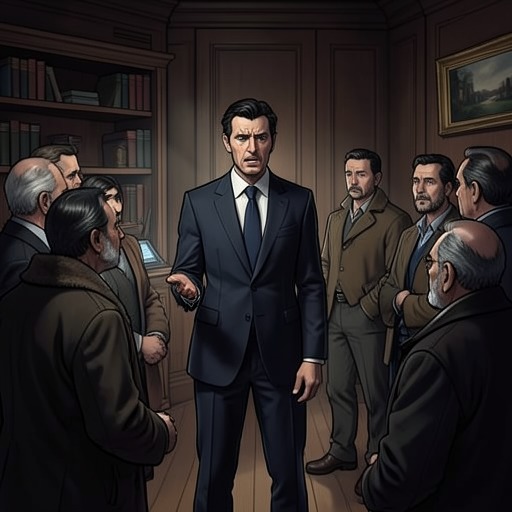
For Dom Corvaisis, the quarantine supplies a possible mechanism for the witnesses’ missing memories. He speculates that motel guests might have been exposed to a chemical or biological agent, then treated at the motel while the Army and the government concealed the incident and replaced their memories. At this point, his account is a theory, not proof of precisely what happened to every witness. What changes is the plausibility of his suspicion: a cordon could keep outsiders away while giving authorities time to detain and manage the people inside it. Ernie resists turning suspicion into certainty, warning that officials might have believed they were choosing the only prudent course rather than acting from simple malice. The disagreement preserves a distinction the novel keeps pressing: a claimed protective purpose does not establish that the means were lawful or humane.
A military security zone
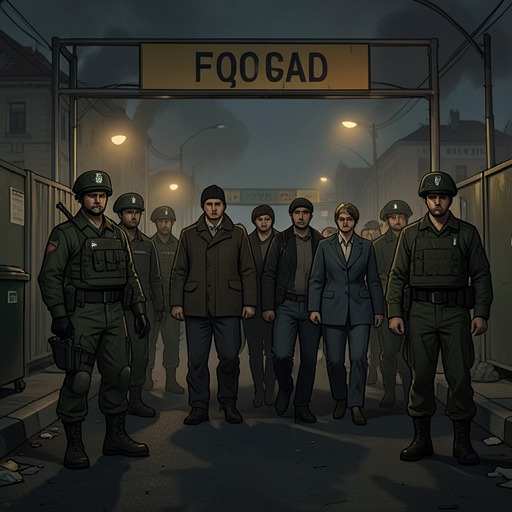
The Army’s handling of the crisis was unusually extensive. According to the Elko Sentinel, Army units attached to Shenkfield established roadblocks and closed a ten-mile stretch of Interstate 80 before informing the Elko County Sheriff or the Nevada State Police. Local and state officers complained that the Army excluded them from crisis management and contingency planning, while assuming control normally associated with civilian authorities. The military’s conduct is therefore not merely secretive; it visibly displaces the officials who would ordinarily share responsibility for an emergency.
The cordon extended beyond the interstate. The Army maintained control of the roadblocks on the only east–west artery through the restricted area and closed eight miles of a north–south county road. Civilian aircraft were diverted, and helicopters patrolled the perimeter by day and night, sweeping the darkness with searchlights. The newspaper also reported rumors of soldiers using infrared equipment to find people entering the zone on foot, horseback, or in four-wheel-drive vehicles. Those rumored patrols are not confirmed in the account, but the documented road closures, air restrictions, and continuous aerial surveillance establish the scale of the operation: an area of roughly eighty square miles was being secured against entry.
The timing adds to the witnesses’ suspicion. Dom and Ginger Weiss remember the Tranquility Grille filling with a strange sound and shaking with earthquake-like tremors at about 8:10 p.m., after darkness had fallen. Their memory blocks begin around the same time, but the newspaper reports that the Interstate 80 roadblocks went up almost at 8 p.m. Dom reads that sequence as evidence that the Army may have had advance warning. The timing raises a question; it does not by itself explain what the Army knew or when it learned it. The early arrival of Colonel Leland Falkirk and a Domestic Emergency Response Organization company reinforces the witnesses’ sense that the response was prepared for something more classified than an ordinary spill.
Ginger’s explanation for the deployment is that the Army needed personnel trusted to keep quiet about what they would see. Dom likewise concludes that ordinary soldiers could not be trusted with the top-secret information at issue. This is the witnesses’ inference, rather than an official explanation, but it fits the exceptional secrecy surrounding the cordon. Dom later describes two supposed factions: hardliners represented by Falkirk, who would have killed the witnesses, and less violent conspirators who preferred memory control. His distinction helps frame the cover-up’s competing methods, even as it leaves the identities and motives of the people behind the memory operation unsettled.
Falkirk and the logic of containment
Falkirk is a field-oriented colonel in the Domestic Emergency Response Organization. His home base is Grand Junction, Colorado, but he spends little time behind a desk; the low-ceilinged, windowless rooms at Shenkfield feel to him like a coffin. His choice to remain there is strategic. He does not want a fully equipped DERO company attracting the attention of ranchers near the road to the gated Thunder Hill Depository, whose secret must remain undiscovered. Shenkfield has previously served as a red herring diverting attention from Thunder Hill, and Falkirk intends to use it again as a base for disinformation aimed at the press and public.
His mistrust reaches inside the Depository as well. Falkirk suspects that its workers may have been changed and does not feel safe among them. In his view, the possibility of contamination transforms the problem from concealing a scandal into defending humanity from extinction. He argues that disclosure would invite political interference and public second-guessing just when decisive action might be needed. That fear gives his position an internal logic, but it also lets a speculative danger justify measures that would otherwise be indefensible. When he contemplates killing the Halbourg and Tolk families and the Nevada witnesses to keep the story contained, the dispute is no longer abstract: the proposed cost of security is the lives of named people.
Falkirk’s most extreme plan turns the quarantine into a trap. He intends to invoke another toxic-spill closure of Interstate 80, take the Tranquility witnesses into custody, and transport them underground to Thunder Hill. There, behind the Depository’s blast doors, he plans to destroy the facility and its occupants with two five-megaton backpack nuclear weapons, including himself in the intended destruction. His plan treats the Depository as the enemy’s source and annihilation as a form of containment. It also exposes the contradiction at the heart of his policy: in seeking to protect humanity, he is prepared to kill witnesses, families, and himself without first establishing that extermination is necessary.
Command, dissent, and institutional fracture
Falkirk’s authority is powerful but contested. He tells General Bob Alvarado that a secret program may be entered into the security computer and activated at his discretion, invoking General Maxwell D. Riddenhour, Chief of Staff of the Army and Chairman of the Joint Chiefs, as the source of his authority. Alvarado challenges the claim and its provenance. Falkirk, in turn, insists that Alvarado’s orders cannot override his responsibility to prevent dangerous people—or what he calls dangerous creatures—from escaping Thunder Hill. Their exchange makes the chain of command part of the crisis: a mission framed as emergency security leaves room for rival claims about who may decide what the emergency demands.
Alvarado’s judgment breaks with Falkirk’s. He objects that killing the families and witnesses merely to contain the story would make the price too high. Riddenhour also counsels restraint. He says the question requires input from neuropathologists, biologists, philosophers, and others, rather than an immediate military decision. He does not rule out a later quarantine or roundup if evidence of an imminent threat appears, but, in its absence, he leaves open the possibility that the cover-up must be undone. The disagreement is not simply between soldiers and civilians: it runs through the military leadership itself, between Falkirk’s presumption of an existential danger and a more cautious demand for evidence and deliberation.
The wider cover-up is similarly divided. The Salcoe family is being held incommunicado in Monterey by the Federal Bureau of Investigation and the Central Intelligence Agency and put through another program of memory repression and alteration. Falkirk regards that operation as doomed, in part because too many agencies are involved. The narrator describes a broader coalition including the Federal Bureau of Investigation, the Central Intelligence Agency, the National Security Agency, the United States Army, and the Air Force; many personnel involved do not know what they are helping conceal. Foster Polnichev already considers the cover-up impossible to maintain, and Parker Faine’s escape strengthens that view. These details prevent the conspiracy from reading as a perfectly coordinated institution: secrecy depends on cooperation among agencies that compete, limit information, and do not share a complete understanding of the secret.
The Army’s changing place in the story
The Army’s role shifts from imposing isolation to facing the consequences of its own secrecy. At the western roadblock, Falkirk, Lieutenant Horner, and two armed DERO corporals use Army transports to block the eastbound lanes of Interstate 80. DERO personnel explain the situation to halted motorists while emergency beacons flash around the barricade. The scene gives the abstract quarantine a practical face: vehicles are stopped, movement is controlled, and a public emergency is presented as a matter the Army can manage at the roadside.
But the institution’s capacity to contain information is increasingly challenged from within and beyond its command structure. Alvarado admits that he handled postcards with gloves and intended to return later, allowing Jack Twist time to find them before anonymously directing other witnesses to Jack for answers. By then, other notes and Polaroids have reached Dom and the Blocks, and a new crisis has begun. Alvarado believes the person who sent the photographs must be at Thunder Hill; he also sees Falkirk not as a reliable partner but as a danger against whom an ally is needed. The planned dissemination of the truth competes with the Army’s systems of restricted access, surveillance, and memory control.
The resulting institutional conflict gives the Army’s secrecy a political and ethical scale. Its emergency powers can close roads before local authorities are informed, isolate witnesses, and shield a military installation from public scrutiny. Yet senior figures disagree about whether those powers still serve protection or have become instruments for preserving a lie. The novel does not make the Army’s stated fear of danger equivalent to proof of danger, nor does it treat every participant as equally informed or equally committed to violence. Instead, it shows how the language of containment can expand from quarantine to memory alteration and planned mass killing—and how dissent within the institution becomes crucial when secrecy itself threatens to decide who may live, what may be known, and whether the truth can reach the public.