Leland Falkirk's Nuclear Attack
StrangersLeland Falkirk's Nuclear Attack is the attempted destruction of Thunder Hill by the colonel who believes that the people affected by extraterrestrial contact carry an infection capable of annihilating humanity. Falkirk converts a secretive military response into a plan for nuclear mass murder: he assembles two backpack bombs and sets their timers, intending to destroy the witnesses, the facility, and himself. His plot is stopped by the witnesses' newly emerging powers, but his suicide shows that the conflict is not resolved by physical survival alone; Falkirk refuses the future that the others are trying to protect.
Causes and Background
The crisis grows out of the Army's earlier account of events in Elko County, Nevada. The motel registry places the initial emergency on Friday and Saturday, July 6 and 7, when, according to the explanation given to the evacuated guests, a truck carrying dangerous chemicals to Shenkfield had been involved in a toxic spill. The motel was closed until Tuesday, and guests left in their own cars. The official account described roadblocks and an evacuation of the danger zone; Ned and Sandy Sarver were permitted to go to their trailer near Beowawe, outside the quarantine area.
The newspaper record makes the Army's handling of that alleged emergency look less like ordinary spill control and more like the protection of a secret. Army units closed a ten-mile stretch of Interstate 80 and established roadblocks before informing the Elko County Sheriff or Nevada State Police. Local authorities complained that the Army excluded them from managing the quarantine and contingency planning, even as the papers reported the reopening of the highway, removal of the quarantine, and evacuees who claimed to have seen nothing. The Sheriff threatened to seek a court order over the Army's intrusion into civilian jurisdiction, but the crisis ended before that dispute could be decided.
Dom Corvaisis and Ginger Weiss connect the exceptional secrecy to the use of a DERO team. Ginger reasons that the team would have been assigned to the quarantine because its members could be trusted with access to something highly classified, not because a routine chemical spill required them to guard an overturned truck or leaking container. She also argues that the Army could not have improvised its roadblocks so quickly without some advance notice of an event. These clues undermine the cover story without yet giving Dom and Ginger a complete explanation of what happened. By the time Falkirk acts, however, the possibility of alien infection has become, in his mind, the central fact—and a justification for treating everyone touched by the event as a threat.
Falkirk's Decision and Access to the Arsenal
Falkirk frames secrecy as a defense of the human species. When Foster Polnichev argues that the Halbourgs and Tolks do not appear dangerous, and that the new power in Emmy Halbourg may be the only thing inside her, Falkirk rejects the possibility that the encounter could be beneficial. He insists that disclosure would invite political interference just when, in his view, humanity must fight an existential war. Polnichev sees evidence of a potentially extraordinary human development; Falkirk treats that interpretation as the enemy's means of conquest. The disagreement is not merely about what the witnesses can do. It is about whether contact demands accommodation or destruction.
At Thunder Hill, Falkirk possesses a route to carry out that conviction. The tactical-nuclear vault is designed to require three palm identifications from a group of eight authorized people, submitted within a minute. VIGILANT oversees the system, but a new program Falkirk designed has made him the sole keeper of the Depository's tactical arsenal. He opens the vault with his own palm. Inside are twenty backpack nuclear weapons, with their detonators and binary explosive packages stored separately. Falkirk's access is therefore both technical and political: a collective safeguard has been subverted into a capability concentrated in one man's hands.
His DERO training has familiarized him with nuclear devices and their assembly. He takes two bomb frames from the wall, retrieves the necessary components, and assembles both weapons in eight minutes. He sets each detonator's timer for fifteen minutes, then carries the devices out of the vault. Each weighs sixty-nine pounds. The narrative stresses the bodily effort of the act: the weight strains his back and shoulders, but the growing pain makes him happier. The weapons turn an abstract security doctrine into an immediate physical burden, one Falkirk willingly bears because he imagines the coming destruction as proof of resolve.
The Attempt and the Race Against the Timers
Falkirk's target is the facility and everyone inside it. In the main cavern he places one backpack bomb on the floor, reasoning that a nuclear blast could bring down the granite chambers and kill anyone sheltering on that level. He also believes the heat would prevent an alien life-form from reconstituting itself. The intended explosion is thus both a killing operation and a test of his certainty: he expects to die in the blast, but regards that death as an acceptable price for preventing what he imagines to be an infection-driven conquest.
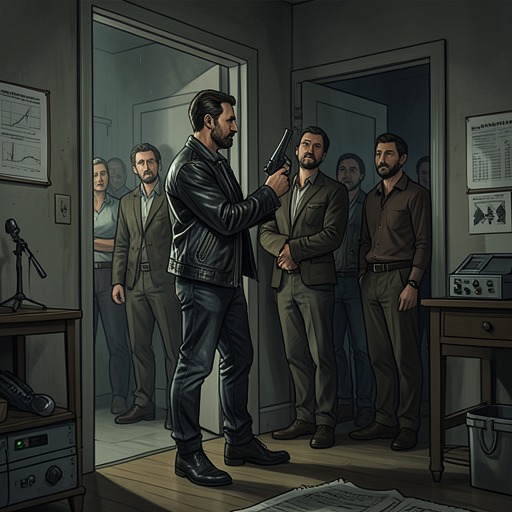
The threat becomes explicit when Falkirk turns his machine gun toward General Bob Alvarado and announces that two backpack bombs are in place: one outside the door and one in the main chamber below. With less than three minutes remaining, he declares that the group will be vaporized before anyone can change him into one of the beings he fears. Lieutenant Horner is armed beside him. The danger is not confined to an eventual nuclear detonation: the countdown leaves the witnesses almost no time, while the armed men can prevent them from reaching the devices.
Dom acts immediately, directing Brendan Cronin to take the bomb outside the door while he goes for the one downstairs. Brendan kneels beside a device with one minute and thirty-three seconds remaining. His previous acts of healing and telekinesis have not given him a reliable procedure for handling a nuclear detonator; earlier, his powers have produced uncontrolled movement among objects and furniture. The scene sets his uncertainty against the precision the task seems to demand: a mistaken move could be fatal, and the clock continues to count down.
Parker Faine joins Brendan and urges him to stop intellectualizing and act on instinct. Parker thrusts his hands toward the detonator and commands it to come out. The device snaps free of its wires and leaps into his hands, but removing it does not end the danger. Its clock is still running, and the detonator contains a conventional explosive charge. The countdown reaches three seconds before Dom wills the illuminated numerals to stop. Parker throws the detonator toward the cavern wall and dives for cover; the ensuing explosion is not the nuclear blast Falkirk intended. The episode's narrow escape depends on several distinct interventions—Parker's extraction, Dom's halt of the timer, and the others' response to the conventional charge—rather than on any one person's control of the crisis.
Aftermath and Significance
The bomb threat ends, but Falkirk is not reconciled to the survivors or their vision of what contact means. In the confusion, he breaks away from Jack Twist and Ernie Block, takes a revolver from a member of the Thunder Hill staff, and refuses to be changed like the others. Before anyone can reach him or use telekinetic power to pull the weapon away, he puts the revolver in his mouth and fires. Ginger Weiss and Dom turn away from his falling body. The narration distinguishes their horror at the waste from revulsion at the physical death: they see Falkirk's act as senseless because humanity has, at that moment, the secret of immortality within its grasp.
That ending makes the failed attack a confrontation between two responses to uncertainty. Falkirk treats the unknown as an enemy and makes annihilation the ultimate instrument of control; the witnesses' actions instead use their powers to preserve one another and prevent the destruction he has set in motion. His suicide completes the logic of his refusal: even after the immediate danger is over, he would rather die than accept transformation. The attempted nuclear strike is therefore not simply averted catastrophe. It exposes how the machinery of containment—the secret program, the exceptional authority, and the arsenal's safeguards altered to serve one keeper—can culminate in a private war against the very people it claims to protect.